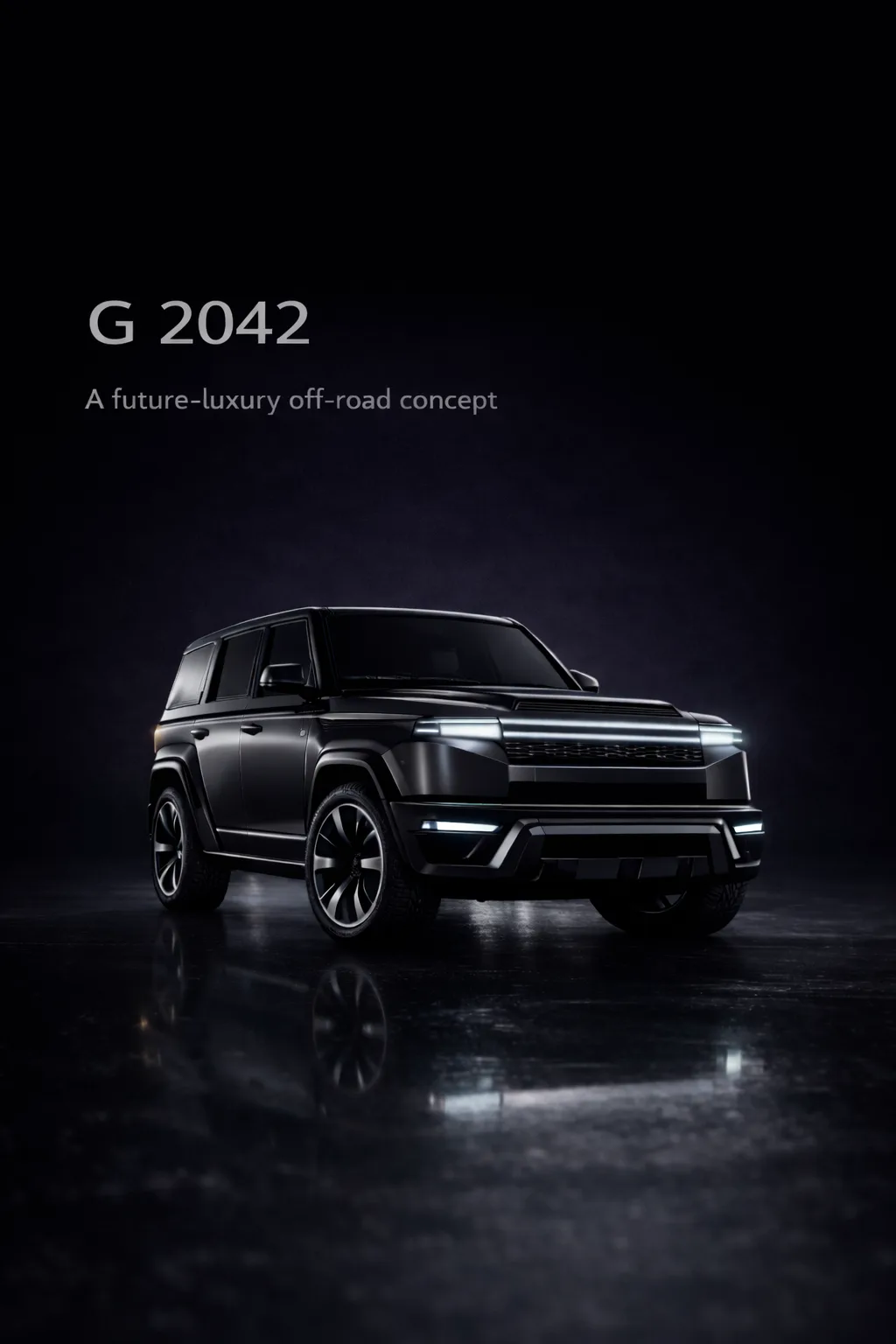

The first thing you notice is the shadow.
It runs along the rear quarter panel in a clean, uninterrupted diagonal. Not a reflection. Not a graphic. A true, deep shadow cast by the mass of the C-pillar onto the bodywork below. The studio kept returning to it. It was not drawn into the sketches. It was not specified in the surface models. It emerged only when the light hit the form at a particular angle, and once seen, it could not be unseen. It became the quiet center of the entire project.
This is how G 2042 works. It does not announce itself with theatrics. It accumulates in the eye slowly, detail by detail, until the whole of it settles into the mind as something inevitable. Something that looks less like it was designed and more like it was discovered.
It is also, crucially, a concept. A speculative design exercise from Lightson Design Lab. It is not a product waiting for a production line. It is not a leaked preview of a manufacturer's roadmap. It is a visual hypothesis. A question posed in surfaces and light. And that freedom—the freedom from homologation, from cost engineering, from the thousand small compromises that turn a sketch into a showroom—is precisely what allows it to be this pure.
Lightson Design Lab set out to explore a single idea: what does the luxury off-road silhouette want to become when it stops looking backward? When it is no longer performing heritage. When it is allowed to be heavy, quiet, and precise in a way that the current market has not yet permitted.
The answer is here. Not as a prediction. Not as a proposal for any specific manufacturer. But as a concentrated visual argument for where the category's power actually resides—in its refusal to soften, its commitment to upright mass, and its unique ability to make restraint feel like the ultimate luxury.
The weight of the thing
There is a word the studio uses internally that does not appear in the final presentation but shaped every decision: groundedness.
G 2042 sits low on its suspension in the hero images, not jacked up for drama. The wheel arches are generous but not exaggerated. The tires have sidewall. The stance is wide without being aggressive. The visual message is not "look what I can climb." It is "look what I am."
This is the liberty a concept affords. A production vehicle must account for approach angles and break-over clearance and off-road geometry that satisfies a specification sheet. A concept must only account for the eye. G 2042 uses that freedom to prioritize visual mass over mechanical clearance. The body sits into the wheel arches rather than hovering above them. The relationship between tire and fender is tight, considered, almost architectural. It reads as planted. Immovable.
The body is rendered in a spectrum of dark finishes that refuse to perform. Deep graphite. Matte silver. Satin black that drinks the studio light. These are not colors designed for a configurator. They are materials designed for a mood. They shift as you circle the vehicle, revealing new surfaces and swallowing others. The effect is architectural. You find yourself studying the way the front fender rolls into the door plane, or how the rear corner holds its edge against the soft gradient of the background. These are the moments the project is built around.
The silhouette is boxy, commanding, unmistakable. It honors the category's visual DNA without quoting it directly. The proportions are familiar enough to feel inevitable, but the surface language is entirely new. There are no retro gestures. No nostalgic trim pieces. No historical references hidden in the details. This is not a tribute. This is a continuation.
And because it is a concept, that continuation is speculative. It does not ask to be built. It asks to be considered. It asks whether the future of this category might be less about adding capability and more about refining presence.
Light, and the lack of it
The front lighting signature is a single horizontal line. That is all.
In a design culture that increasingly rewards complexity—more segments, more animations, more flickering signatures that beg for attention—G 2042 chooses silence. The line is crisp, uninterrupted, and perfectly level. It establishes width. It anchors the face. It does nothing else.
The rear is sharper. A vertical cut of light on each side, terminating cleanly at the beltline. It is graphic without being graphic design. It feels structural, as if the light is not an appliqué but a reveal—a glimpse of the energy running through the body's core.
This restraint is not minimalism for its own sake. It is a bet on the viewer's patience. The project assumes you will look long enough to notice the way the hood plane catches a sliver of highlight, or how the side glass sits flush with the D-pillar in an almost seamless transition. These are not details for a press release. They are details for someone who has already fallen into the image and wants to stay there.
The room it stands in
The environment is not a location. It is an absence.
G 2042 is presented in a dark studio void, lit with the precision of a gallery installation. The floor is a polished black mirror. The reflections are long, controlled, and unnaturally smooth. There is no gravel. No desert. No mountain road disappearing into fog. The vehicle is not in a story. It is in a state of suspension.
This decision is essential. By removing the context, Lightson Design Lab removes the alibi. The car cannot hide behind the drama of its surroundings. It must stand on its own surfaces, its own mass, its own command of the space. The studio becomes a chamber for examination. You are not invited to imagine where it might go. You are invited to see what it is.
It is a confident move. Many concepts rely on the promise of adventure to complete the picture. G 2042 declines. It suggests that the adventure begins with the object itself—its weight in the room, its refusal to explain, its quiet insistence that you keep looking.
This is also an honest presentation of what the project actually is. A concept. A studio piece. Not a field test. Not a lifestyle shoot. Just the idea, held in a clean, black space, waiting for an eye that will stay.
A note on the category
The luxury off-road archetype occupies a strange position in the culture. It is simultaneously one of the most recognizable shapes in the world and one of the least understood.
For decades, the public has been trained to read it as a symbol of capability. But that reading misses the deeper appeal. The appeal is not in what it can do. It is in what it is. Upright. Unyielding. Unapologetically boxy in an era of wind-tunnel curves. The silhouette has become a form of visual dissent. It rejects the aesthetic compromises that have smoothed every other vehicle category into aerodynamic sameness.
This is why it endures. Not because people need to ford rivers. Because they want to look at something that holds its ground.
G 2042 understands this. It does not try to make the box more slippery. It does not round the corners to please the air. It leans into the geometry. It treats the flat planes and the vertical glass and the proud fenders as assets, not liabilities. It is a future-luxury expression of the same truth that made the original so compelling: some shapes do not need to change. They only need to be refined.
And because this is a concept, that refinement is pure. Unburdened by pedestrian safety regulations or side-impact structures or the thousand invisible constraints that shape every production car. G 2042 gets to be the idea of the thing. That is the point. And that is enough.
The studio behind it
Lightson Design Lab works in the space between what exists and what could.
Their practice is built around cinematic future-vision for luxury and tech brands. They do not design production vehicles. They design visual arguments. Speculative concepts that clarify a category's emotional territory. G 2042 is a precise example of this approach. It is not a product waiting for a factory. It is a proposition waiting for a conversation.
The project reflects the studio's deeper commitments: surface control over decoration, atmosphere over action, and the belief that the most powerful images are the ones that trust the viewer to meet them halfway. There is no voiceover. No narrative. No hero's journey. Just the object, the light, and the space between.
This is harder than it looks. It requires a discipline that most visual work avoids. The instinct to add is strong. The instinct to explain is stronger. G 2042 resists both. It holds its frame and waits.
That shadow on the rear quarter panel was not planned. But the studio was wise enough to notice it, to protect it, and to let it become the quiet anchor of the entire series. That is the work. Not inventing something new. Recognizing what is already there and giving it room to speak.
A future without nostalgia
There is a version of this project that would have leaned on the past. A grille shape borrowed from history. A wheel design that references an earlier decade. A color palette pulled from the archives. That version would have been easier to understand. It would have been more immediately legible as a continuation of a known story.
G 2042 takes the harder path. It trusts the archetype enough to let it stand on its own, without the crutch of heritage cues. The result is a concept that feels both familiar and unsettled. You know what it is. But you have not seen it quite like this before.
The surfaces are too clean. The stance is too controlled. The darkness is too complete. It is a vision of the category that has been stripped of its nostalgia and rebuilt around presence alone. Some will find this cold. The studio would likely accept that. Cold is not the same as lifeless. Cold can be clarifying. It can be the temperature at which desire becomes something more than impulse—something considered, sustained, and all the more durable for it.
G 2042 is not trying to be loved at first sight. It is trying to be remembered long after the tab is closed. It is a slow project for a slow eye. And in that slowness, it makes its case.
Lightson Design Lab has not built a vehicle. They have built a way of seeing one. That is the difference. That is the work. And for a concept, that is everything.