
By Lightson Design Lab for Craftdas
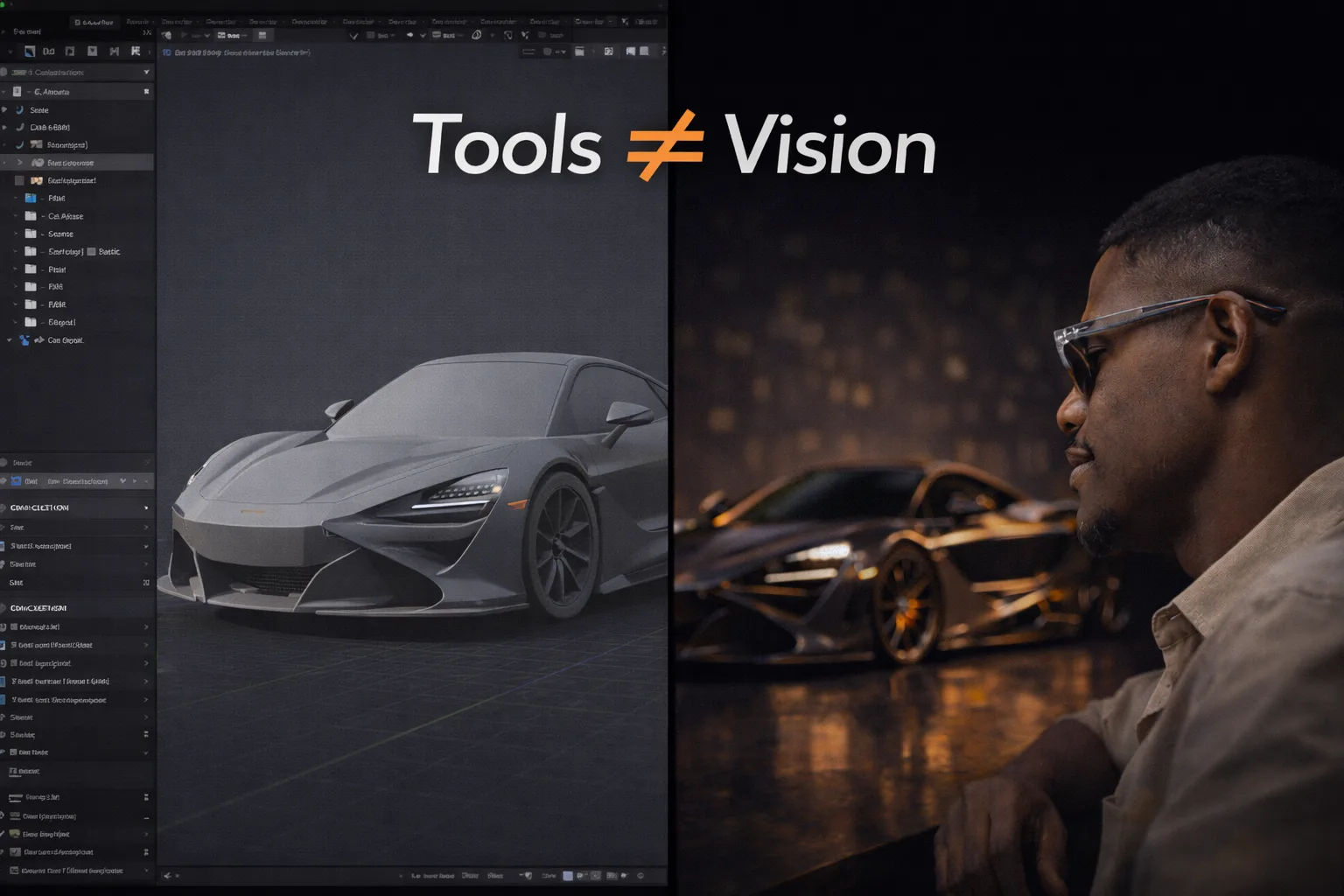
Knowing Blender means understanding the tool. Thinking like a 3D artist means understanding image-making. The gap between those two things is where stronger composition, lighting, material judgment, and visual storytelling begin.
Why this difference matters
Many artists reach a point where their technical ability improves, but their work still feels flat. They know the shortcuts, understand the modifiers, and can follow tutorials with confidence, yet the final images still feel more assembled than directed.
That is usually the point where tool knowledge stops being enough. Professional 3D work does not depend only on operating software well. It depends on seeing clearly, making deliberate choices, and shaping images that communicate something specific.
This is the real difference between knowing Blender and thinking like a 3D artist.
Blender is the tool, not the vision
Blender gives you a way to model, shade, light, animate, and render. That technical range is powerful, but software itself does not decide what matters in the image.
A person who only knows the tool often focuses on execution first: modeling the object, assigning materials, placing a camera, and producing a render that proves the scene works. A 3D artist starts earlier and asks harder questions. What should this image feel like? Where should the eye go first? What should seem premium, quiet, dramatic, restrained, or dominant?
The software helps make those decisions visible, but it does not make them for you.
Thinking like an artist begins with seeing
The deeper skill behind 3D is not just technique. It is observation. Artists notice how light wraps around a curved object, how edges soften reflections, how distance changes emotional tone, and how surfaces reveal character through tiny variations.
That kind of seeing changes the work. Materials stop feeling like slider combinations. Lighting stops feeling like illumination alone. Composition stops feeling like object placement. Everything becomes part of a visual language.
This is why strong artists study much more than software. They study photographs, films, architecture, objects, product campaigns, and how real materials behave in real light.
Composition is not just framing
A technical user often asks how to fit the object into the frame. An artist asks what the frame is saying about the object.
Camera height, lens choice, spacing, negative space, symmetry, and depth all shape meaning. A centered frame can feel iconic. A lower angle can feel dominant. A tighter crop can feel intimate. A wider composition can make the subject feel isolated or editorial depending on how the space is used.
Thinking like a 3D artist means using composition to build hierarchy. It should be obvious what matters first, what matters second, and how the eye is meant to move.
Lighting is about mood, not visibility
One of the clearest differences between technical rendering and artistic rendering is lighting intent. Many weak renders are not weak because the artist lacks lights. They are weak because the lights do not express a mood.
Artists use lighting to define emotional tone, shape form, and support the subject’s role in the frame. Shadows become part of the design. Contrast becomes a storytelling decision. Softness or hardness becomes a statement about the image, not just a setting.
This is why a scene can be fully visible and still feel lifeless. Visibility alone is not enough. Mood is what gives the render direction.
Materials depend on observation, not guesswork
Material work improves when the artist stops asking only how to recreate a surface and starts asking why the real surface looks the way it does. A premium painted metal surface, a soft-touch polymer, brushed aluminum, leather, polished plastic, or matte rubber all behave differently under light.
Smart material decisions come from observing reflection quality, roughness variation, subtle imperfection, edge behavior, and how a surface sits within the broader story of the render.
That is the difference between applying a material and building one with intention.
Storytelling is what turns a render into an image
Every strong render tells some kind of story, even when the subject is just a single product or object. The story may be about luxury, durability, calm, speed, precision, atmosphere, or desire. But it is still a story.
A 3D artist thinks about how camera, material, composition, light, and environment work together to support that feeling. Without that layer of intention, even a technically polished scene can feel empty.
Thinking like an artist means deciding what the image is supposed to communicate and then making each choice serve that purpose.
Presentation is part of the craft
The raw render is rarely the whole job. Artists understand that finishing matters. Contrast balance, subtle color grading, background control, and restrained post-processing all affect how complete the final image feels.
This does not mean post should rescue weak work. It means finishing should complete strong work. Presentation is part of visual judgment, and visual judgment is exactly what separates tool familiarity from artistic thinking.
How to start thinking like a 3D artist
Slow down before building. Gather stronger reference. Study lighting outside of 3D. Analyze why an image feels premium or weak. Critique your own work in terms of hierarchy, mood, and narrative instead of only technical correctness.
Finish more projects, then review them honestly. Ask what the image is saying, not just whether the render worked. Over time, that habit changes the way you see and the way you build.
The shift from Blender user to 3D artist happens when technique becomes a tool for intention rather than an end in itself.
Read next
Conclusion
Knowing Blender is valuable, but it is only part of the path. Strong 3D work comes from the ability to see, judge, and direct an image with purpose.
That is what makes the difference between operating the software and thinking like a 3D artist.