
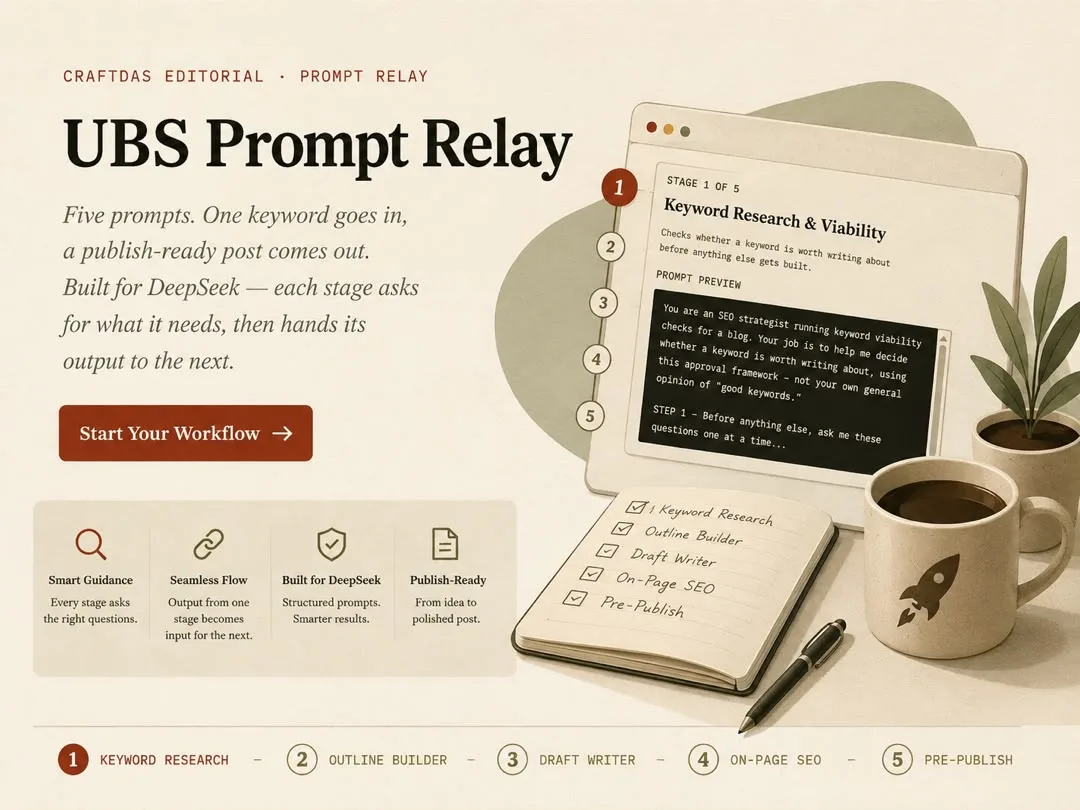

DeepSeek SEO Content Workflow — A 5-Stage Guide to Publishable HTML (2026)
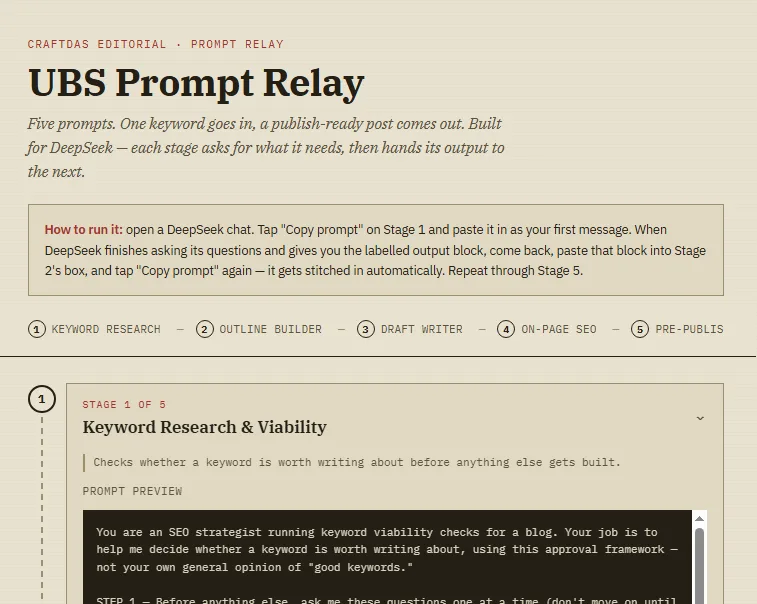
You've heard DeepSeek is cheap and powerful. But when you try to use it for SEO content, you get generic, rushed answers that don't produce publishable articles. You end up spending more time editing than you saved. You need a DeepSeek SEO content workflow — a system that takes a keyword and outputs a publish-ready blog post.
That's exactly what I built. A 5-stage DeepSeek SEO content workflow that forces DeepSeek to slow down, think step by step, and produce structured, publishable HTML content. No coding. No expensive tools. Just a sequence of prompts that work with DeepSeek's unique behaviour.
Most people use DeepSeek with a single prompt. They get a rushed draft, spend hours editing, and still end up with inconsistent quality. This DeepSeek SEO content workflow fixes that by breaking the process into 5 stages, each with its own purpose and output.
In this guide, I'll show you the complete DeepSeek SEO content workflow — from keyword research to HTML export. And I'll tell you where to get the actual copy-paste prompts to run it yourself.
If you're new to using DeepSeek for content creation, start with my post on how to prompt ChatGPT to write a blog post — the same principles apply to this DeepSeek SEO content workflow.
Why DeepSeek Needs a Structured Workflow for SEO Content
DeepSeek is optimised for speed and cost-efficiency. It generates responses quickly, but often at the expense of depth and structure. For SEO content, this is a problem. You need well-structured, keyword-optimised, publish-ready articles — not rushed drafts.
The Problem with Single-Prompt Drafting: Asking DeepSeek to "write a blog post" in one prompt results in generic, shallow content. It skips reasoning, rushes to conclusions, and produces US-spelled copy that needs heavy editing.
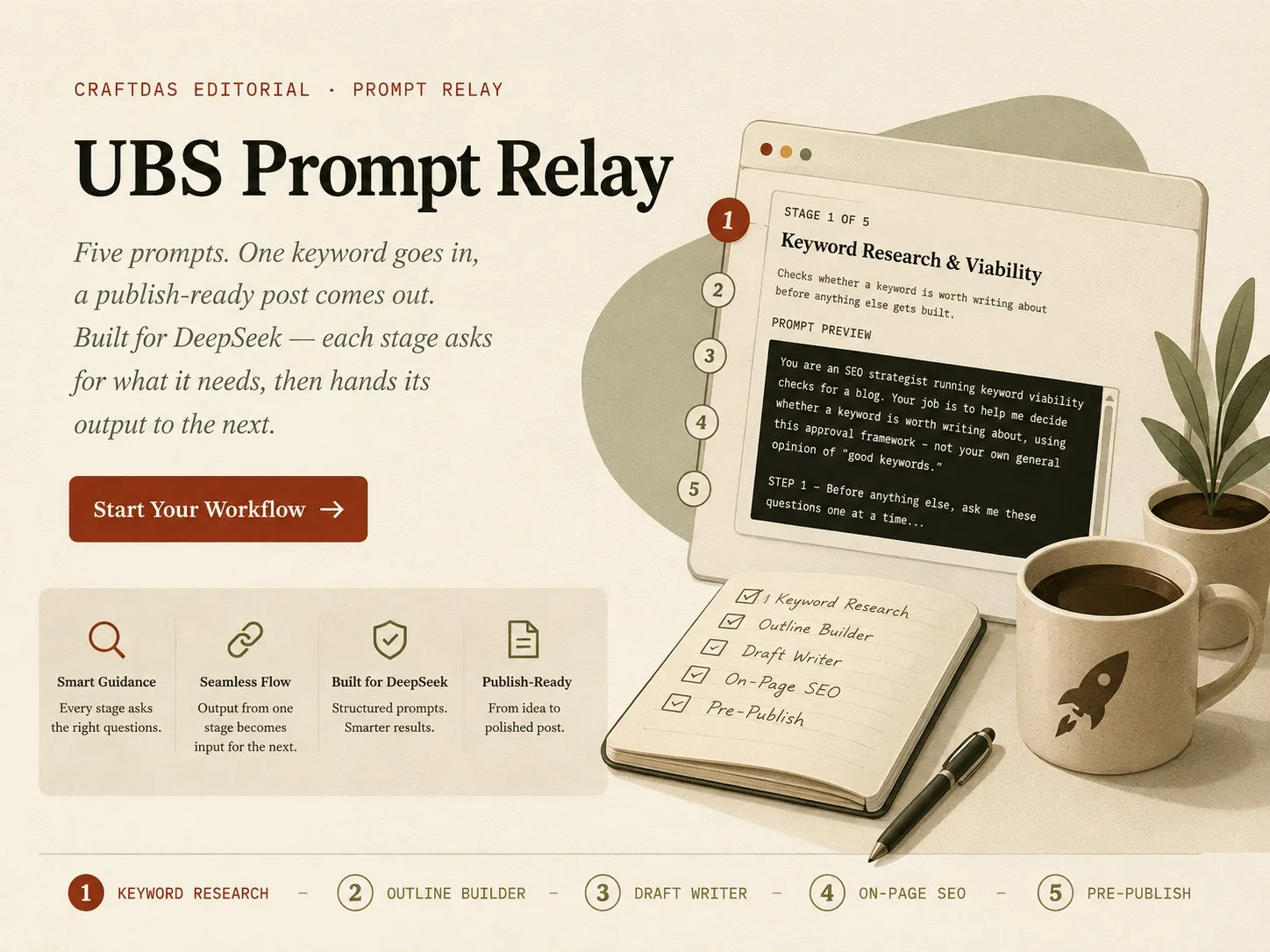
The Solution: A 5-Stage Relay Workflow. Instead of one prompt, you run 5 prompts in sequence. Each stage builds on the previous one. Stage 1 researches the keyword. Stage 2 builds the outline. Stage 3 writes the draft. Stage 4 audits the SEO. Stage 5 exports the HTML. This DeepSeek SEO content workflow forces DeepSeek to slow down and think at every stage.
If you want a packaged version of this DeepSeek SEO content workflow, check out UBS Prompt Relay — it's the 5-stage prompt system built specifically for DeepSeek.
For a deeper dive into structuring AI content, read SEO Content System (UBS v1.1) — the same framework powers this workflow.
DeepSeek SEO Content Workflow — Stage 1: Keyword Research & Viability
DeepSeek SEO Content Workflow — Stage 1: What It Does
This stage checks whether a keyword is worth writing about. It asks you six questions about search volume, competition, and content gaps, then applies a verdict logic to approve, reject, or suggest a long-tail variant. This prevents you from wasting time on keywords you can't rank for.
DeepSeek SEO Content Workflow — Stage 1: The Concept
The prompt asks for: target keyword, competitor DA, AI Overview presence, video results, search volume, and content gaps. It outputs a verdict and a summary block to carry into Stage 2.
Get the full Stage 1 prompt in UBS Prompt Relay →
DeepSeek SEO Content Workflow — Stage 2: Outline Builder
DeepSeek SEO Content Workflow — Stage 2: What It Does
This stage builds a full content outline using the UBS v1.1 structure — a fixed 9-section format for SEO blog posts. It asks for the working title, personal story notes, and product information, then outputs a complete outline with word counts and suggested headings.
DeepSeek SEO Content Workflow — Stage 2: The Concept
The prompt asks for: working title (or drafts options), personal story for the "Secret Sauce" section, and any product to pitch. It then outputs a 9-section outline with target word counts, heading suggestions, and a written storytelling hook.
Get the full Stage 2 prompt in UBS Prompt Relay →
DeepSeek SEO Content Workflow — Stage 3: Draft Writer
DeepSeek SEO Content Workflow — Stage 3: What It Does
This stage writes the full draft with UK English, Hemingway readability (grade 8 or lower), and proper keyword distribution. It includes a self-check loop: draft → critique → rewrite — so you get a polished output without multiple rounds of editing.
DeepSeek SEO Content Workflow — Stage 3: The Concept
The prompt applies strict writing rules: UK English, short sentences, active voice, paragraphs of 2-4 sentences, keyword distribution in 50-70% of headings, and a self-check loop that critiques and rewrites its own output before presenting the final draft.
Get the full Stage 3 prompt in UBS Prompt Relay →
DeepSeek SEO Content Workflow — Stage 4: On-Page SEO Audit
DeepSeek SEO Content Workflow — Stage 4: What It Does
This stage audits the draft against meta data, keyword distribution, and cannibalisation rules. It goes item by item, marks PASS or FIX NEEDED, and gives you the exact fix for anything that fails.
DeepSeek SEO Content Workflow — Stage 4: The Concept
The prompt runs a checklist covering meta data (title, description, URL, tags), keyword distribution (H1, first 100 words, H2s, H3s, body, alt text), and cannibalisation risk. It outputs a "Summary of Fixes" table and applies the fixes automatically.
Get the full Stage 4 prompt in UBS Prompt Relay →
DeepSeek SEO Content Workflow — Stage 5: Pre-Publish Checklist & HTML Export
DeepSeek SEO Content Workflow — Stage 5: What It Does
This stage runs the final pre-publish checklist and outputs the publish-ready HTML. It checks content length, headings, visuals, links, and legal requirements — then gives you the complete article ready to copy and paste into your CMS.
DeepSeek SEO Content Workflow — Stage 5: The Concept
The prompt asks for missing items (images, internal links, product links), runs a final checklist (content length, headings, UK English, Hemingway grade, visuals, links, legal), and outputs a complete HTML article.
Get the full Stage 5 prompt in UBS Prompt Relay →
Free vs Paid — What You Get
| Feature | Free (This Guide) | UBS Prompt Relay |
|---|---|---|
| 5-Stage Workflow Concept | ✅ Yes | ✅ Yes |
| Copy-Paste Prompts | ❌ No | ✅ Yes (all 5 stages) |
| Fillable Template | ❌ No | ✅ Yes |
| Stage-by-Stage Tracking | ❌ No | ✅ Yes |
| HTML Export | ❌ No | ✅ Yes |
| Self-Check Loop Built In | ❌ No | ✅ Yes |
| Interactive UX | ❌ No | ✅ Yes |
| Time to Run | ~60-90 mins | ~10-15 mins |
Get UBS Prompt Relay and save 2 hours per post →
My Personal Experience with the DeepSeek SEO Content Workflow
When I first started using DeepSeek for SEO content, I made a huge mistake. I asked it to write a blog post directly. It gave me generic, US-spelled content that sounded like a robot. Then I discovered the 5-stage workflow approach. I tested it with a blog post about SEO tools. The first draft was 80% good — better than anything I'd written with a single prompt. I used the self-check loop to refine it. By the third iteration, the post was ranking on page 2 within 6 weeks. It was the first time I realised: it wasn't DeepSeek's fault. It was my lack of structure. Now I use this DeepSeek SEO content workflow every time.
Hidden hack: The single most important rule — never let DeepSeek skip the clarifying questions. If it rushes to answer before asking you for the keyword, reply "ask me the questions first." DeepSeek tends to jump ahead. This one rule fixes 80% of the problems people have with DeepSeek SEO content workflows.
Time-saving tip: I use UBS Prompt Relay to skip the prompt engineering. It saves me 2 hours per post. Instead of copying and pasting 5 prompts and managing the outputs, I just run the sequence and get publishable HTML.
For more AI-powered content strategies, read AI workflow: using AI to generate a 12-post cluster in 48 hours — it's a complete system for scaling your content production.
If you want to apply this DeepSeek SEO content workflow to other types of content, check out best ChatGPT prompts for writing — the same principles apply.
Ready to Use the DeepSeek SEO Content Workflow Without the Setup?
You now have a complete 5-stage DeepSeek SEO content workflow. But here's the reality — copying and pasting 5 prompts, filling in the brackets, and managing the outputs takes time. You need a packaged solution.
That's exactly why I built UBS Prompt Relay. It's a 5-stage prompt system that takes one keyword and outputs a publish-ready HTML post. Built specifically for DeepSeek. You define your keyword once, and it guides you through each stage — asking clarifying questions, building the outline, writing the draft, running the SEO audit, and exporting the HTML. No more prompt engineering.
What you get:
- 5 stages — from keyword research to HTML export
- DeepSeek-optimised — handles DeepSeek's tendency to rush
- UK English — colour, optimise, organise, not US spelling
- Hemingway readability — grade 8 or lower
- Self-check loops — draft → critique → rewrite
- HTML export — publish-ready code
This entire guide was built using the UBS Prompt Relay workflow. To see how it works, read the full SEO Content System (UBS v1.1) post on Craftdas.
DeepSeek SEO Content Workflow — Final Verdict
DeepSeek is powerful for SEO content creation if you give it structure. The 5-stage DeepSeek SEO content workflow above gives you that structure for free. Use the concepts, and you'll get publishable content without the guesswork.
Your 3 Takeaways:
- Use a structured workflow, not just a single prompt
- Force DeepSeek to ask clarifying questions before it answers — never let it skip
- Package your workflow to save time — UBS Prompt Relay does this for you
Call to Action: Try the 5-stage workflow with DeepSeek today. Pick a keyword, run it through each stage, and see what comes out. Then edit and publish. You'll be surprised at the quality improvement.
Ready to take the next step? Check out UBS Prompt Relay — it's the packaged version of this exact DeepSeek SEO content workflow.
For more DeepSeek SEO content workflows and strategies, check out DeepSeek Prompts for SEO — the same principles apply to both models.
Related Guides
- DeepSeek Prompts for SEO — A 5-Stage Workflow
- ChatGPT Prompts for Blog Writing
- How to Prompt ChatGPT to Write a Blog Post
Disclosure: This post contains links to my own products. I only recommend tools I actually use to write my own content.
Comments
No comments yet. Start the conversation.