
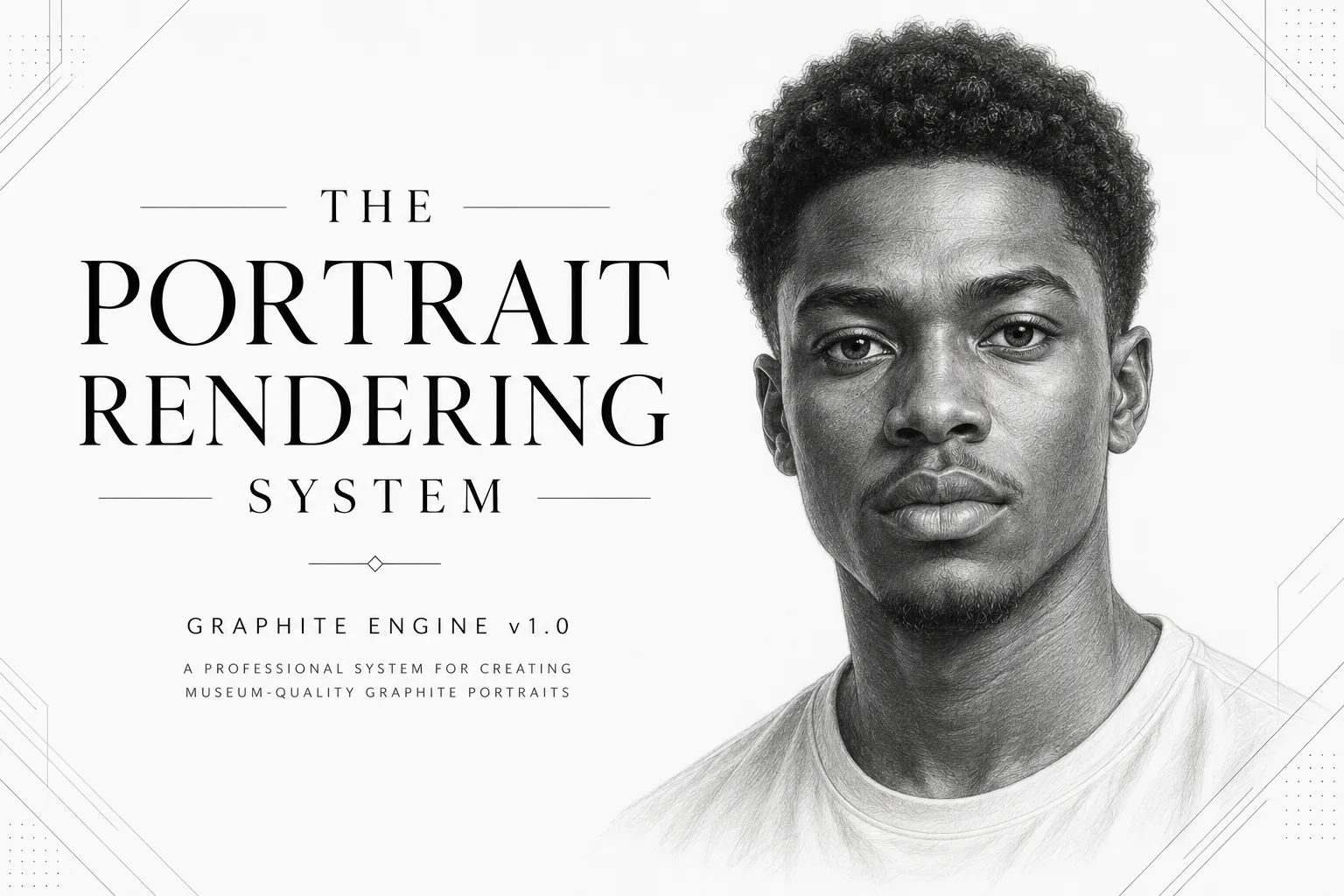

There is a moment every artist knows—that quiet thrill when a pencil first meets fresh Bristol board. It’s not just about making marks. It’s about building something real, layer by layer.
But over the last year, watching the rise of generative AI, I couldn't shake a growing frustration. I kept seeing the same thing over and over: a photograph uploaded, a command like "pencil sketch" typed, and the machine spitting out something that looked like a cheap, glossy Instagram filter. Digital. Flat. Soulless.
The magic of the traditional graphite process—the structure, the grit, the build-up—was completely missing. AI was imitating the look of art without understanding the craft.
So, I set out to solve a problem that nobody was talking about: How do you teach a machine to draw like a human master?
Why AI Fails at Real Drawing
The fundamental issue with most AI art generators is that they approach drawing as a visual filter. They flatten your photo into grayscale, add some noise, and call it a "sketch." But anyone who has ever held a pencil knows the truth—portrait art isn't a filter. It is a timeless workflow:
- Mapping the bone structure with a light HB pencil.
- Blocking in the big shadows with 2B graphite.
- Slowly building the depth by progressing through 4B and 6B layers.
- Blending and softening with tissue paper and a blending stump.
- Lifting the soul with a kneaded eraser to reclaim the highlights.
If we wanted AI to create museum-quality graphite art, we had to stop asking it for a result—and start commanding it to follow a stage-by-stage creative process.
Introducing the Portrait Rendering System (PRS) — Graphite Engine v1.0
After months of testing, failing, and rebuilding, I finally cracked the code. I reverse-engineered the physical drawing process of a master artist and translated it into a strict, unforgiving AI prompt architecture. I call it the PRS Graphite Engine v1.0.
“Instead of asking the AI to 'make a sketch,' PRS forces the machine to build the portrait step-by-step, exactly as a human hand would.”
This system locks the subject's identity. It constructs the face with HB guidelines. It restricts soft charcoal solely to the deepest, richest accents. It even includes a Quality Verification Engine that checks the artwork against real-world craftsmanship standards before it's finalized.
The Gold Standard Result
When you run PRS through ChatGPT (DALL-E 3), the difference is undeniable. You don't get a filtered photograph. You get an authentic, hand-rendered masterpiece that looks like it just came off a living room drawing board.
🖼️ The Gold Standard Result
(Insert your ChatGPT masterpiece here)
What’s Inside the Complete Toolkit?
I have compiled the entire PRS system into a free, beautifully formatted 35-page PDF. This isn't just a list of prompts—it's a full creative manual:
✅ 8 Core Engines – A rigorous, stage-based prompt workflow.
✅ Full Unabridged Prompts – Every line preserved exactly as written.
✅ ChatGPT Workflow Guide – Step-by-step usage for best results.
✅ Midjourney Compressed Workflow – A powerful one-line prompt for v6.1.
✅ Troubleshooting Guide – Why Gemini fails at Step 2, and how to fix it.
✅ Quick-Reference Sheets – The 3 Golden Rules of PRS and workflow cards.
No filters. No shortcuts. Just authentic, hand-rendered craftsmanship.
Why I’m Giving This Away for Free
I’ve spent a long time building this system, and I deeply believe that good tools should be in the hands of the people who need them most. Whether you're a traditional artist exploring AI, a digital creator wanting more texture, or a design studio looking for next-level prompt engineering—this toolkit is for you.
Knowledge, in its purest form, is meant to be shared. If this helps just one person create something truly beautiful, then the months of effort were entirely worth it.
📘 Download the PRS Toolkit — Free
Get the full 35-page PDF and start creating museum-quality graphite portraits today.
Claim Your Free Copy →✏️ P.S. — Let’s build together.
If you use the PRS system, I genuinely want to see what you create. Send me your results, your variations, or even your failures. This system is alive, and your feedback will help shape v2.0.
— Daramola Paul Imoleayo, Lightson Design Lab
Comments
No comments yet. Start the conversation.