
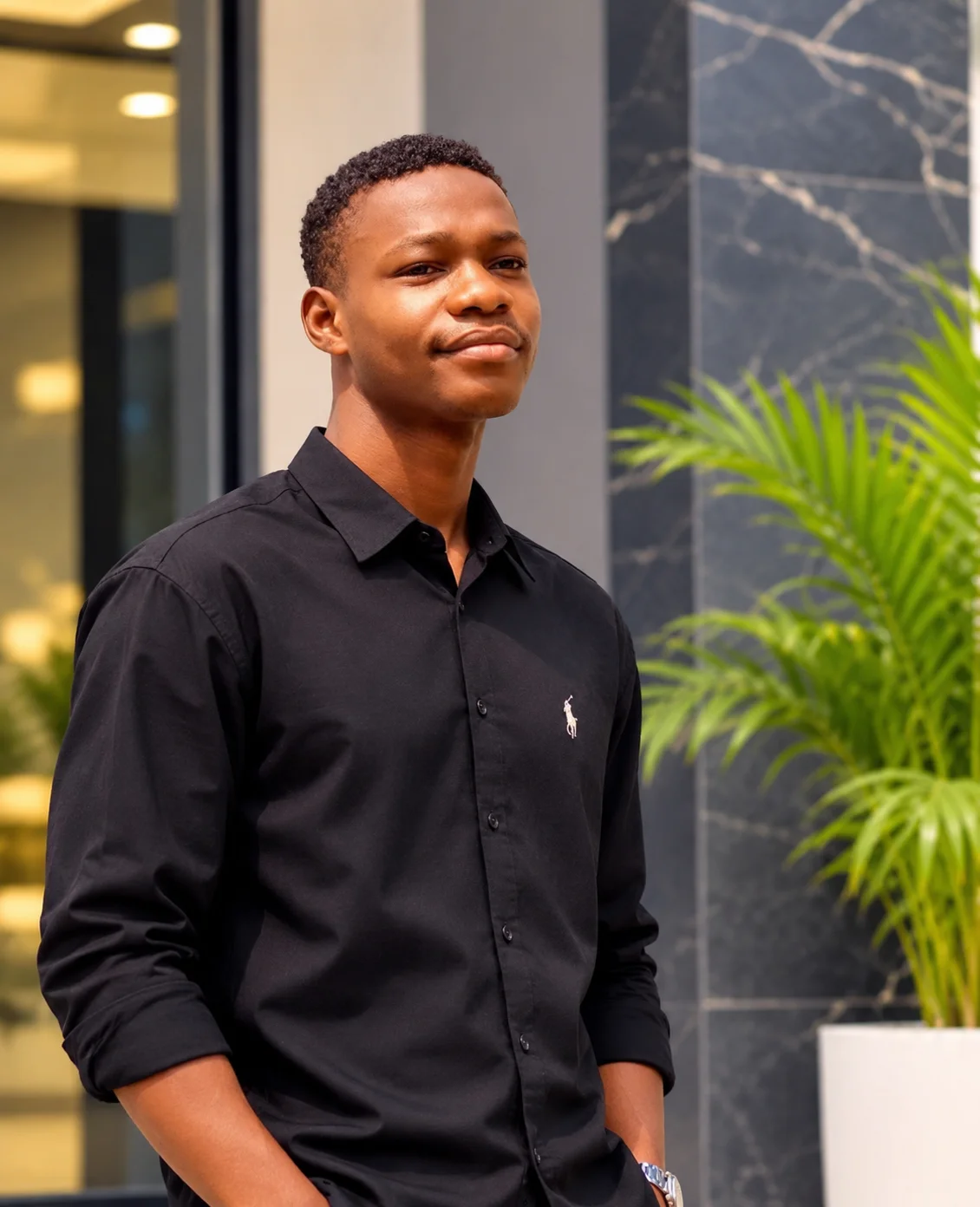
My Story — Lightson (Paul Imoleayo Daramola)
I've always been a creative person, even before I understood what creativity could become.
Growing up, I was the introverted boy who spent a lot of time sketching, imagining and making things. I didn't always have the materials I needed, but that never stopped me from trying. I used cartons to build houses, cars, aeroplanes and stadiums. Sometimes, I would even improvise wiring inside those models, imagining how I could make them come alive with light.
I was fascinated by the idea of creating something from nothing.
Before I entered Rufus Polytechnic Owo, I had developed an interest in portrait drawing. Drawing became more than a hobby; it became a way of expressing ideas I couldn't always explain with words.
Then came Quantity Surveying.
I didn't exactly plan to study it. I found myself in a field that was quite different from the direction my imagination had always pulled me toward. Mathematics wasn't my strongest area, and I struggled with some of the core aspects of Quantity Surveying, particularly estimating, tendering and bills of quantities.
However, I found myself more drawn to building technology, architectural drawing and technical drawing. Those were the areas where my creative instincts felt more at home.
Despite the challenges, I completed my studies.
But my story didn't stop there.
Discovering a New Dimension of Creativity
At some point, I discovered Blender through someone I met. It opened a new world to me.
I began to see that the things I had once imagined and built with cartons could also exist digitally. I started exploring 3D design, learning through tutorials and experimenting with AI as a learning companion.
At the beginning, I didn't even have a computer. I was learning and experimenting with my phone, trying to understand tools and techniques that many people would have considered difficult to learn without proper equipment.
There were moments when people misunderstood what I was doing. To some, spending so much time on a phone looked like idleness. To me, it was a classroom, a creative laboratory and a gateway to possibilities I couldn't yet afford.
I kept learning.
I kept experimenting.
I kept building.
Eventually, those experiments, ideas and creative interests began to take shape as Lightson Design Lab.
Building Lightson Design Lab
Lightson Design Lab was born from my desire to turn imagination into something tangible.
I didn't want to limit myself to a single creative discipline. I wanted to explore design, concept development, 3D modelling, AI-assisted creativity, visualisation and the possibilities of transforming ideas into products and experiences.
My vision for Lightson is bigger than a design studio.
I want to build a creative company that can grow into something global, create opportunities, develop ideas and give talented creatives a place to build meaningful careers without feeling restricted to conventional paths.
Freedom and expansion are central to the kind of business I want to build.
I believe creativity should not only produce beautiful things; it should also create opportunities, solve problems and build businesses.
From Creating Things to Understanding People
As I continued exploring creativity, business and marketing, I became increasingly interested in something beyond the design itself.
People.
Why do some ideas capture attention while others are ignored? Why does one message make someone feel connected, while another leaves them indifferent? What makes people trust a brand, desire a product, remember a story or take action?
These questions began to change how I viewed communication.
I realised that creativity, marketing and persuasion are not simply about making things look good or choosing the right words. They are also about understanding how people think, feel, perceive, interpret and make decisions.
This curiosity shaped my interest in consumer psychology, behavioural insights and persuasive communication.
I began to see writing differently. Not merely as a way to communicate information, but as a way to connect ideas with human perception, emotions, motivations and decisions.
That perspective became the foundation of my identity as a Psychoscripter.
Why I Call Myself a Psychoscripter
Psychoscripter is more than a title I use. It represents the way I approach communication.
I am interested in the psychology behind the message, not just the message itself.
I explore how attention works, how people interpret information, what influences perception, how emotions shape decisions, and how words can be structured to create meaningful connections between a brand and its audience.
My goal is to bring psychological understanding into the way stories, marketing messages and persuasive communication are developed.
I don't want to write simply to fill a page.
I want to understand the person reading it.
I want to understand what matters to them, what they struggle with, what they desire, what they fear, what they believe and what influences their decisions.
Then I want to use that understanding to craft communication that feels relevant, compelling and purposeful.
That's the thinking behind Psychoscripter.
The Journey Is Still Unfolding
My journey hasn't been smooth. I've experienced financial limitations, mental pressure, physical challenges, misunderstanding and moments when the vision seemed bigger than the resources available to pursue it.
But I've also encountered people who encouraged me to think bigger. One of them was Ayodele Daisi, CEO of Craftdas, whose influence and encouragement helped me look at my ambitions and creative journey differently.
I've learned that you don't always need to have everything before you begin. Sometimes, you need curiosity, persistence, the willingness to learn and the courage to experiment with what you have.
I'm still learning. I'm still exploring. I'm still building.
Today, I see myself as a creative entrepreneur, the founder and CEO of Lightson Design Lab, and a Psychoscripter exploring the intersection of human psychology, creativity, communication, technology and business.
My ambition is to build things that outlive the moment, create opportunities for others and contribute ideas that make people think differently.
I'm not interested in being confined to one box.
I'm interested in possibilities.
And I'm only getting started.
— Paul Imoleayo Daramola

