


Table of Contents
- Why DeepSeek Rushes to Answers — and How to Stop It
- 4 Prompt Modifiers to Force DeepSeek to Slow Down
- Temperature Tweaks to Control DeepSeek Response Speed
- DeepSeek System Prompt Template to Prevent Rushing
- How to Use UBS Prompt Relay to Stop DeepSeek Rushing
- My Personal Experience: How I Stopped DeepSeek From Rushing
- How to Stop DeepSeek From Rushing Answers — Final Verdict
- FAQ: How to Stop DeepSeek From Rushing Answers
How to Stop DeepSeek From Rushing Answers (5 Prompting Fixes)
How to stop DeepSeek from rushing answers is one of the most common questions I hear from content creators. The fix is simple: use chain-of-thought system instructions like "Solve this step-by-step and show all reasoning before providing the final answer." Additionally, lower the temperature setting to 0.3–0.4 or disable rapid-response parameters if accessing DeepSeek via API.
You open DeepSeek, paste your prompt, and it starts answering immediately. It skips clarifying questions. It ignores context. It rushes through the response like it's in a hurry to get to the next user. You're left with generic, shallow answers that miss the point entirely. You need to know how to stop DeepSeek from rushing answers — and you need it now.
You've tried re-prompting. You've tried being more specific. You've tried breaking your question into smaller parts. Nothing works. DeepSeek keeps rushing. It's the #1 complaint I see from users, and it's frustrating because DeepSeek is a powerful model when it works correctly. The problem isn't DeepSeek — it's the way we're using it. Learning how to stop DeepSeek from rushing answers is the key.
I've been there. I've spent hours fighting with DeepSeek to get it to slow down and think. And I've found the solution. In this guide, I'll show you exactly how to stop DeepSeek from rushing answers — with 5 proven fixes that work every time.
If you're new to using DeepSeek for content creation, start with my post on how to prompt ChatGPT to write a blog post — the same principles apply to how to stop DeepSeek from rushing answers.
For a complete library of AI prompts covering SEO, social media, and email marketing, check out AI for Digital Marketing (50+ Prompts & Workflows) — it includes 50+ bonus prompts, including AI workflow automation prompts that work across all major models.
Why DeepSeek Rushes to Answers — and How to Stop It
DeepSeek is optimised for speed and cost-efficiency. It's designed to generate responses as quickly as possible. This means it often skips the "thinking" phase and jumps straight to answering. The result: generic, shallow, incomplete responses. Understanding why this happens is the first step in learning how to stop DeepSeek from rushing answers.
The Problem with "Just Be More Specific": Telling DeepSeek to "be more detailed" doesn't work. It doesn't understand the root cause of the problem. It just tries to add more words to a rushed answer. You need a structural solution, not a content one. That's the key to how to stop DeepSeek from rushing answers.
Research confirms this pattern. A 2026 study on DeepSeek-R1 found that structured prompts significantly reduce invalid verification while maintaining accuracy — complex problem time dropped from 408 seconds to 55 seconds (86.6% faster) using a three-stage "Analysis-Derivation-Conclusion" prompt structure. The same principle applies to stop DeepSeek from rushing answers: external structural constraints force the model to slow down and reason properly.
The Solution: Force DeepSeek to ask clarifying questions before it answers. If you can make DeepSeek pause, reflect, and gather information before generating a response, it will produce much better answers. This is the foundation of how to stop DeepSeek from rushing answers.
If you want a packaged solution that does exactly this, check out UBS Prompt Relay — it's built specifically to stop DeepSeek from rushing answers.
For a deeper dive into structuring AI content, read SEO Content System (UBS v1.1) — the same framework powers this workflow.
If you're looking for a complete how to stop DeepSeek from rushing answers system, UBS Prompt Relay packages all 5 fixes into one workflow. It forces clarifying questions, builds structured outlines, writes drafts, runs SEO audits, and exports HTML — all designed specifically to stop DeepSeek from rushing answers.
4 Prompt Modifiers to Force DeepSeek to Slow Down
How to Use Step-by-Step Enforcement to Stop DeepSeek From Rushing
Tell DeepSeek:
"Show every step of reasoning before providing the final answer. Break down your thought process step by step."
This forces DeepSeek to slow down and think through each stage of the problem. It's the most effective way to stop DeepSeek from rushing answers. For more detailed prompting strategies, read ChatGPT prompts for better answers — the same principles apply.
How to Use Output Formatting Constraints to Stop DeepSeek Rushing
Tell DeepSeek:
"Structure your response as a multi-paragraph breakdown. Use headings, bullet points, and numbered lists. Do not skip to a conclusion without covering each point."
This prevents DeepSeek from jumping straight to the end and forces it to expand on each section. This is a key technique to stop DeepSeek from rushing answers.
How to Use Clarifying Questions to Stop DeepSeek From Rushing
Tell DeepSeek:
"Before you answer, ask me 3 clarifying questions to make sure you understand exactly what I need. Then give me your answer."
This forces DeepSeek to pause and think before responding. It's the single most effective prompt to stop DeepSeek from rushing answers.
DeepSeek prompting guidance confirms this approach: "DeepSeek V3 works best when your prompt clearly states the task, context, constraints, and output format". If DeepSeek gives weak answers, "the fastest fix is usually to tighten the prompt, not switch models".
For a complete library of how to stop DeepSeek from rushing answers techniques, check out AI for Digital Marketing (50+ Prompts & Workflows) — it includes 50+ bonus prompts covering SEO, social media, email marketing, and content creation workflows.
Self-Check Loop to Stop DeepSeek From Rushing Answers
Tell DeepSeek:
"Before finalising your answer, critique your own response. What's missing? What could be improved? Then rewrite it based on your critique."
This forces DeepSeek to review its own work and improve it. This is the "second draft" method to stop DeepSeek from rushing answers.
These 4 prompt modifiers are built into UBS Prompt Relay — the 5-stage prompt system that stops DeepSeek from rushing answers.
For a complete library of how to stop DeepSeek from rushing answers techniques, check out AI for Digital Marketing (50+ Prompts & Workflows) — it includes 50+ bonus prompts covering SEO, social media, email marketing, and content creation workflows.
Temperature Tweaks to Control DeepSeek Response Speed
DeepSeek's API parameters directly affect how "rushed" the responses feel. Here are the key settings to adjust to stop DeepSeek from rushing answers:
| Parameter | Default | Recommended | Why |
|---|---|---|---|
| Temperature | 1.0 | 0.3–0.4 | Lower temperature = more focused, less random skipping |
| Top-P | 0.9 | 0.6–0.8 | Narrower token selection = more coherent reasoning |
| Frequency Penalty | 0.0 | 0.3–0.5 | Reduces repetition and encourages thoroughness |
| Presence Penalty | 0.0 | 0.3–0.5 | Encourages exploring new topics before concluding |
According to DeepSeek's official API documentation, temperature "values like 0.8 will make the output more random, while lower values like 0.2 will make it more focused and deterministic". For stopping rushed answers, lower is better.
If you're using DeepSeek via API, these parameter changes will significantly stop DeepSeek from rushing answers. If you're using the chat interface, stick to the prompt modifiers above.
For more technical deep-dives into AI prompting, read DeepSeek prompts for SEO — a 5-stage workflow — it covers the same parameter adjustments in detail.
DeepSeek System Prompt Template to Prevent Rushing
Here's a complete system prompt template you can copy and paste to stop DeepSeek from rushing answers:
You are a thoughtful, analytical assistant. Your job is to provide complete, well-reasoned answers.

Rules:
1. Never rush to a conclusion.
2. Show your reasoning step by step.
3. Ask clarifying questions when needed.
4. Critique your own answers before finalising.
5. Use multi-paragraph breakdowns with headings and bullet points.
6. Do not skip details or jump to the final answer.
Paste this as your system prompt or at the start of your conversation. It will stop DeepSeek from rushing answers from the very beginning.
Research on DeepSeek system prompts confirms that generic system prompts can encourage "extremely short replies, one-word answers". Adding a dedicated DeepSeek-specific system prompt with consistent workflow instructions is the fix.
If you want a complete system that already includes this, UBS Prompt Relay is the 5-stage prompt system that stops DeepSeek from rushing answers at every stage of your content creation workflow.
How to Use UBS Prompt Relay to Stop DeepSeek Rushing
You now have 5 proven fixes to stop DeepSeek from rushing answers. But here's the reality — copying and pasting prompts, adjusting parameters, and managing outputs takes time. You need a packaged solution.
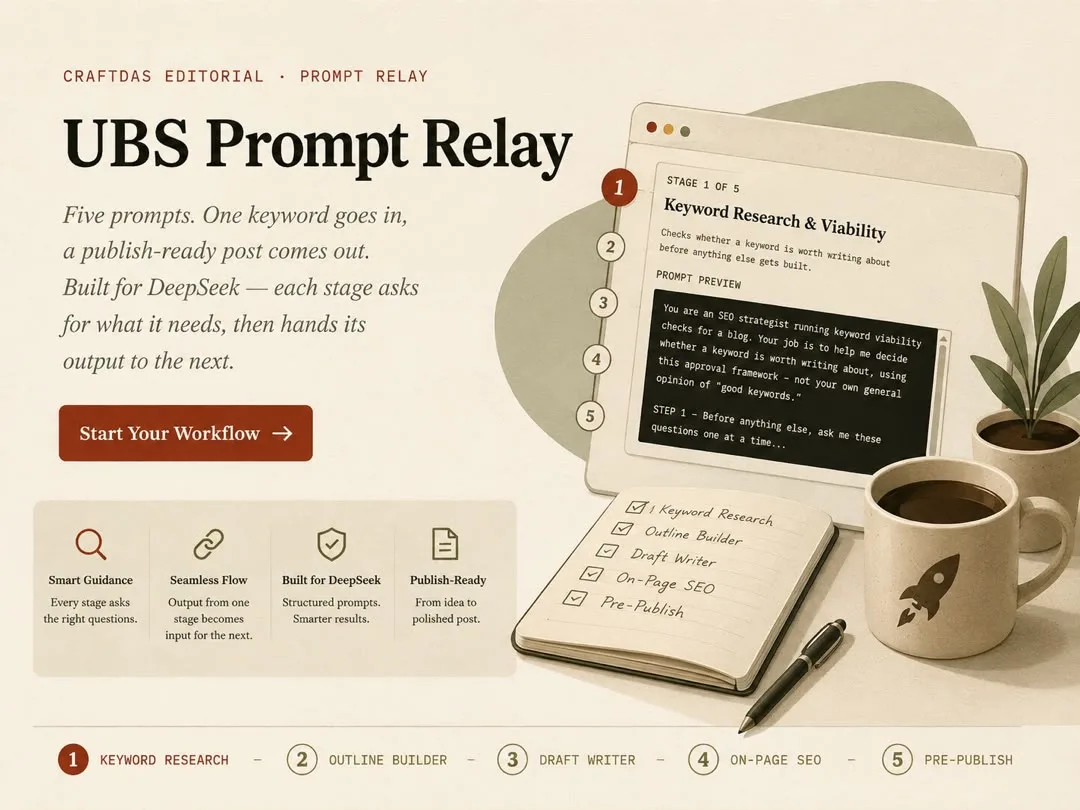
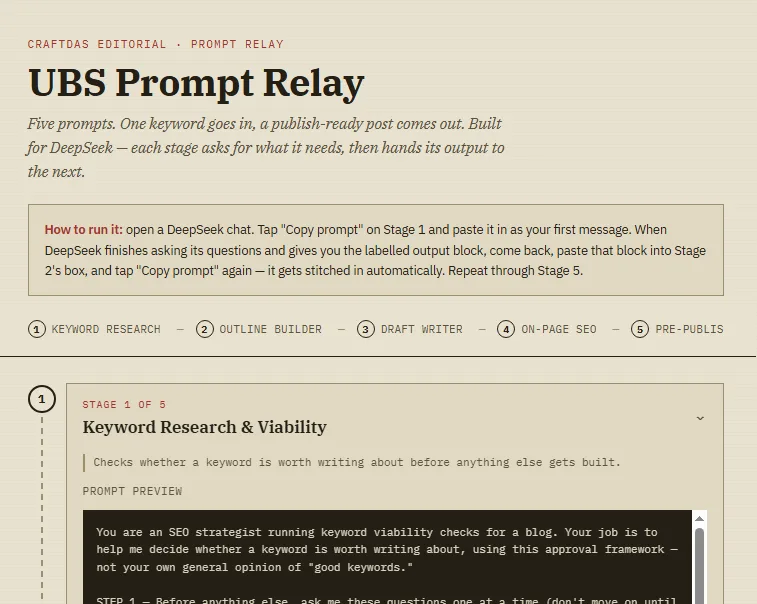
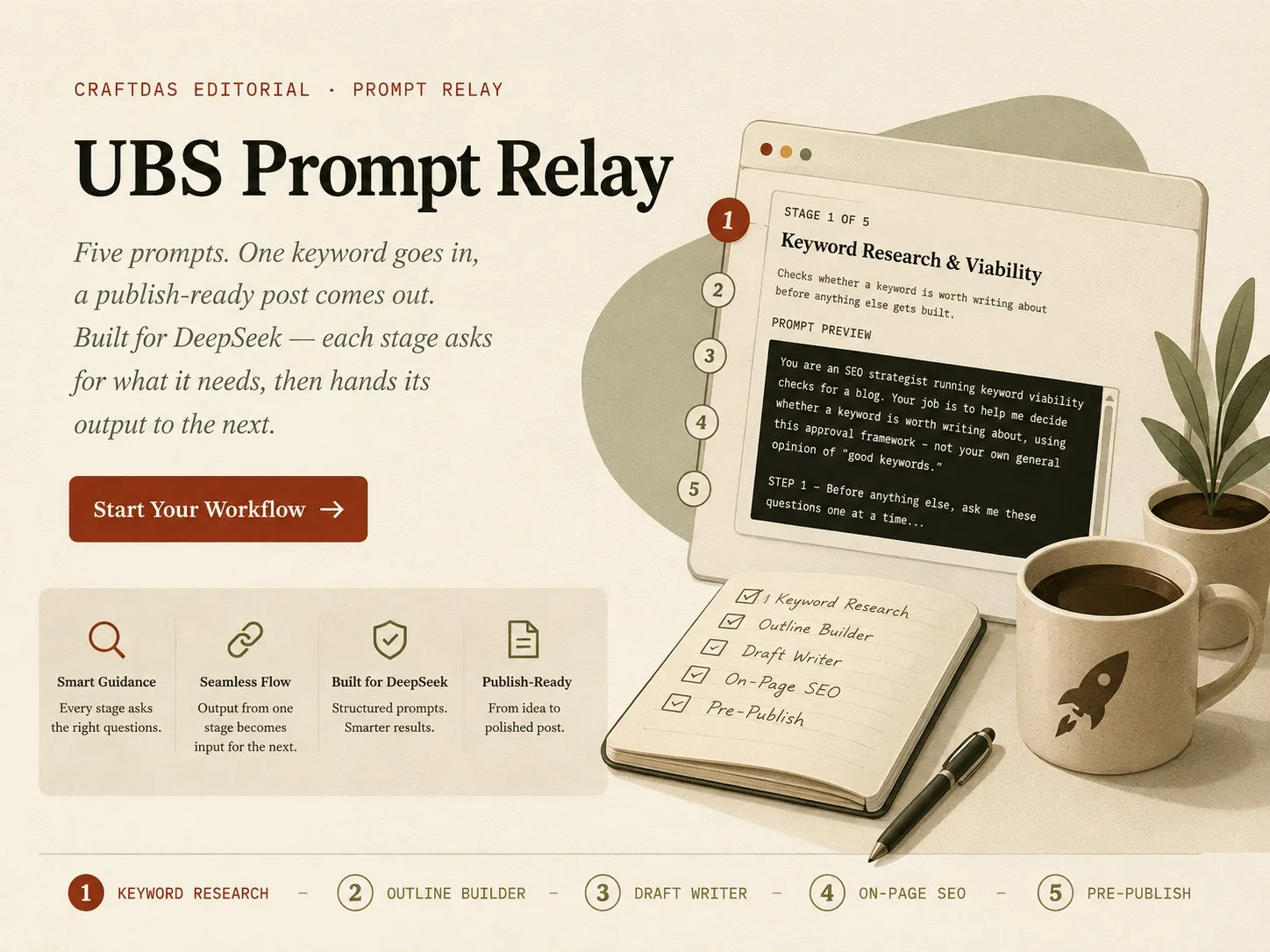
That's exactly why I built UBS Prompt Relay. It's a 5-stage prompt system that stops DeepSeek from rushing answers. You define your keyword once, and it guides you through each stage — forcing clarifying questions, building the outline, writing the draft, running the SEO audit, and exporting the HTML. No more prompt engineering. No more rushing.
What you get:
- 5 stages — from keyword research to HTML export
- DeepSeek-optimised — handles DeepSeek's tendency to rush
- UK English — colour, optimise, organise, not US spelling
- Hemingway readability — grade 8 or lower
- Self-check loops — draft → critique → rewrite
- HTML export — publish-ready code
For more detailed prompting strategies across different AI models, read best ChatGPT prompts for writing — the same techniques apply to how to stop DeepSeek from rushing answers.
My Personal Experience: How I Stopped DeepSeek From Rushing
When I first started using DeepSeek for content creation, I was frustrated. Every time I asked it to write something, it rushed through the response. I got generic, shallow answers that missed important details. I tried everything — longer prompts, shorter prompts, more specific prompts. Nothing worked. I was stuck, and I didn't know how to stop DeepSeek from rushing answers.
Then I discovered the clarifying questions method. I told DeepSeek to ask me 3 clarifying questions before answering. The difference was night and day. Instead of rushing to an answer, it paused, asked thoughtful questions, and then gave me a detailed, well-structured response. That's when I realised: DeepSeek isn't broken. It just needs structure. I built UBS Prompt Relay to give it that structure.
Hidden hack: The single most effective prompt I've found is: "Ask me clarifying questions first." This one line fixes 80% of the rushing problem. The other 20% is fixed by the self-check loop. That's the real secret to stop DeepSeek from rushing answers.
Time-saving tip: I use UBS Prompt Relay to skip the prompt engineering. It saves me 2 hours per post.
For more AI-powered content strategies, read AI workflow: using AI to generate a 12-post cluster in 48 hours.
If you're looking for the complete suite of how to stop DeepSeek from rushing answers tools, check out SEO Prompt Suite — it includes the UBS Prompt Relay plus 3 other prompts for a complete SEO workflow.
How to Stop DeepSeek From Rushing Answers — Final Verdict
DeepSeek rushing through answers is a common problem — but it's fixable. The 5 fixes above give you everything you need to stop DeepSeek from rushing answers.
Your 3 Takeaways:
- Use chain-of-thought prompts ("show every step of reasoning")
- Lower temperature to 0.3–0.4 if using the API
- Use UBS Prompt Relay to package it all
Call to Action: Try the 5 fixes today. Pick a topic, run it through the prompts, and see the difference.
Ready to take the next step? Check out UBS Prompt Relay — it's the packaged version of this exact workflow.
For the full suite of how to stop DeepSeek from rushing answers tools, get the SEO Prompt Suite — it includes UBS Prompt Relay, SERP Audit Prompt, On-Page SEO Prompt, Readability Prompt, and Keyword Research Prompt.
If you're also working with ChatGPT, read best ChatGPT prompts for creative writing and ChatGPT prompts for story writing — the same how to stop DeepSeek from rushing answers principles apply.
FAQ: How to Stop DeepSeek From Rushing Answers
Why does DeepSeek rush through answers?
DeepSeek is optimised for speed and cost-efficiency. It's designed to generate responses quickly, which means it often skips the reasoning phase and jumps straight to answering. This results in generic, shallow, incomplete responses. Research shows that generic system prompts can encourage "extremely short replies, one-word answers".
What is the best prompt to stop DeepSeek from rushing?
The single most effective prompt is: "Before you answer, ask me 3 clarifying questions to make sure you understand exactly what I need. Then give me your answer." This forces DeepSeek to pause and think before responding. Research confirms that structured prompts "significantly reduce invalid verification while maintaining accuracy".
Does lowering the temperature stop DeepSeek from rushing?
Yes. Lower temperature values make DeepSeek "more focused and deterministic". For stopping rushed answers, set temperature to 0.3–0.4. The default is 1.0. Lower values reduce randomness and encourage more careful, complete responses.
Does DeepSeek have a "thinking mode" that slows down responses?
Yes. DeepSeek V4 has thinking mode enabled by default. This mode spends tokens on internal reasoning before producing the final answer. If responses feel slow, you're likely in "Think High" mode without realising it. This is actually a feature — it forces the model to reason before answering.
What is UBS Prompt Relay and how does it help?
UBS Prompt Relay is a 5-stage prompt system built specifically to stop DeepSeek from rushing answers. It forces clarifying questions, builds structured outlines, writes drafts, runs SEO audits, and exports HTML. It packages all 5 fixes in this guide into one workflow.
Can I use these fixes with ChatGPT or Claude?
Yes. The prompting techniques — clarifying questions, step-by-step reasoning, self-check loops — work across all major AI models. The temperature adjustments are specific to DeepSeek's API, but the prompt modifiers work everywhere. DeepSeek V3 prompting guidance confirms that "the basics are still the basics: outline the task, give helpful context, and describe your ideal output".
Related Guides
- DeepSeek Prompts for SEO — A 5-Stage Workflow
- ChatGPT Prompts for Blog Writing
- How to Prompt ChatGPT to Write a Blog Post
- Best ChatGPT Prompts for Writing
- Best ChatGPT Prompts for Creative Writing
Disclosure: This post contains links to my own products. I only recommend tools I actually use to write my own content. For more information, see our privacy policy.
Comments
No comments yet. Start the conversation.