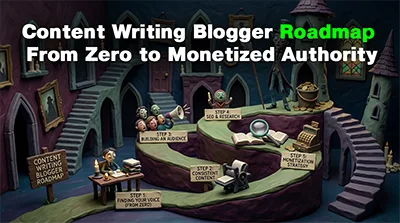

Content Writing Blogger Roadmap: From Zero to Monetized Authority
A phased, search-intent driven plan to learn, rank, build topical authority, and earn — starting with beginner-friendly content, not random writing tips.
Google’s guidance: Helpful, reliable, people-first content wins. Google’s AI features & Bing Webmaster Guidelines reward content that answers real questions, surfaces in Copilot & AI search. This roadmap aligns with E-E-A-T and answer-engine optimization. If you're new to the platform, start by reading the Welcome to Craftdas guide to understand the connected ecosystem you'll be building within.
Why most new content writing bloggers fail: They start by posting scattered “writing tips” without a strategic foundation. Instead, a winning blogger learns content writing in phases, understands search intent, publishes beginner-friendly articles, builds internal links, optimizes for both search engines and AI answers, then monetizes through Craftdas blogging, affiliate offers, writing services, templates, audits, and future lessons. This guide gives you the exact playbook. The overall philosophy aligns with the reality that blog posts take time to rank — you're building long-term assets, not chasing quick wins.
Phase 1 — Beginner Content Writing Foundation
Goal: Understand what content writing is, how it works, and why businesses need it. First posts must be educational, not advanced. A common mistake new bloggers make is jumping straight into advanced topics like "how to write for Fortune 500 companies" before covering basic definitions. That confuses readers and signals low authority to search engines. Instead, start with the fundamentals that answer real beginner questions. Google rewards content that demonstrates deep understanding of foundational topics because it satisfies user intent at the earliest stage of the learning journey. When you publish comprehensive beginner guides, you build trust with both human readers and search engine crawlers, increasing the likelihood of ranking for dozens of long-tail variations of "what is content writing" and "how to start content writing." This phase is not optional — it is the SEO foundation that every successful content writing blog must build first. As you publish these foundational pieces, remember that your Craftdas posts are not for fun — each one builds your authority and contributes to the platform's overall trust signals.
What to post first: Beginner guides, writing basics, glossary terms, content examples, common mistakes, blog writing tips. Each piece of content in this phase should answer one clear question that a complete novice types into Google or Bing. For example, "what is content writing for beginners" has high search volume but low competition if you write a truly helpful, detailed guide of 2,000+ words with examples, a table of contents, and a frequently asked questions section at the end. Including a definition box within the first 150 words also increases your chances of appearing in Google's AI Overviews and Bing's Copilot responses, because answer engines extract concise definitions from well-structured content. Do not write thin, 500-word articles. Write definitive resources that become the go-to reference for beginners in your niche. That is how you build topical authority from day one. The good news is that you can write posts that Google and AI understand even without SEO tools — clarity and structure matter more than software.
Research queries to target (each becomes its own article): what is content writing for beginners, how does content writing work, content writing vs copywriting (high-value comparison post that attracts both writers and business owners), types of content writing (create a pillar page covering blog posts, website copy, emails, white papers, case studies, social media captions, product descriptions, and video scripts), content writing mistakes beginners make (list at least 12 mistakes with before/after examples), how to write a blog post for beginners (include a downloadable template), best content writing tools for beginners (review 5-7 free and paid tools with screenshots). Each of these articles should internally link to each other, forming a content hub that Google recognizes as a topical cluster.
Insight: New bloggers often skip “why content writing matters for business.” Create a post: “Why small businesses pay for content writing — 5 real reasons” — that attracts both aspiring writers AND potential clients. This dual-audience approach is powerful because it brings traffic from two distinct search intents: people wanting to become writers, and business owners wanting to hire writers. Both are monetizable. The aspiring writer may buy your templates or affiliate tools. The business owner may hire your services. To optimize this post for Google, include subheadings like "Reason 1: Content writing drives organic search traffic (statistics included)" and "Reason 2: Quality content builds brand authority and trust." Add a real-world case study or hypothetical example showing how a small business increased website traffic by 300% after publishing consistent blog content. Data-driven sections perform well in search results because they signal expertise and usefulness. If you're also interested in adjacent creative niches, explore the Graphic Design Blogging Roadmap or the Email Marketing Blogging Roadmap for cross-promotion opportunities.
Phase 2 — Pick A Clear Sub-Niche
Instead of being a generic writing blog, specialize. Readers trust specialists, and search engines reward niche authority. A blog that covers "content writing for SaaS startups" will outrank a general writing blog for keywords like "SaaS content writing tips" or "how to write case studies for software companies." The same principle applies across all sub-niches. Specialization also increases conversion rates because visitors feel you understand their specific problems. A small business owner searching for "website content writing for plumbers" will immediately trust a blog that has multiple articles about home services content marketing, rather than a blog that writes about everything from poetry to product descriptions. Google's algorithm detects this relevance through co-occurrence of niche-specific terms throughout your site.
Best sub-niches with high search demand and low competition for beginners: Blog writing (focus on WordPress blogging, Medium writing, or Substack newsletters), SEO writing (target local SEO content, ecommerce SEO articles, or B2B SEO case studies), website content writing (homepage, about page, service page, landing page copy), copywriting (email sequences, sales pages, VSL scripts, ad copy), product description writing (Amazon listings, Shopify product pages, Etsy descriptions), email content writing (newsletters, welcome sequences, abandoned cart emails, post-purchase follow-ups), technical content writing (API documentation, user manuals, developer tutorials — high rates but requires research), brand storytelling (mission statements, brand origin stories, about us pages that convert), AI-assisted writing (prompt engineering for ChatGPT, Jasper, Copy.ai, Claude — a growing niche with commercial intent), and small business content writing (the broadest but most profitable if you pick an industry like real estate, fitness, legal, or home improvement). The beginner blogger money plan for web design creators offers a similar strategic approach that you can adapt to content writing.
Research queries to find your profitable angle: profitable content writing blog niches (use this to brainstorm 10-15 potential angles), best content writing niches for beginners (focus on niches with existing demand and visible search results), content writing topics people search for (use Google Autocomplete and People Also Ask boxes to generate article ideas), blog writing niche ideas (tourism blogs, finance blogs, food blogs, parenting blogs — each requires specific content styles), SEO writing niche ideas (on-page SEO, off-page SEO, technical SEO content, link building content), copywriting blog topic ideas (direct response copywriting, brand copywriting, social media copywriting), website content writing topics (homepage formulas, about us page storytelling, service page optimization), content writing for small businesses (pricing guides, proposal templates, client onboarding checklists), content writing for ecommerce brands (category descriptions, size guides, gift guides, buying guides), best content writing niche for affiliate marketing (tool reviews, software comparisons, template roundups), high intent content writing keywords (keywords that include "hire," "pricing," "cost," "services," "freelancer," "agency"), most requested content writing services online (blog writing services, SEO content writing, website copywriting, product descriptions, email newsletters).
Once you pick your sub-niche, write a "manifesto post" explaining exactly who you serve and what problems you solve. For example: "Why I Only Write Content For Vegan Ecommerce Brands" or "The Complete Guide To Technical Writing For API Startups." This pillar page will become your highest-converting service page over time. For a broader perspective on turning a niche blog into a revenue ecosystem, review The High-Signal Architect and The Complete Income Architecture — these principles apply directly to content writing.
Phase 3 — Keyword Research For Content Writing Blog
Goal: Find what people already search for before writing. Keyword research eliminates guesswork and ensures every article you publish has existing search demand. Many beginners skip this step and write about topics they find interesting but nobody searches for, leading to zero traffic and demotivation. Proper keyword research takes 1-2 hours per week but saves months of wasted effort. For a content writing blog, focus on keywords with "how to," "what is," "best," "vs," "for beginners," "tips," "examples," "template," "checklist," and "tools" modifiers because these indicate clear informational or commercial intent. Avoid head terms like "content writing" (too competitive) and instead target long-tail phrases like "content writing for real estate agents" or "how to write product descriptions for Etsy sellers."
What to post after keyword research: How-to guides that solve specific writing problems, writing templates that save time, mistake posts that prevent common errors, checklist posts for editing and publishing, content examples with analysis, tool posts comparing features and pricing, and beginner roadmaps like this one. Each of these content types aligns with specific keyword intents. A "how-to" post matches transactional and informational queries. A "mistake post" attracts readers who have already tried something and failed, making them more likely to buy a solution. A "tool post" captures commercial intent — people comparing software before purchasing. If you're new to the technical side of publishing on Craftdas, review the complete step-by-step guide to posting on Craftdas to ensure your content is properly formatted from the start.
Research queries to use in your keyword tool (Ubersuggest, Keysearch, Ahrefs, or Google Keyword Planner): keyword research for content writing blog (use this search to find seed keywords), low competition content writing keywords (filter by difficulty score under 20 if using paid tools, or use Google's "People also ask" for free alternatives), long tail keywords for content writing (these have 3-5 words and convert 2.5x better than short keywords), content writing keyword ideas for beginners (brainstorm from your own beginner struggles), blog writing keyword ideas (use AnswerThePublic for question-based keywords), SEO writing keywords (target "SEO content writing for beginners" not just "SEO writing"), copywriting keyword ideas ("copywriting tips for landing pages" performs well), content writing questions people ask (scrape Reddit, Quora, and Facebook groups for real beginner questions), People Also Ask content writing topics (extract from Google SERPs for your seed keywords), content writing buyer intent keywords ("hire content writer for blog," "content writing pricing packages," "SEO article writing service near me"), content writing template keywords ("blog post outline template," "SEO content brief template," "content calendar template"), content writing tools keywords ("free grammar checker for writers," "best AI writer for bloggers"), how to find keywords for writing blog posts (teach this process in a tutorial post), content writing SEO content ideas (cluster keywords by topic using a spreadsheet), best free SEO tools for beginner writers (Google Keyword Planner, AnswerThePublic, AlsoAsked.com, Keyword Surfer Chrome extension).
Create a spreadsheet with columns for keyword, search volume, keyword difficulty, intent (informational, commercial, transactional, navigational), and suggested article title. Target 2-3 keywords per article, with one primary keyword in the H1 tag and secondary keywords in H2s and body text. This structured approach signals relevance to Google's ranking algorithms. For a deeper technical framework on writing SEO content, study the SEO Content System UBS v1.1 — a locked structure for writing better SEO content with any AI.
Phase 4 — Content Pillars For The Blog
Content pillars are the five core topic categories that every article on your blog belongs to. They create an information architecture that search engines can easily crawl and understand. When you organize your blog around clear pillars, you build topical authority faster because Google sees that you have comprehensive coverage of a subject, not just isolated articles. Each pillar becomes a silo of interlinked content, with a pillar page at the top and cluster articles supporting it with internal links. This structure also improves user experience — readers can navigate from a beginner post to an advanced post within the same pillar without getting lost.
Pillar 1: Content Writing Basics — This pillar targets absolute beginners who might not even know what content writing is yet. Articles under this pillar should answer foundational questions, define industry terms, and provide a clear learning path. Target keywords include: content writing beginner guide (aim for 3000+ words with a table of contents, glossary, and quiz or checklist), how to start content writing (include a step-by-step week-by-week plan), content writing basics step by step (break down the writing process from research to editing to publishing), what should a beginner content writer learn first (prioritize skills like audience analysis, readability, tone of voice, and basic SEO), content writing learning roadmap (create a visual timeline from month 1 to month 12), types of content writers (blog writers, copywriters, technical writers, grant writers, medical writers, UX writers — each with salary data and skill requirements), content writing skills for beginners (writing, editing, research, time management, client communication, basic HTML/markdown, SEO fundamentals), content writing strategy for beginners (how to plan a month of content, create an editorial calendar, repurpose content across platforms). Every article in this pillar should link back to a central "Content Writing 101" pillar page that lives at /content-writing-for-beginners.
Pillar 2: Blog Writing And SEO Writing — This pillar attracts readers who specifically want to write for blogs or optimize content for search engines. Blog writing and SEO writing overlap significantly, but you can treat them as sub-pillars under one main category. Target keywords: how to write a blog post for beginners (include a downloadable outline template and a real example with before/after versions), SEO writing for beginners (explain keyword placement, meta descriptions, alt text, internal linking, URL structure, and readability scores), how to write SEO friendly content (teach the concept of search intent — informational, navigational, commercial, transactional — with examples for each), blog post structure for SEO (the exact heading hierarchy: H1 for title, H2 for main sections, H3 for sub-points, H4 for examples), how to write blog introductions (templates like the "hook-line-sinker" method or the "problem-agitation-solution" framework), how to write blog conclusions (summarize key takeaways, add a question to encourage comments, include a clear CTA to a service, product, or related post), how to use headings in blog posts (explain that headings should form an outline when read alone, and include keywords naturally without keyword stuffing), how to match search intent in blog writing (analyze the top 5 Google results for your target keyword and match their content type, format, and angle), how to write helpful blog content (Google's own helpful content guidelines explained for beginners — avoid writing for search engines first, write for humans, demonstrate first-hand experience), blog writing mistakes beginners make (list includes: no clear structure, ignoring search intent, keyword stuffing, thin content, no internal links, no images, no proofreading, no call to action). For a complete framework, study the SEO Content System UBS v1.1 which provides a locked structure that works with any AI tool.
Pillar 3: Copywriting And Sales Content — Copywriting focuses on persuasion and action. This pillar attracts business owners and marketers who need sales pages, email sequences, and ads. Target keywords: copywriting for beginners (explain the difference between copywriting and content writing — copy sells, content informs), content writing vs copywriting (a dedicated comparison post that targets both terms, with a table comparing purpose, length, tone, metrics, examples, and typical rates), how to write sales copy (the PAS framework: Problem-Agitation-Solution, with real-world examples from successful brands), how to write product descriptions (template: [Feature] + [Benefit] + [Emotional trigger] + [Social proof], with examples for physical products, digital products, and services), how to write landing page copy (structure: hero section, problem statement, solution, how it works, social proof, risk reversal, CTA, FAQ), how to write call to action (list of 50+ CTAs categorized by intent: download, buy, subscribe, contact, learn more, share), copywriting formulas for beginners (AIDA: Attention-Interest-Desire-Action, PAS: Problem-Agitation-Solution, FAB: Feature-Advantage-Benefit, 4Cs: Clear-Concise-Compelling-Credible, PPP: Picture-Promise-Prove), AIDA copywriting examples (break down a successful email or landing page using the AIDA framework with annotations), PAS copywriting examples (annotate a before/after version of weak copy transformed with PAS), copywriting mistakes beginners make (no unique selling proposition, too much jargon, weak headlines, no urgency, no social proof, no risk reversal, boring formatting). This pillar monetizes well through affiliate offers for copywriting courses (Copyhackers, Copyblogger) and software (Hemingway, ProWritingAid, Jasper).
Pillar 4: Website And Brand Content — This pillar serves entrepreneurs and small business owners who need copy for their own websites. Target keywords: how to write website content (explain that website content must be scannable, benefit-driven, and trust-building, with distinct approaches for homepage, about page, service page, and contact page), homepage content writing tips (template: headline that states value proposition → sub-headline that explains how → social proof logos → benefits section → how it works → final CTA), about us page writing tips (the storybrand framework: customer is the hero, brand is the guide, customer faces a problem, brand provides a plan, brand calls customer to action, customer finds success), service page content writing (template: service overview → who this service is for → what's included → pricing or request quote → case study → FAQ), brand storytelling for beginners (teach the three-act structure: status quo → inciting incident → transformation, with examples from brands like Nike, Apple, and Patagonia), how to write brand voice guidelines (templates with dimensions: formal vs casual, funny vs serious, respectful vs irreverent, enthusiastic vs matter-of-fact), website copywriting checklist (on-page SEO elements, readability score, mobile formatting, CTA clarity, proofreading, A/B testing ideas), content writing for small business websites (niche down to specific industries: restaurants, dentists, lawyers, real estate agents, contractors, coaches, consultants, ecommerce stores, nonprofits), how to write portfolio content (for freelancers: case study template with challenge, solution, results, and testimonial, plus tips for presenting writing samples), how to write content that builds trust (elements: transparency, authority signals (badges, certifications), social proof (testimonials, case studies), guarantees, clear pricing or pricing philosophy, author bios with real photos and LinkedIn links).
Pillar 5: Tools, Templates And AI-Assisted Writing — This pillar targets readers who want to work faster and smarter. It has high commercial intent because tool recommendations lead directly to affiliate commissions. Target keywords: best content writing tools for beginners (curated list of 10-15 tools across categories: writing, editing, grammar, SEO, productivity, research, organization), best AI tools for content writing (ChatGPT, Jasper, Copy.ai, Writesonic, Rytr, Claude — compare pricing, features, output quality, learning curve, and best use cases), content writing templates for beginners (offer downloadable templates in Google Docs or Notion: blog post template, SEO brief template, content calendar template, client questionnaire template, editing checklist template, revision log template), blog post outline templates (multiple formats: listicle, how-to, comparison, case study, ultimate guide, newsjacking, myth-busting, interview, roundup, review), SEO content brief template (template includes: target keyword, secondary keywords, search intent, suggested title, meta description, headers outline, word count target, internal linking opportunities, external linking opportunities, competitor analysis, questions to answer, statistics to include), content calendar template (spreadsheet with columns: publish date, title, keyword, pillar category, content format, writer assigned, editor assigned, status, promotion channels, affiliate links to include), headline generator tools (CoSchedule Headline Analyzer, Sharethrough Headline Analyzer, Advanced Marketing Institute headline analyzer — each explained with how to use them to improve CTR), grammar tools for writers (Grammarly, ProWritingAid, Hemingway, LanguageTool — compare free vs paid tiers, accuracy, platform integrations, reporting features), AI writing tools for bloggers (ethically: explain how to use AI for outlines, research, first drafts, headline generation, and meta descriptions, but warn against publishing unedited AI content which Google may penalize under spam policies), how to use AI for content writing without losing originality (framework: AI for speed and structure, human for voice, examples, stories, opinions, data, and final polish — include a before/after example of AI-generated text improved by a human writer). The SEO Content System UBS v1.1 is particularly valuable here as it provides a locked structure that ensures quality even when using AI assistance.
Each pillar should have a dedicated category page on your blog that explains the pillar and lists all related articles. This category page itself can rank for pillar keywords like "content writing basics" or "copywriting for beginners." Interlink pillar pages to each other where relevant — for example, the tools pillar links to the SEO pillar for keyword research tools, and the SEO pillar links back to the tools pillar for content optimization software.
Phase 5 — How To Write Posts That Can Rank (Search + AI Answers)
Goal: Every post should answer one clear search intent. Search intent is the "why" behind a user's query. If someone searches "best content writing tools," they want a curated list with comparisons and pricing (commercial intent). If they search "how to use Grammarly," they want a step-by-step tutorial (informational intent). If they search "hire content writer," they want a service page with a contact form (transactional intent). Matching intent is the single most important ranking factor after relevance. Google measures this through user behavior — if people click your result and immediately bounce back to Google because your page didn't match what they wanted, your rankings will drop over time. Always check the top 3 Google results for your target keyword before writing. If they are all listicles, write a listicle. If they are all long-form guides, write a long-form guide. If they are all product pages, do not try to rank an informational article — the intent is transactional.
Recommended post structure that satisfies both human readers and ranking algorithms:
- Clear title with the main keyword near the beginning. Example: "Content Writing For Beginners: 7 Skills You Need To Start (2025 Guide)" — not "Starting Out in Content Writing." The keyword-forward title improves click-through rates and relevance signals.
- Short direct answer within the first 150 words. Also called the "definition box" or "TL;DR summary." Answer the question immediately before explaining details. For "what is content writing," write: "Content writing is the process of planning, writing, and editing web content — typically for digital marketing purposes. It includes blog posts, website copy, emails, social media captions, product descriptions, and white papers." This short answer optimizes your content for Google's AI Overviews and featured snippets. Learn more about the locked structure for writing better SEO content that incorporates these principles.
- Beginner-friendly explanation using simple language, short sentences, and active voice. Assume the reader knows nothing. Define every term the first time you use it. Break complex ideas into analogies (e.g., "SEO is like a library catalog — it helps search engines find and organize your content.").
- Step-by-step guide with numbered steps or bullet points for any process-oriented content (how to write, how to edit, how to research, how to optimize). Each step should be actionable and specific. Avoid vague advice like "write good content" — instead say "write a headline that includes a number, an adjective, a keyword, and a promise, like '7 Proven Ways To Write Catchy Headlines That Get Clicks'."
- Examples from real brands or detailed hypotheticals that illustrate your points. For copywriting content, show a weak sentence and rewrite it stronger. For SEO content, show a paragraph before and after keyword optimization. For template posts, include a screenshot of the filled-out template. Examples increase time-on-page and demonstrate E-E-A-T (Experience, Expertise, Authoritativeness, Trustworthiness).
- Common mistakes section with at least 5 specific errors and how to fix each one. This section often gets shared on social media because people love content that saves them from embarrassment. Use a table format for quick scanning: Mistake | Why It Hurts | How To Fix It.
- Checklist or downloadable resource at the end of the post. A printable checklist, editable template, or cheat sheet increases email signups (if gated) or return visits (if free). From an SEO perspective, checklists also increase dwell time because readers scroll back up to verify items.
- Internal links to 3-5 related posts using descriptive anchor text. For a post about SEO writing, link to "what is keyword research," "how to write meta descriptions," "internal linking strategy," "SEO content tools," and "common SEO mistakes." Internal links distribute link equity and help search engines understand your site's structure. For a comprehensive approach, study the SEO Content System UBS v1.1 which provides a framework for consistent, high-quality output.
- Craftdas CTA that matches the post's intent. For informational posts, the CTA might be "download our free content calendar template from Craftdas Market." For commercial posts, "compare the top 5 AI writing tools on Craftdas." For transactional posts, "hire an SEO content writer starting at $XXX on Craftdas Services." If you plan to sell digital products, review the guide on how to sell digital products online on Craftdas Market.
- FAQ section with 3-7 questions and concise answers using FAQ schema markup (JSON-LD). Schema helps Google show your FAQ directly in search results as rich results, which increases click-through rates. Write each FAQ as a question a real beginner would ask, then answer in 1-3 sentences. Include keywords naturally in both questions and answers.
Research queries for post optimization: how to write SEO blog post for content writing (the exact process from keyword selection to publishing), content writing blog post structure (use this search to find winning templates), how to write helpful content for Google (study Google's Search Quality Evaluator Guidelines, specifically the E-E-A-T criteria), how to match search intent in content writing (learn to classify intent into informational, navigational, commercial, and transactional), how to write direct answers for SEO (the "inverted pyramid" style: conclusion first, then evidence), how to write content writing tutorials (use the "I do, we do, you do" model from teaching pedagogy), how to write content writing examples (show a bad example, explain why it's bad, show a good example, explain why it's better), how to write content writing tool reviews (template: background, features, pricing, pros, cons, who it's best for, alternatives, final verdict, affiliate link), how to write FAQ for content writing posts (research real FAQs from Reddit, Quora, and YouTube comments), how to optimize content writing blog posts (on-page SEO checklist: title tag, meta description, URL slug, H1, H2s, image alt text, internal links, external links, readability scores, mobile formatting), how to write beginner friendly writing content (readability score of grade 6-8, short paragraphs, subheadings every 300 words, bold text for key phrases, bullet points for lists, white space generous), how to use examples in content writing articles (concrete > abstract, specific > generic, recent > outdated, relevant > tangential), how to avoid thin content in writing blog (thin content = under 1000 words with no original insights, no examples, no data, no visuals, no structure — fix by adding each element systematically), how to update content writing blog posts (refresh dated statistics, add new examples, expand thin sections, improve formatting, add new internal links, update the publish date, add a change log), SEO checklist for content writing blog (downloadable 30-point checklist covering keyword research, on-page SEO, technical SEO, content quality, user experience, and promotion).
Additional insight for AI answers (Google SGE, Bing Copilot, Perplexity): Answer engines prioritize content that is structured, concise, and authoritative. To optimize for AI-generated answers, use definition lists (<dl> or bulleted definitions), include a "key takeaways" box at the top of long posts, format statistics as bolded numbers within sentences (e.g., "content marketing generates 3x more leads than outbound marketing and costs 62% less"), and cite your sources with external links to authoritative domains (.gov, .edu, or established industry publications). When AI engines summarize your content and attribute it to your blog, you get brand exposure and referral traffic even if users don't click through immediately. Over time, consistent AI optimization turns your blog into a source that AI models rely on, similar to how Wikipedia became a primary source for knowledge panels.
Phase 6 — Internal Linking Strategy
Goal: Build topic authority by connecting related posts together into a content silo or topic cluster model. Internal links are one of the most underutilized ranking factors. Each internal link passes "link equity" (ranking power) from one page to another. When you link from a high-authority pillar page to a new cluster post, you accelerate that new post's ability to rank. More importantly, internal links create a navigation path for both users and search engine crawlers. A well-linked blog allows Googlebot to discover all your content in just a few clicks. A poorly linked blog leaves pages orphaned (no internal links pointing to them), and orphaned pages rarely rank. The SEO Content System UBS v1.1 provides a locked structure that naturally incorporates internal linking opportunities.
Main pillar article (the central hub for the entire content writing ecosystem): Content Writing For Beginners: The Complete Roadmap To Learning, Practicing, Ranking, And Making Money On Craftdas — This article should be the longest, most comprehensive post on your blog (5,000-10,000 words). It should include a table of contents linking to each section, and each section should link out to dedicated cluster articles. For example, the "Learning" section links to "What Is Content Writing" and "Content Writing Vs Copywriting." The "Practicing" section links to "How To Write A Blog Post For Beginners." The "Ranking" section links to "SEO Writing For Beginners" and "Internal Linking Strategy." The "Making Money" section links to "How To Make Money With Content Writing On Craftdas" and "Best Content Writing Tools For Beginners (Affiliate)." Every cluster article should link back to this pillar page using descriptive anchor text like "back to the complete content writing roadmap." This reciprocal linking pattern signals to Google that these pages belong to a single topic cluster.
Supporting posts (cluster content that answers specific sub-questions): What Is Content Writing And How Does It Work? (targets definitional intent with a short answer box, glossary, and examples of content writing in different industries), Content Writing Vs Copywriting: What Is The Difference? (use a comparison table with 8-10 criteria, plus a decision flowchart for when to use each), How To Write A Blog Post For Beginners (week-long mini-course broken into 7 daily lessons, each with a checklist), SEO Writing For Beginners (teach the 10 essential on-page SEO elements every blog post needs, with a browser extension checklist), Best Content Writing Tools For Beginners (categorize by free vs paid, beginner vs advanced, and use case: writing, editing, SEO, grammar, productivity), How To Write Website Content That Builds Trust (focus on the "about us" page, "testimonials" page, and "case studies" section as trust converters), Common Content Writing Mistakes Beginners Make (list 15 mistakes with before/after examples, plus a "self-audit checklist" for readers to review their own work), How To Make Money With Content Writing On Craftdas (specific strategies for using Craftdas Market to sell templates, Craftdas Services to offer writing packages, and Craftdas Affiliate Program to recommend tools — include exact pricing recommendations and outreach scripts).
Research queries for internal link architecture: internal linking strategy for content writing blog (study the Wikipedia model: every page links to related pages, and no page is more than 4 clicks from the homepage), topic clusters for content writing SEO (the hub-and-spoke model: one pillar page, 10-30 cluster pages, all interlinked), content writing content cluster examples (search for "content writing topic cluster" to see real examples from authoritative blogs), pillar page for content writing blog (how to write a pillar page that ranks — include a template with word count recommendations, heading structure, and internal link density), how to create topical authority in content writing (publish 30+ articles on related subtopics, interlink them strategically, and update them regularly — Google measures topical authority by the depth and interconnectedness of your content), best anchor text for internal links (use descriptive phrases like "this guide to SEO writing" not generic phrases like "click here" — descriptive anchor text gives Google context about the target page), how many internal links per blog post (John Mueller from Google has said there is no fixed limit, but usability research suggests 5-10 internal links per 2000 words is natural; more than 15 becomes distracting), how to link related content writing posts (when you mention a concept you've written about elsewhere, link to that post immediately — do not wait until the end), SEO silo structure for content writing blog (a silo is a group of pages that only link internally to each other and to the pillar, without cross-linking to unrelated pillars — this concentrates link equity within the silo), content writing blog content hub (a hub is similar to a silo but allows cross-linking between hubs; choose silo for competitive niches, hub for general authority building), internal linking mistakes bloggers make (orphaned pages, generic anchor text, too few links, too many links, linking to low-quality pages, broken links, non-descriptive anchor text, linking only from sidebars/footers instead of in-content), how to link affiliate posts from writing guides (disclose affiliate links clearly, use "nofollow" or "sponsored" attributes as required by Google, and place affiliate links contextually within helpful content, not as突兀 banners), how to link service pages from blog content (use call-to-action boxes within the body of relevant posts — for example, in a post about SEO writing, include a box that says "Need an SEO writer? I offer done-for-you blog posts starting at $XXX. See my services."), how to use internal links to rank blog posts (identify your highest-authority pages using Google Search Console, then add links from those pages to newer pages that need ranking power — this is called "link sculpting" and is still effective when done naturally), content writing topic map for bloggers (create a visual mind map of all your content ideas organized by pillar, then build internal links that follow the natural connections shown in the map — Google's crawlers essentially "read" this map when they navigate your links).
Implement a weekly internal linking audit: use a crawling tool like Screaming Frog or the free Link Whisper plugin to identify pages with fewer than 3 internal links and add relevant links from older posts. Also identify broken internal links (404 errors) and either fix the link or remove it. Maintain a "link graph" spreadsheet that tracks which pages link to which, ensuring your most important commercial pages (service pages, affiliate roundups, template sales pages) receive internal links from your most authoritative informational content.
Phase 7 — Ranking In Search Engines And AI Answers
Goal: Make the content easy for Google, Bing, AI search (Google SGE, Bing Copilot, Perplexity, You.com), and answer engines (like the ones powering voice search and smart speakers) to understand and extract. Traditional SEO optimized for blue-link results. The new landscape includes zero-click searches where users get answers directly on the search results page. Your content must win in both environments. To rank in AI answers, you need structured data, clear definitions, and comprehensive coverage. To rank in traditional organic results, you still need backlinks, domain authority, and user engagement signals. The most future-proof strategy optimizes for both simultaneously. Understand the reasons why blog posts take time to rank even when you're doing everything right — this will keep you motivated during the early months.
Best content types that AI engines love to surface:
- Definition posts: "What is content writing" with a clear definition in the first paragraph, followed by examples, etymology, related terms, and a comparison table. AI engines extract the definition sentence directly into answer boxes.
- Beginner roadmap posts: Step-by-step numbered guides with clear headings for each phase or week. AI engines can extract the entire roadmap as a numbered list in response to "how to start content writing."
- Checklist posts: Bulleted or numbered lists of actionable items. AI engines present checklists directly in search results, often with checkboxes that users can interact with.
- Template posts: Downloadable templates with clear labels and instructions. AI engines summarize what the template includes and how to use it.
- Comparison posts: "X vs Y" with tables comparing features, pricing, pros, cons, and best use cases. AI engines extract comparison tables into interactive widgets.
- Step-by-step tutorials: Numbered steps with code blocks, screenshots, or examples at each step. AI engines can generate the entire tutorial as a collapsed expandable section in search results.
- FAQ posts: Question-and-answer pairs marked up with FAQ schema. AI engines pull these directly into "People also ask" carousels.
- Mistake-and-fix posts: Before/after examples with clear labels "wrong" and "right." AI engines summarize the mistake and the fix as a tip.
- Example-based posts: Real-world examples with analysis. AI engines extract the example and the lesson learned.
Research queries for AI and answer engine optimization: how to optimize content writing posts for AI answers (use clear, declarative sentences; avoid fluff and ambiguous pronouns; define acronyms on first use), how to appear in AI answers with blog content (apply for Google's SGE whitelist if available, but more importantly, write content that is concise, factual, and original — AI models prioritize novel information that provides unique value), answer engine optimization for content writers (a new discipline that focuses on structured data, direct answers, and entity-based SEO), how to structure blog posts for AI search (use the "question → direct answer → evidence → examples → alternatives → conclusion" structure), how to write direct answers in content writing posts (position the answer within a <div> or <p> with a clear class like "direct-answer" and keep it under 300 characters), how to optimize for Google AI Overviews (formerly SGE — use headings that match common questions, include at least one statistic from a reputable source, and add an "expert take" section with your unique perspective), how to optimize for Bing Copilot search (Bing prioritizes content from reputable domains and fresh content — update your posts regularly, add author bios with credentials, and use schema markup including author schema and article schema), how to write FAQ schema for content writing posts (generate JSON-LD for each FAQ using Google's structured data testing tool, ensure each question and answer pair is complete, and avoid putting promotional content inside FAQ answers or Google may ignore the schema), how to make writing content easy to summarize (use summary-friendly formatting: short paragraphs, bullet points, bold key phrases, and a "summary" box at the beginning or end — AI models often skip long text blocks and only read structured elements), how to rank content writing blog posts (traditional ranking factors still matter: backlinks, domain age, click-through rate, dwell time, bounce rate, pogo-sticking, and Chrome user data — AI optimization is additive, not a replacement), how to write experience based content writing articles (Google's E-E-A-T guidelines emphasize first-hand experience — include specific stories like "when I first started content writing, I made the mistake of..." or screenshots from your own tools, analytics, or client work to prove you have done what you teach), how to create helpful content writing guides (helpful content satisfies the user's need completely within the guide, without forcing them to click through multiple pages or watch a video — aim for "one-stop shop" articles of 3000+ words that answer every possible follow-up question), how to write original content writing examples (do not copy examples from other blogs — create your own examples based on hypothetical businesses or real case studies with permission. Original examples are a differentiator that AI models cannot generate from training data alone), how to optimize blog posts for featured snippets (target question keywords, format answers as a bulleted list or numbered steps, use <ul> or <ol> tags, keep the answer concise, and use the question as an H2 or H3 heading), how to build trust in content writing content (transparency about affiliate relationships, author bylines with real photos and LinkedIn profiles, citation of sources, regular updates with change logs, responding to comments, and displaying trust signals like badges, certifications, or testimonials). The SEO Content System UBS v1.1 provides a locked structure that ensures your content meets these optimization standards consistently.
Implement a quarterly "AI readiness audit": run your top 10 posts through an AI summarizer (like ChatGPT or Claude) and ask it to summarize the post. If the AI can accurately summarize the key points, your structure is good. If the AI invents information or misses major sections, revise the post to be more clear and structured. Also check if your content appears in Google's AI Overviews by searching for your target keywords in Chrome or using a VPN set to a region where SGE is enabled (like the US with Search Labs enrollment). When you see your content referenced in an AI Overview, screenshot it and use that as social proof to attract backlinks and shares.
Phase 8 — Craftdas Blog + Affiliate Monetization
Goal: Turn traffic into income, not just views. Traffic without monetization is a hobby. Monetization without traffic is a store with no customers. Build traffic first (Phases 1-7), then layer monetization on top. The most profitable content writing blogs use multiple revenue streams so they are not dependent on any single source. Craftdas provides a unique advantage because it combines blogging, marketplace, affiliate program, and service platform in one ecosystem. You do not need to send traffic off-site to monetize — readers can buy templates, hire you, or join affiliate offers without leaving Craftdas. This reduces friction and increases conversion rates. Learn how to sell digital products online on Craftdas Market as part of your monetization strategy.
Money routes on Craftdas (use all of them, starting with the easiest):
- Publish content writing guides (monetize through display ads once you have 10,000+ monthly pageviews — apply for Craftdas' ad program or join an ad network like Mediavine or AdThrive).
- Promote Craftdas affiliate offers (Craftdas has an affiliate program that pays commissions when you refer new bloggers, buyers, or sellers to the platform. Write posts like "Why I moved my writing blog to Craftdas" or "Craftdas vs WordPress: which is better for content writers?" Include your affiliate link naturally within those comparisons).
- Recommend useful writing, SEO, grammar, and AI tools (join affiliate programs for Grammarly, Jasper, SurferSEO, Semrush, Ahrefs, ProWritingAid, Hemingway, Scrivener, Ubersuggest, AnswerThePublic, Canva, ConvertKit, and any other tool you genuinely use and recommend. Create "best tools" roundups and "X vs Y" comparison posts. Disclose affiliate relationships clearly at the beginning of the post to maintain trust and comply with FTC guidelines).
- Sell writing templates on Craftdas Market (templates are digital products with near-zero marginal cost. Create templates for: blog post outlines, SEO content briefs, editorial calendars, client onboarding questionnaires, style guides, editing checklists, revision logs, content batching planners, social media caption templates, email newsletter templates, pitch email templates for guest posting, freelance contracts, invoice templates, case study templates, and portfolio templates. Price templates at $5-$25 depending on complexity. Bundle 5-10 templates into a "starter kit" for $37-$67. The Craftdas Market handles payment processing, file delivery, and customer support, so you just create once and sell indefinitely). Use the creator's guide to selling digital products to optimize your listings.
- Offer blog writing services (create a "Hire Me" page on your Craftdas blog that lists your services: blog post writing ($50-$500 per post depending on length and niche), ghostwriting, content strategy, editorial calendars, content repurposing (turning one blog post into 5 social media updates and an email newsletter). Package services into monthly retainers ($1000-$5000/month for 4-12 posts). Link to this service page from every blog post footer and from relevant internal links within posts about "how to outsource content writing.")
- Offer SEO content writing services (a premium service that includes keyword research, SEO brief creation, content writing, on-page optimization, meta description writing, internal linking recommendations, and sometimes backlink outreach. Price at premium rates ($500-$2000 per article or $3000-$10,000 per month retainer). Use case studies on your blog to demonstrate results, e.g., "how SEO content increased organic traffic by 340% in 6 months for a SaaS client.")
- Offer website content writing services (write or rewrite entire websites: homepage, about page, service pages, contact page, blog pages, legal pages. Price per page ($100-$500 per page) or as a full website package ($2000-$15,000 depending on number of pages and depth of research). Use examples of before/after website copy on your portfolio page to sell this service.)
- Offer content audit services (review an existing blog or website and provide a 20-50 page report with recommendations: which posts to update, which to delete, which to consolidate, which to interlink, keyword gaps, content gaps, structure improvements, and a prioritized action plan. Price based on number of posts: $500 for up to 50 posts, $1000 for 50-200 posts, $2000+ for 200+ posts. This is a high-ticket, low-effort service once you have an audit template.)
- Offer content calendar creation (create a 3-month, 6-month, or 12-month content calendar for a client's blog, including topic ideas, keywords, target intents, assigned writers, and publishing dates. Price at $300-$1500 depending on length. This service works well for agencies and marketing directors who have writing teams but need strategic direction.)
- Build beginner writing lessons later (once you have 50+ blog posts and an email list of 1000+ subscribers, create a digital course or paid community. Course topics: "Content Writing Bootcamp: From Zero to First Client in 90 Days" or "SEO Writing Masterclass" priced at $197-$997. Host the course on Craftdas or a platform like Teachable. The blog posts you already wrote become the course curriculum — you just need to record videos, create worksheets, and add live Q&A sessions.)
- Link readers to portfolio and services (every blog post should have a contextual call-to-action to your services or templates. For example, after a post about "how to write a blog post," add a CTA: "Want me to write it for you? Hire me for done-for-you blog posts starting at $XXX. Or grab my blog post template for $7 to write it yourself." This captures both hands-off and hands-on buyers.)
- Use analytics to double down on high-performing posts (check Google Search Console and Craftdas analytics monthly. Identify posts that already rank on page 1-2 for valuable keywords. Update those posts with fresh examples, new statistics, additional sections, improved formatting, new internal links, and stronger CTAs. Add affiliate links to those posts if relevant. Promote those posts on social media and in email newsletters. One high-performing post updated quarterly can generate passive income for years. Conversely, identify posts with zero traffic after 6 months. Either rewrite them completely (change the angle, add 1000+ words, optimize the title and meta description) or delete/merge them to avoid diluting your site's quality signals.)
Research queries for monetization: how bloggers make money with content writing (case studies of real bloggers earning $1000-$100,000+ per month from writing blogs), affiliate marketing with content writing blog (step-by-step from joining programs to disclosure compliance to maximizing conversion rates), best affiliate programs for content writing bloggers (ShareASale, Impact, CJ Affiliate, Amazon Associates for books on writing, individual tool affiliate programs), how to promote writing tools as an affiliate (create "honest review" posts, video reviews embedded on your blog, comparison tables, "best for" recommendations, and tool tutorials that naturally include affiliate links), how to write content writing affiliate posts (disclose affiliation upfront, share personal experience with the tool, include screenshots, list pros and cons honestly, compare to alternatives, provide a clear recommendation, then include your affiliate link with a "buy now" button), how to write writing tool comparison posts (template: introduction explaining the problem the tool solves, comparison table with 8-10 features, detailed review of each tool (200-300 words each), "which tool is best for which scenario" section, winner for most users, final verdict table, affiliate links for each tool), how to write best content writing tools articles ("best tools for beginners," "best free tools," "best AI writing tools," "best SEO tools for writers" — each targets different commercial intent), how to sell writing templates online (set up a shop on Craftdas Market, create product images and descriptions, price competitively, offer a free sample template to collect emails, cross-sell template bundles at checkout — refer to the complete guide to selling on Craftdas Market), how to sell blog post templates (create templates for different post types: listicle, how-to, case study, ultimate guide, newsjacking, myth-busting, interview, roundup, review, comparison, resource, stat roundup, thought leadership, guest post pitch), how to make money writing blog posts (direct client work: find clients on ProBlogger, BloggingPro, Upwork, Freelancer, or through inbound inquiries from your blog), how to offer content writing services (pricing models: per word ($0.05-$1.00), per hour ($25-$250), per project (flat fee based on scope), or retainer (monthly recurring). Create service packages with clear deliverables, timelines, and pricing to reduce back-and-forth negotiation), how to offer SEO writing services (specialize in a niche like "SEO content for ecommerce" or "local SEO blog posts" to command higher rates. Create a sample SEO brief as a lead magnet to demonstrate your process), how to turn content writing blog readers into clients (use content upgrades: at the end of a "how to write a blog post" article, offer a free "blog post checklist" in exchange for email, then send a 5-email sequence that introduces your services and ends with a consultation booking link), how to monetize content writing content (audit your existing posts for monetization opportunities: can you add affiliate links to tools mentioned? can you add a service CTA to posts about client challenges? can you repurpose the post as a template to sell on Craftdas Market?), how to build income streams from content writing blog (diversification: affiliate income (20-40% of total), template sales (10-20%), services (40-60%), courses/community (10-20% once established), display ads (5-10% when traffic scales). The exact mix depends on your audience. If you attract mostly beginners, templates and courses sell better. If you attract business owners, services and affiliate tools sell better. Monitor your analytics to see which CTAs convert and double down.)
Start monetization early, even before you have significant traffic. Add affiliate links to your first 10 posts. Create one free template and offer it as an email lead magnet on post #5. Add a "hire me" page by post #10. This "monetize from day one" mindset ensures you build a business, not just a hobby blog. When traffic arrives, the monetization infrastructure is already in place to capture value immediately.
Phase 9 — Massive Growth Content Strategy (High-Income Posts)
Goal: Create posts that attract beginners, business owners, creators, marketers, and affiliate clicks simultaneously. Not all content is created equal. Some post types generate 10x more traffic, shares, and income than others. Prioritize these high-income post types once you have established your foundational content (Phases 1-4). Each high-income post type requires more research and effort but delivers disproportionate returns. Schedule one high-income post per week alongside your regular content schedule.
High-income post types (each with specific templates and structures):
- Best content writing tools posts — These posts monetize through multiple affiliate links per tool. Structure: introduction explaining why tools matter, category breakdown (writing tools, editing tools, SEO tools, grammar tools, productivity tools, research tools, organization tools), detailed review of each tool (200 words, 2-3 screenshots, pros, cons, pricing, best for), comparison table at the end, "final verdict" section with recommended tool for each use case, FAQ about choosing tools. Update quarterly because tools change features and pricing frequently.
- Writing tool comparison posts — "Grammarly vs ProWritingAid" or "Jasper vs Copy.ai." These posts rank for high-intent keywords (people comparing before buying). Structure: side-by-side feature table (20+ features), detailed comparison of pricing, accuracy, ease of use, integrations, customer support, and use cases, real-world test (write the same piece of content with both tools and show results), winner for beginners, winner for professionals, winner for best value, final summary table, affiliate links for both tools (and sometimes a "best alternative" third tool).
- Blog post template posts — "Free blog post outline template." Monitize by offering a basic template for free (to collect emails) and a premium template bundle for sale. Structure: explain what the template includes, show a screenshot of the filled template, explain how to use each section, provide a downloadable link for the free version, upsell to the premium version (more templates, editable format, video walkthrough).
- SEO content template posts — "SEO content brief template for writers." Target SEO managers and content strategists who will download, use, and share your template. Monetize through affiliate links to SEO tools mentioned in the template and/or selling an editable version. Structure: explain what a content brief is and why it matters, show your template, walk through each field (target keyword, secondary keywords, search intent, suggested title, meta description, headers outline, word count target, internal linking opportunities, external linking opportunities, competitor analysis, questions to answer, statistics to include), provide the downloadable template, offer a paid version with automation (e.g., a Google Sheets template with dropdowns and formulas). The SEO Content System UBS v1.1 is an excellent example of a structured template you can adapt and promote.
- Content calendar posts — "Free content calendar template for bloggers." Similar structure to template posts, but focus on planning and organization. Include instructions for different planning methods (quarterly, monthly, weekly, daily). Offer integration instructions for tools like Trello, Asana, Notion, Airtable. Monetize through affiliate links to project management tools and/or a premium content calendar with preset prompts and SEO integration.
- Website content posts — "How to write a homepage that converts in 2025." These target business owners directly, so they have high commercial intent for your services. Structure: research-backed best practices, before/after examples from real websites, a checklist for self-audit, a CTA to hire you for a homepage rewrite. Additional posts in this category: "How to write an about us page that tells your story," "Service page optimization (5 examples)," "Contact page copy that gets responses."
- Pricing guide posts — "Content writing pricing guide: how much to charge in 2025." These attract both freelancers (who want to know what to charge) and clients (who want to know fair rates). Monetize by offering a pricing calculator template or consultation. Structure: breakdown by content type (blog posts, website copy, emails, etc.), breakdown by experience level (beginner, intermediate, expert), breakdown by pricing model (per word, per hour, per project, retainer), regional differences, niche differences (technical writing pays more than general blog posts), how to create a pricing package, common pricing mistakes, CTA to a rate calculator or strategy session.
- Beginner roadmap posts — "How to become a content writer in 90 days." These attract high volumes of long-tail search traffic. Monterize through affiliate links to recommended courses/tools, templates for each step, and eventually your own course or community. Structure: week-by-week action plan (12 weeks), each week has 3-5 specific tasks, recommended resources, and a deliverable (e.g., "by end of week 4, you'll have written 3 portfolio pieces"). Include downloadable checklist and progress tracker.
- Mistake posts — "7 content writing mistakes that make you look like a beginner." These get high engagement and shares because readers recognize themselves in the mistakes. Monetize through affiliate links to tools that fix the mistakes (e.g., grammar tools for mistake #1, SEO tools for mistake #3) and service CTAs ("can't fix these mistakes alone? Hire me to audit your content.").
- Checklist posts — "The ultimate content writing checklist (100+ items)." These get bookmarked, printed, and shared. Monterize by offering the checklist as a downloadable PDF (email opt-in) and selling an editable version or a companion spreadsheet. Structure: categorize by phase (research, outline, draft, edit, SEO, publish, promote), include checkboxes for each item, offer explanation for unclear items, provide downloadable version.
- Writing examples posts — "Content writing examples: 15 portfolios that landed clients." These inspire readers and provide tangible models. Monterize through affiliate links to portfolio platforms (Contently, Journo Portfolio, Muck Rack) and templates for creating portfolio pieces. Structure: show each example (with permission or screenshots from public portfolios), analyze why it works (what makes this example effective?), extract a lesson or template from each example, provide a worksheet for readers to create their own version.
Research queries for high-income content: best content writing tools for beginners (the #1 monetizable keyword in the niche — aim for #1 ranking on Google and Bing), best AI writing tools for bloggers (growing commercial intent as AI tools proliferate — update monthly because new tools launch frequently), best grammar tools for writers (Grammarly dominates but alternatives like ProWritingAid have higher affiliate commissions), best SEO tools for content writers (Semrush, Ahrefs, SurferSEO, Frase, Clearscope — each has affiliate programs), Jasper vs Copy.ai for content writing (high-intent comparison keyword), Grammarly alternatives for writers (targets price-sensitive buyers looking for free options — monetize via free tools with affiliate links for paid upgrades), Surfer SEO alternatives for content writers (Surfer SEO has high recurring commission, and people seeking alternatives also have commercial intent), content writing pricing guide (attracts both sides of the market — use strategic CTAs for each reader type), SEO content writing pricing (more specific, higher commercial intent), blog writing service pricing (attracts clients ready to hire — make your service CTA prominent), website content writing pricing (same principle, focus on homepage and about page projects), blog post template examples (visual post with screenshots — link to your template shop), SEO content brief examples (same strategy, but target content managers), content calendar examples (monthly, quarterly, annually — offer your own as a template or service), website content examples (showcase before/after versions from real clients or hypothetical brands), content writing checklist for small business (attracts small business owners who either want to DIY (template sale) or hire out (service CTA)), content writing examples for portfolio (attracts freelancers who need portfolio inspiration — monetize via portfolio template, coaching, or affiliate links to portfolio platforms).
Promote your high-income posts aggressively: share them to LinkedIn, Twitter, Reddit (r/content_marketing, r/freelanceWriters, r/Blogging), Facebook groups, Indie Hackers, and Growth Hackers. Run limited-time "template launch discounts" in Craftdas groups. Reach out to tool companies after writing a review and ask if they'd share your post (they often do, especially if the review is balanced and includes a screenshot of you using their tool). Build email sequences that send new subscribers to your best high-income posts. One high-performing high-income post can generate affiliate commissions for years with minimal maintenance.
Phase 10 — 90-Day Posting Plan (Exact Schedule)
This 90-day plan assumes you publish 2-3 articles per week. If you can publish more (daily), accelerate the plan. If you can only publish 1 per week, stretch the plan to 6 months. Consistency matters more than volume. Publish on the same days each week so readers and search engines know when to expect new content. Use a content calendar to plan ahead, write in batches, and schedule posts in advance. Each article should be 1200-3000 words minimum. Shorter articles (under 1000 words) rarely rank well unless they are news or definitions.
Month 1: Learn And Publish Basics (Foundation Phase)
- Week 1: "content writing for beginners" (3000+ word pillar preview) + "what is content writing" (2000+ word definition post with examples)
- Week 2: "content writing vs copywriting" (2500+ word comparison with table) + "types of content writing" (3000+ word pillar listing 10+ types with examples for each)
- Week 3: "content writing skills for beginners" (2000+ word skill breakdown with self-assessment checklist) + "how to start content writing from scratch" (step-by-step guide with 7-day action plan)
- Week 4: "content writing mistakes beginners make" (2500+ word post with 15 mistakes, before/after examples) + "best content writing tools for beginners" (high-income post with 10+ tools, screenshots, affiliate links)
End of Month 1 metrics goal: 8-10 published posts, 500-2000 monthly pageviews, 10-50 email subscribers.
Month 2: Build Authority And Internal Links (Cluster Phase)
- Week 5: "how to write a blog post for beginners" (3000+ word tutorial with outline template) + "blog post structure for SEO" (2000+ word post with diagram/example)
- Week 6: "how to write website content that builds trust" (2500+ word post with before/after examples) + "SEO writing for beginners" (2500+ word post with 10 on-page SEO elements)
- Week 7: "how to write product descriptions that sell" (2000+ word post with templates for different product types) + "content writing examples for portfolio" (2500+ word post with 10+ analyzed examples)
- Week 8: "content writing checklist for beginners" (high-income downloadable checklist post) + "blog writing mistakes beginners make" (2000+ word post, cross-link to month 1 mistake post)
End of Month 2 metrics goal: 16-20 total posts, internal links established between related posts, 1000-5000 monthly pageviews, 50-200 email subscribers. Start seeing first organic keyword rankings in positions 10-30.
Month 3: Monetization And Affiliate Content (Income Phase)
- Week 9: "best AI writing tools for bloggers" (high-income comparison post with 5-7 tools) + "Jasper vs Copy.ai vs ChatGPT for content writing" (high-intent comparison post)
- Week 10: "how to make money with content writing on Craftdas" (monetization roadmap post + Craftdas affiliate links) + "how to sell writing templates online" (tutorial + link to your Craftdas Market shop)
- Week 11: "how to offer content writing services" (service page disguised as blog post, with clear hire me CTA) + "content writing pricing guide: what to charge in 2025" (high-intent guide for both freelancers and clients)
- Week 12: "how to build a content writing portfolio (with examples)" (portfolio guide + CTA to portfolio review service) + "how to get content writing clients (7 strategies)" (lead generation guide + CTA to your services)
End of Month 3 metrics goal: 24-30 total posts, internal linking structure complete between all pillars, 2000-10,000 monthly pageviews, 100-500 email subscribers, first affiliate commissions ($50-$500), first service inquiry, first template sale on Craftdas Market.
Beyond 90 days: Continue publishing 2-3 posts per week, rotating through your five pillars. Update your highest-traffic posts quarterly. Add new high-income posts as tools and trends emerge (e.g., new AI writing tools, new SEO features). Build backlinks through guest posting, HARO responses, and outreach to blogs that link to similar content. Scale to 50, 100, then 200+ posts over 12-18 months. At 200+ high-quality posts, you should see 10,000-50,000+ monthly pageviews, $500-$5000+ monthly affiliate income, $1000-$10,000+ monthly service income, and $200-$2000+ monthly template income. Reinvest profits into better tools, courses to improve your skills, and possibly outsourcing some content writing to scale faster.
Best First Pillar Article (The One You Must Write Before Anything Else)
Content Writing For Beginners: The Complete Roadmap To Learning, Practicing, Ranking, And Making Money On Craftdas — This single article will become the hub for your entire blog. It should be 5000-10000 words, include a table of contents linking to each section, and each section should link out to dedicated cluster articles. The introduction should immediately hook beginners by acknowledging their fears (imposter syndrome, not knowing where to start, fear of failure). Each phase should include a "what to do this week" action item. The conclusion should have multiple CTAs: download the free checklist, join the email list, hire you for coaching, buy the template bundle, or explore your services. Optimize this pillar for the keyword "content writing for beginners" plus all related long-tail variations. Interlink every new post you write back to this pillar. Within 6 months, this pillar should rank on page 1 for its primary keyword, driving consistent daily traffic that flows through your entire content ecosystem. Remember that indexing takes time, but consistent publishing builds the foundation for long-term success.
Best First Supporting Posts (Publish These After The Pillar, In This Order)
- What Is Content Writing And How Does It Work? — A deep definition post that answers questions beginners don't even know they have. Include industry statistics, a brief history of content writing, and examples from different industries (tech, health, finance, ecommerce, B2B, B2C). End with a FAQ section that captures "people also ask" queries.
- Content Writing Vs Copywriting: What Is The Difference? — A comparison post that clarifies confusion and helps readers self-identify which path suits them. Use a detailed table comparing purpose, audience, call to action, length, tone, metrics, tools, training, and salary ranges. Include a "decision flowchart" with yes/no questions.
- How To Write A Blog Post For Beginners — A step-by-step tutorial from idea generation to hitting publish. Break down the process into pre-writing, writing, editing, and publishing phases. Include screenshots of each step (Google Docs settings, WordPress editor, etc.) and a downloadable outline template.
- SEO Writing For Beginners — Demystify SEO for writers who are intimidated by it. Explain that SEO writing is just writing that helps people find your content. Cover keyword placement, meta descriptions, headings, internal links, image alt text, URL structure, readability scores, and featured snippets. Provide a 10-point checklist for SEO optimization. The SEO Content System UBS v1.1 offers a structured approach that can accelerate your learning.
- Best Content Writing Tools For Beginners — Focus on free and low-cost tools first ($0-$30/month). Categorize by use case: writing (Google Docs, Notion, Ulysses), editing (Grammarly, Hemingway, ProWritingAid free tier), SEO (Ubersuggest free, Keywords Everywhere, AnswerThePublic free), grammar (LanguageTool, Scribens), productivity (Trello, Asana, Todoist), research (Feedly, Pocket, Raindrop). Include a "starter kit" recommendation: the 5 tools every beginner needs.
- How To Write Website Content That Builds Trust — Focus on the psychological elements of trust: social proof, authority signals, transparency, guarantees, real photos, client logos, case studies, testimonials, clear contact information, and an authentic "about us" story. Provide templates for homepage, about page, service page, and contact page.
- Common Content Writing Mistakes Beginners Make — Expand beyond the "obvious" mistakes (typos, passive voice) to include strategic mistakes (ignoring search intent, no internal links, thin content, no CTA, inconsistent publishing, no promotion, no audience research). Each mistake should include: what the beginner does, why it's wrong, what to do instead, and a before/after example.
- How To Make Money With Content Writing On Craftdas — A specific, actionable guide that leverages Craftdas' unique features. Cover: setting up your Craftdas blog for monetization, joining Craftdas Affiliate Program, listing templates on Craftdas Market (refer to the creator's guide to selling digital products), creating a service page on Craftdas Services, using Craftdas analytics to optimize, and cross-promoting between these income streams. Include exact pricing recommendations based on your experience level.
These 9 articles (1 pillar + 8 supporting) form your minimum viable blog. Once these are published, interlinked, and optimized, you have a complete educational resource for beginner content writers. Every subsequent article you write will either expand an existing pillar (adding more cluster content) or create a new pillar (if you identify an underserved topic area). Do not overcomplicate before publishing these 9. Many bloggers fail because they plan endlessly but never publish. Set a deadline of 30 days to publish all 9 articles. Done is better than perfect. You can update and improve later.
Simple Craftdas Funnel (How Traffic Becomes Income)
- Reader finds the article through Google, Bing, AI search, or Craftdas discovery. They search for "how to start content writing" or "best tools for content writers" or "content writing mistakes" — your article appears on page 1 because you optimized for search intent, used clear headings, provided a direct answer, and built internal links. The reader clicks because your title and meta description promised exactly what they need. Understand that ranking takes time, so be patient during the initial months while the algorithm learns to trust your content.
- The article answers the reader’s content writing problem completely. Unlike competitors who give partial answers and force readers to click through multiple pages, your article is a one-stop resource. It defines terms, provides examples, offers actionable steps, and includes visuals (screenshots, tables, diagrams). The reader stays on your page for 3-8 minutes, signaling to Google that your content is helpful and deserves to rank even higher.
- The article links to related posts for deeper learning. As the reader finishes the article, they see internal links to "what is content writing vs copywriting" and "SEO writing for beginners." They click because those are natural next questions. They spend another 5-10 minutes on your site, reading 2-4 additional articles. This increases dwell time, reduces bounce rate, and builds trust. Google sees this engaged user behavior and ranks your entire site higher.
- The article recommends a useful tool, template, service, or Craftdas affiliate offer. Within the content, naturally integrated (not突兀 banners), you recommend a tool you genuinely use. For a "content writing tools" post, you list Grammarly, Jasper, and SurferSEO with affiliate links. For a "how to write a blog post" post, you recommend your blog post outline template from Craftdas Market. For a "content writing mistakes" post, you offer a content audit service to fix those mistakes. For a "make money with content writing" post, you promote the Craftdas Affiliate Program. Each recommendation solves a problem the reader currently has — the reader is in "buying mode" because your content has educated them and shown them a gap they cannot fill alone. If you're selling templates, the guide to selling on Craftdas Market will help you optimize your product listings.
- The reader clicks, buys, joins, downloads, or contacts the blogger. The reader clicks your affiliate link and purchases Grammarly Premium — you earn a commission. Another reader buys your blog post template on Craftdas Market — you earn the sale price minus fees. A business owner reads your "website content that builds trust" post and fills out your contact form to hire you for a homepage rewrite — you earn a $500-$2000 project. A beginner reads your roadmap and joins the Craftdas platform through your affiliate link — you earn a recurring commission if they become a paying member. Each reader takes the action that matches their intent and readiness, and you earn income without aggressive sales tactics because you provided value first.
The key insight: This funnel works because it matches monetization to intent. Informational intent readers (what is content writing) get affiliate links to free trials or low-cost tools. Commercial intent readers (best tools, vs comparisons) get affiliate links to paid tools and comparisons that help them decide. Transactional intent readers (hire writer, buy template) get direct service or product CTAs. Do not try to sell a $2000 service to a reader who just learned "what is content writing." Do not send an affiliate link for a $99/month tool to a reader who cannot yet write a complete sentence. Match the offer to the reader's position in the learning journey, and conversion rates increase dramatically.
Final Direction (The Strategic Summary)
This content writing blogger should start with beginner education (Phase 1-4), then build content clusters around blog writing, SEO writing, copywriting, website content, tools, templates, and monetization (Phases 4-7). The order of operations is critical: foundation before specialization, education before monetization, traffic before income. Do not rush to add affiliate links and service CTAs before you have traffic — you will waste time optimizing CTAs that 10 people see. Instead, focus on publishing helpful, optimized content for 3-6 months, then layer on monetization aggressively. Once monetized, continue publishing but also update old content, build backlinks, and expand into new formats (video, podcast, email courses, communities).
The long-term goal is to turn his Craftdas blog into a full income system: traffic from search (SEO and AI discovery engines), trust from helpful writing examples and transparent expertise, affiliate income from tool recommendations (passive, scales with traffic), sales from writing templates (semi-passive, requires initial creation and occasional updates), and clients from content writing services (active, highest effort but highest income per hour). Over 12-24 months, the passive income streams (affiliate + templates) should cover basic expenses, while active income (services) provides the majority of revenue and allows reinvestment into the business. As the service business grows, increase rates and focus on retainers rather than one-off projects, which stabilizes income and reduces client acquisition overhead. For inspiration, study other successful roadmaps like the Graphic Design Blogging Roadmap and the Email Marketing Blogging Roadmap to see how the same principles apply across different niches.
Additional critical insight — The secret to winning in 2025 and beyond: Don't just write “tips.” Write complete learning paths. Every beginner who lands on your blog should feel they got a mini-course for free. That builds email signups, social shares, return visits, and word-of-mouth referrals. Combine people-first experience (authentic stories, real examples, empathy for beginner struggles) with answer-engine optimization (clear definitions, structured data, concise answers), and you will outrank generic writing blogs within 6 months. The writers who thrive in the AI era are not the ones who fear AI — they are the ones who use AI to speed up research and outlines, then add their unique human insights, examples, and voice. AI can write a generic post about "how to write a blog post." AI cannot write a post about YOUR experience of writing 200 blog posts for YOUR specific niche and the specific lessons YOU learned. That unique perspective is the competitive advantage that AI cannot replicate. Lean into it. Document your journey. Share your failures and pivots. The more human and specific your content, the more it stands out in a sea of generic AI-generated articles. That is the ultimate SEO strategy for the next decade.