
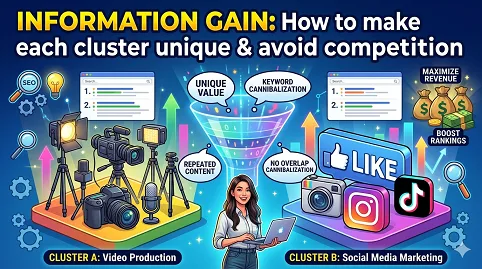

Information Gain: How to Make Each Cluster Unique So They Don't Compete With Each Other
The most frustrating failure mode in a topic cluster strategy is watching your own pages compete against each other in search results. You invested weeks mapping keywords, applied the internal linking math for optimal link ratios, and built what should be a cohesive ecosystem. Yet two cluster posts targeting similar queries cannibalize each other, splitting authority and depressing both rankings. The root cause is almost always a failure of information gain. Each cluster post must contribute unique information that no other page on your site, or ideally on the web, already provides. When every cluster post earns its existence through original insight, proprietary data, or a genuinely distinct angle, cannibalization disappears and aggregate rankings rise. This guide teaches you how to engineer information gain into every cluster post you publish.
What Information Gain Means for Topic Clusters
Information gain is a concept borrowed from machine learning that has become increasingly relevant to modern SEO. In the context of search, information gain measures how much new, unique information a page contributes beyond what the user has already seen. Search engines, particularly Google, have developed sophisticated ways to evaluate whether a page adds something new or merely rephrases what already exists across the web. For topic clusters, information gain operates at two levels. First, each cluster post must provide information gain relative to the rest of the internet, offering something that no competing page on the same topic provides. Second, and critically for cluster architecture, each cluster post must provide information gain relative to the other pages in your cluster. When two cluster posts cover substantially the same ground from substantially the same angle, one of them has zero information gain and will be treated as duplicate or near-duplicate content by search engines.
The traditional approach to content creation treats information as a commodity to be rewritten. A writer researches a topic by reading the top three search results, synthesizes what they learned, and produces a new article that says the same things in different words. This approach worked adequately when search engines evaluated pages primarily on keyword usage and backlink counts. It fails in 2026, when search engines can identify original research, unique perspectives, and genuinely new contributions to a topic. For your topic cluster to work as a system rather than a collection of competing pages, every cluster post must be conceived from the start as a unique contribution. The question that guides cluster planning is not "what keyword should this post target" but "what does this post say that no other page on my site or the web already says."
The Five Sources of Information Gain for Cluster Posts
Information gain does not require that every cluster post be a work of original academic research. It requires that each post draws from at least one source of uniqueness that differentiates it from other content on the same topic. There are five reliable sources of information gain that cluster posts can draw from, and the most powerful cluster posts combine two or more.
Original data and research is the strongest source of information gain. When you conduct a survey, run an experiment, analyze a dataset, or compile statistics that do not exist elsewhere, you create content that no competitor can replicate without citing you. A cluster post on "email subject line open rates by industry" that includes original survey data from 500 marketers provides information gain that a post summarizing publicly available benchmark reports cannot match. Original data earns backlinks naturally, establishes your domain as a primary source, and differentiates your cluster post from every competitor covering the same topic with secondhand statistics.
Unique perspective and experience is the most accessible source of information gain for most content teams. Your company, your clients, and your practitioners have experiences that no one else has. A cluster post on "implementing a CRM migration for a 50-person sales team" that draws on your team's actual migration experience, including the specific problems encountered and the solutions developed, provides information gain that a generic CRM migration guide cannot. The post should include details that only come from having done the work: the unexpected data cleaning issues that emerged, the specific sequence of steps that proved most effective, the mistakes that cost time and how to avoid them. This experiential knowledge cannot be researched from competitors because it does not exist in the public record until you publish it.
Depth and specificity beyond the SERP standard provides information gain even when the topic has been widely covered. Most search results for a given query are relatively shallow, covering the obvious points and stopping where the research gets difficult. A cluster post that goes significantly deeper, addressing edge cases, documenting exceptions, or exploring nuances that competitors gloss over, provides information gain through thoroughness. A post on "how to calibrate an espresso grinder" that includes step-by-step instructions for ten specific grinder models, with photographs of each adjustment mechanism, provides genuine information gain over a post that offers generic calibration advice applicable to any grinder.
A distinct structural or pedagogical approach differentiates your content through how the information is organized and taught. If every competitor explains a concept through prose paragraphs, your cluster post might use decision trees, flowcharts, comparison tables, or interactive elements that make the information more accessible. If every competitor organizes their content chronologically, your post might organize it by user goal, skill level, or common problem scenario. The underlying information may overlap with existing resources, but the structural approach makes it newly useful, which search engines can detect through user engagement signals like time on page, scroll depth, and return visits.
Integration and synthesis across sources provides information gain by connecting ideas that are typically siloed. A cluster post that synthesizes insights from academic research, practitioner interviews, product documentation, and community discussions creates a resource more comprehensive than any single source. The value is in the synthesis, the identification of patterns and contradictions across sources that no individual source articulates. This is genuinely new information, created by the act of connecting what was previously disconnected.
Auditing Your Cluster for Information Gain Gaps
Before publishing new cluster posts, audit your existing cluster content for information gain gaps. For each cluster post, identify its primary source of information gain. If a post draws only from publicly available information that competitors already cover, and does so at a comparable depth with no unique perspective or structure, flag it as a weak post. These weak posts are the ones most likely to cannibalize other cluster content or fail to rank entirely because they offer search engines no reason to choose them over existing results.
The audit should also examine pairs of cluster posts that target similar or adjacent keywords. For each pair, articulate in one sentence what makes Post A different from Post B. If you cannot articulate a clear, meaningful difference, the posts are at risk of cannibalization. The fix is either to consolidate them into a single, stronger post that combines the information gain of both, or to re-angle one of the posts so that it draws on a different source of uniqueness. Consolidation is often the right answer for thin posts that were created to target keyword variations rather than to serve genuinely distinct user intents. Re-angling is the right answer when both posts have substantive content but lack clear differentiation.
Information Gain in Practice: A Before-and-After Example
Consider a topic cluster for a financial planning website. The cluster includes three posts targeting similar long-tail keywords: "how to save for retirement in your 30s," "retirement savings strategies for millennials," and "best retirement accounts for young professionals." Auditing these posts reveals that all three cover substantially the same ground: the importance of starting early, the power of compound interest, an overview of 401(k)s and IRAs, and generic advice about contribution rates. The posts use different words and target slightly different keyword phrases, but they offer nearly identical information. They are cannibalizing each other because no post provides meaningful information gain over the others.
The information gain fix restructures these three posts around distinct sources of uniqueness. "How to save for retirement in your 30s" becomes a post built around original survey data, perhaps a survey of 500 people in their 40s and 50s about what they wish they had done differently in their 30s. The post presents proprietary data and actionable lessons drawn from that data. "Retirement savings strategies for millennials" becomes a post built around unique perspective, drawing on interviews with five financial planners who specialize in millennial clients and share the specific strategies they have seen work best for this demographic. The post synthesizes practitioner experience that exists nowhere else. "Best retirement accounts for young professionals" becomes a post built around depth and specificity, providing an exhaustive comparison of every retirement account type available to young professionals, including fee structures, investment options, withdrawal rules, and optimal usage scenarios with concrete numerical examples. Each post now has clear, articulable information gain. Search engines can see that each contributes something unique. Cannibalization resolves because the posts are no longer competing to be the best answer to the same question; they are each the best answer to a genuinely distinct aspect of the broader topic.
Building Information Gain Into Your Content Planning Process
Information gain cannot be added in the editing phase. It must be designed into the content from the planning stage. For each cluster post in your content map, add a field to your planning document that specifies the primary source of information gain. This field forces content planners and writers to articulate what makes the post unique before writing begins. If the field is empty or filled with something vague like "comprehensive coverage," the post concept needs more work before it proceeds to production.
The information gain field should also specify what the post will not cover. Defining the boundaries of a cluster post is as important as defining its content. When every post in a cluster has clear boundaries, the risk of unintentional overlap decreases dramatically. A post on "how to calibrate an espresso grinder" might explicitly note that it does not cover grinder selection, cleaning, or maintenance, because those topics have their own dedicated cluster posts. These boundary statements can be included in the post's introduction, signaling to both readers and search engines that the post is deliberately focused and part of a larger structured resource.
Information gain is the quality control mechanism that keeps a topic cluster healthy as it scales. When you have ten cluster posts, overlap is manageable. When you have fifty or a hundred, the probability of accidental duplication increases dramatically unless information gain is a deliberate part of the planning process. Every cluster post must earn its place in the ecosystem by contributing something unique. When they all do, your cluster becomes more than the sum of its parts, and each page strengthens every other instead of competing with it.
Comments
No comments yet. Start the conversation.