
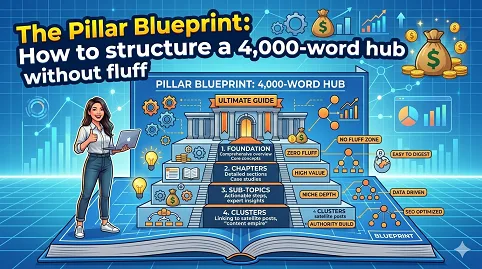

The Pillar Blueprint: How to Structure a 4,000-Word Hub Without Fluff
Your topic cluster strategy lives or dies on the quality of your pillar page. After completing thorough keyword research to find your seed topic and long-tail spokes, you face the critical transition from planning to production. A 4,000-word pillar page sounds intimidating, and the temptation to pad it with fluff is real. But a fluff-filled pillar fails. It bores readers, signals low quality to search engines, and wastes the authority your cluster posts work hard to send its way. This blueprint provides the exact structural framework for writing a pillar page that earns every one of its four thousand words through substance, not filler. You will learn the chapter-by-chapter architecture, the writing techniques that eliminate padding, and the structural decisions that turn a long article into an authoritative hub.
Why Most Long-Form Content Fails the Pillar Test
The internet is full of long articles that say very little. These pieces stretch a 1,200-word idea into 4,000 words through repetition, unnecessary anecdotes, overwrought introductions, and paragraphs that circle the point without ever landing on it. They were written to hit a word count, not to serve a reader. When this approach is applied to a pillar page, the results are catastrophic. A pillar page is not just any long article. It is the central hub of a topic cluster, the page that every cluster post links up to, the resource that search engines evaluate to determine whether your entire cluster deserves authority. A fluff-filled pillar signals that your expertise is shallow. A dense, structured, genuinely valuable pillar signals that you are the definitive source. The difference between these two outcomes is determined by structure, not just writing quality. A strong blueprint produces strong pillars. A vague brief produces wordy pages that rank nowhere.
The core problem is that most writers approach a pillar page as they would approach a blog post, just longer. They start writing at the beginning and continue until they hit the word count, allowing the content to meander wherever it naturally goes. A pillar page requires the opposite approach. You must design the structure first, allocating word count to each section based on its importance, ensuring every chapter earns its place, and building the internal linking framework before you write the first sentence of prose. This architectural discipline is what separates a pillar page that dominates search results from one that merely exists on your site.
The Pillar Page Architecture: A Chapter-by-Chapter Blueprint
A 4,000-word pillar page should be organized into clearly defined chapters, each serving a distinct purpose in the reader's journey and the page's SEO function. The following blueprint allocates approximate word counts to each section, providing a framework you can adapt to your specific topic while maintaining the structural integrity that makes pillars rank.
Chapter 1: The Definitive Opening (300-400 words). Your introduction must accomplish three things within the first hundred words: define the topic clearly, establish why it matters, and signal what the reader will gain by continuing. Do not open with a vague observation about the industry or a personal anecdote about your journey. Open with a confident statement of what this page covers and who it serves. The remainder of the introduction should preview the structure of the page, orienting readers to the chapters ahead, and include the first natural internal link to a high-priority cluster post. This chapter sets expectations and filters out readers who are not your audience while compelling the right readers to continue.
Chapter 2: Foundational Knowledge (500-600 words). Before you can explore the nuances of your topic, you must establish a shared understanding of the fundamentals. This chapter defines key terms, explains core concepts, and provides the baseline knowledge a complete beginner needs to benefit from the rest of the page. This is where you answer the question what is this topic at its most essential level. Avoid the temptation to go deep here. Depth belongs in cluster posts. Your job in this chapter is to provide enough foundation that the subsequent chapters make sense, then link to a cluster post that exhaustively covers the fundamentals for readers who need more. End this chapter with a contextual internal link to your definitions or getting-started cluster content.
Chapter 3: The Core Framework (600-700 words). This is the heart of your pillar page. Here you present your unique framework, methodology, or perspective on the topic. If your pillar covers email marketing, this chapter might present your five-step email campaign framework. If it covers personal finance, this might be your philosophy on the order of financial priorities. This chapter differentiates your pillar from competitors who cover the same topic. It demonstrates original thinking and genuine expertise. It gives readers a mental model they can apply immediately. The framework should be your own, backed by your experience and perspective. It should be specific enough to be actionable but broad enough that each step or component can link to a dedicated cluster post for readers who need implementation detail.
Chapter 4: Practical Application (500-600 words). Theory without application frustrates readers. This chapter translates the framework from Chapter 3 into concrete steps, examples, or case studies. Show the framework in action. Walk through a real or hypothetical scenario where applying the framework produces a better outcome than the common approach. Use specific numbers, timelines, and results where possible. This chapter proves that your framework works, building the trust that keeps readers on your site and motivates them to explore your cluster content. End this chapter with links to cluster posts that provide step-by-step tutorials, templates, or tools related to the application.
Chapter 5: Common Mistakes and How to Avoid Them (400-500 words). Every topic has pitfalls that beginners and even intermediates fall into. Documenting these mistakes serves multiple purposes. It demonstrates that your expertise includes knowing what can go wrong, not just what should go right. It provides immediately useful guidance that readers appreciate. And it creates natural opportunities to link to cluster posts that address each mistake in greater depth, with detailed correction strategies. Present each mistake clearly, explain why it happens and the consequences, and provide the concise fix. The exhaustive explanation of each fix lives on the linked cluster page.
Chapter 6: Tools, Resources, and Next Steps (300-400 words). Your pillar page should not end abruptly. This chapter provides readers with a curated pathway forward. Summarize the key tools, resources, or further reading that will help them continue their learning journey. Every recommendation should include a link to a relevant cluster post on your site or, where appropriate, to an external authoritative resource. Provide clear next-step guidance: if the reader absorbed the pillar, what should they read first among your cluster content, and why. This chapter transitions the reader from passive consumption to active engagement with your broader content ecosystem.
Chapter 7: FAQ Integration (300-400 words). Rather than appending a long FAQ section at the bottom of the page, integrate the most important frequently asked questions into the relevant chapters throughout the pillar. This chapter serves as a catch-all for questions that did not fit naturally elsewhere. Present each question concisely, answer it directly, and link to the cluster post that provides the complete answer. This FAQ integration serves both user experience and SEO by naturally incorporating long-tail question keywords into your pillar content and providing additional internal linking opportunities.
Writing Techniques That Eliminate Fluff
A solid structure provides the skeleton. The writing itself must put meat on the bones without adding empty calories. The most effective technique for fluff-free pillar writing is to write each chapter as a standalone mini-article with a clear point, then edit ruthlessly. After drafting a chapter, ask yourself: if a reader only read this chapter and nothing else on the page, would they learn something valuable? If the answer is no, the chapter needs strengthening or cutting. Every paragraph should either introduce a new idea, support an idea with evidence or examples, or transition logically between ideas. Paragraphs that do none of these things are fluff and must be cut regardless of how elegantly they are written.
Another powerful technique is the reverse outline. After completing your first draft, outline the page again from the finished text, noting the main point of each paragraph. Review this outline for redundancy. If two paragraphs make the same point, combine them or cut one. If a paragraph's point is unclear, rewrite it for clarity or remove it. The reverse outline reveals structural weaknesses that are invisible when reading linearly. It also highlights where you have over-allocated words to minor points and under-allocated to major ones, allowing you to rebalance before publishing.
Use concrete language over abstract language. A sentence like "effective email marketing requires strategic consideration of multiple factors to optimize performance outcomes" says nothing. A sentence like "write subject lines under 40 characters that include a specific benefit, because mobile inboxes truncate at that length and benefits drive opens" says something. Abstract language is the primary hiding place of fluff. Hunt it down in your editing pass and replace every instance with specific, actionable, verifiable statements. This practice alone will cut hundreds of wasted words from a 4,000-word draft while simultaneously making the content more valuable to readers.
The Internal Linking Framework Within the Pillar
A pillar page is not complete until its internal linking structure is fully implemented. The links are not decorative additions after the writing is done; they are integral to the page's function as a hub. Each chapter should conclude with at least one contextual link to a relevant cluster post. The anchor text for these links should naturally include the target keyword of the linked page, not generic phrases like click here or learn more. The link should flow from the content, appearing where a reader who wants deeper information on that specific subtopic would naturally want to click.
Beyond chapter-concluding links, incorporate mid-paragraph links where a concept is mentioned that has a dedicated cluster page. If your pillar mentions "A/B testing subject lines" in passing, and you have a cluster post on exactly that topic, link those words. These contextual mid-paragraph links are often the highest-performing internal links because they appear exactly where reader interest in the subtopic peaks. Do not over-link. A pillar page with a link in every sentence is unreadable and looks manipulative. Aim for one to three internal links per chapter, concentrated where they provide genuine user value.
Your pillar page should also include a main navigation element, typically positioned after the introduction or at the end of Chapter 2, that lists the major sections of the page with anchor links. This table of contents serves two purposes. For users, it allows quick navigation to the section most relevant to their immediate need. For search engines, it can generate sitelinks in search results, expanding your SERP real estate and click-through rate. The table of contents should use descriptive anchor text that reinforces the topic structure, not clever or cryptic labels.
Formatting for Readability and Engagement
A 4,000-word wall of text is unreadable regardless of its quality. Formatting is not separate from content quality; it is part of it. Use descriptive subheadings that tell a skimming reader exactly what each section contains. A reader should be able to understand the page's argument and find the section relevant to their need by reading nothing but the subheadings. Keep paragraphs short, typically three to five sentences. Long paragraphs signal difficulty and cause readers to bounce before they begin. Use bulleted and numbered lists for information that benefits from scannability, such as steps, components, or comparisons. Use bold text sparingly to highlight key takeaways that a skimming reader should not miss. Use images, charts, and diagrams where they genuinely add information, not as decorative filler.
The goal of all formatting is to respect the reader's time and reading mode. Most readers of long-form online content are not reading linearly. They are scanning, looking for the section that answers their specific question. Your formatting should make that scanning efficient. If your page is well-formatted, a reader who only spends ninety seconds on the page can still extract value and may bookmark the page for deeper reading later. If your formatting is poor, that same reader leaves with nothing and associates your brand with a frustrating user experience.
Testing Your Pillar Structure Before Full Production
Before you invest the full effort of writing and polishing a 4,000-word pillar, test your structure with a detailed outline shared with stakeholders or trusted readers. The outline should include every chapter heading, the main points each chapter will cover, and the internal links planned for each chapter. Ask reviewers two questions. First, is there anything missing that a comprehensive resource on this topic must include? Second, is there anything in the outline that feels like padding or that could be cut without losing value? This feedback, gathered before the writing begins, prevents the painful process of restructuring a completed draft.
You can also test your structure against the current top-ranking pages for your seed keyword. Open the top three results and compare their structure to your outline. What do they cover that you missed? What do you cover that they missed? The goal is not to copy their structure but to ensure yours is more comprehensive and better organized. The gaps you identify become your competitive advantage. The sections they cover that you planned to omit need either incorporation into your pillar or a clear rationale for why a cluster post is the better home for that subtopic.
A well-structured pillar page is the difference between a topic cluster that dominates and one that disappoints. With this blueprint, you have the architectural plan. The next phase of the strategy shifts from building the hub to building the spokes, with a specific focus on the logistical decisions about content velocity, team resources, and publication sequencing that determine whether your cluster actually gets built.
Comments
No comments yet. Start the conversation.