

Introduction
Building a personal brand is one of the most important steps for any creative who wants to stand out, attract opportunities, and grow professionally. Whether you are a designer, content creator, photographer, writer, illustrator, video editor, blogger, or freelancer, your personal brand is how people recognise your work, understand your value, and decide whether to trust you.
Many creatives focus only on creating beautiful work, but in today’s digital world, creativity alone is not always enough. You also need to understand how people respond to your work. This is where data becomes useful.
Data helps creatives move from guessing to making informed decisions. Instead of posting content randomly or assuming what people like, you can use data to understand your audience, measure your growth, improve your content strategy, and position yourself more professionally.
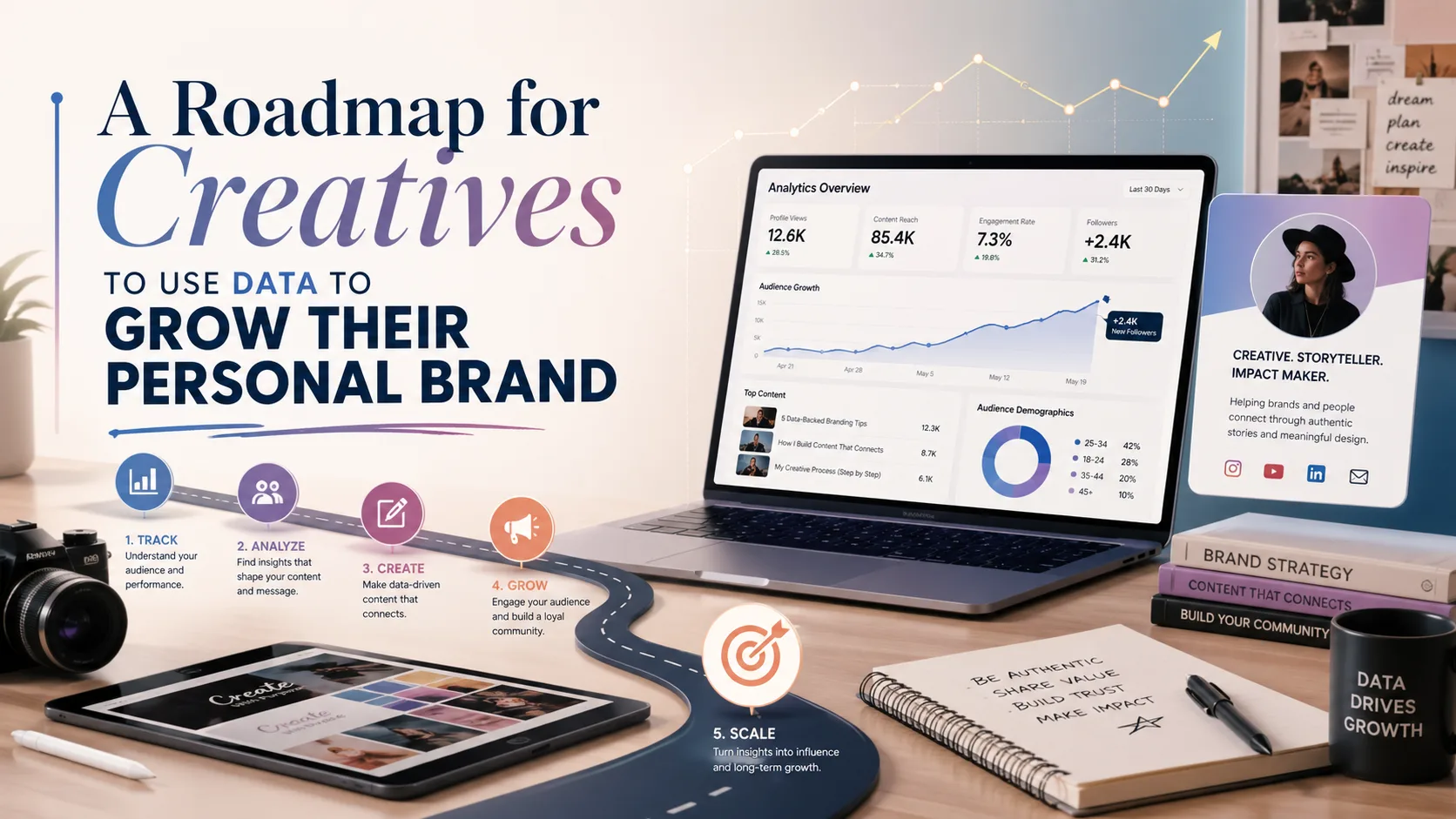
Using data to grow your personal brand does not mean becoming too technical. It means paying attention to the right information and using it to make better creative decisions. This roadmap will guide you step by step on how creatives can use data to build a stronger personal brand.
What Is a Personal Brand?
A personal brand is the way people see, remember, and describe you based on your work, message, values, and online presence. It is not just about having a logo, a nice profile picture, or a beautiful portfolio. It is about the identity and reputation you build over time.
For example, when people think of you, what comes to their mind? Do they see you as a designer who understands branding? A data analyst who helps creatives grow? A content creator who teaches useful skills? A freelancer who solves business problems?
Your personal brand answers important questions such as:
- What do you do?
- Who do you help?
- What value do you provide?
- What makes your work different?
- Why should people trust you?
- What problem can you solve?
For creatives, a strong personal brand can help attract clients, followers, collaborations, job opportunities, and recognition. However, building a strong brand requires more than posting regularly. You need to know whether your message is reaching the right people and whether your content is producing results.
Why Data Matters in Personal Branding
Data helps you understand how your audience interacts with your brand. It shows what people like, what they ignore, what they share, what they save, and what makes them take action.
Without data, personal branding becomes guesswork. You may keep creating content without knowing whether it is helping you grow. You may focus on the wrong platform, post the wrong type of content, or ignore topics your audience actually cares about.
With data, you can answer questions like:
- Which content gets the most engagement?
- Which platform brings the most attention?
- What topics does my audience care about?
- What type of content brings profile visits?
- Which posts attract followers or clients?
- Is my personal brand growing over time?
- What should I improve next?
Data gives direction. It helps you build your brand with purpose instead of relying only on assumptions.
Step 1: Define Your Personal Brand Goal
Before using data, you need to know what you want your personal brand to achieve. A personal brand without a clear goal can become confusing because you may not know what to track or improve.
Your goal may be to:
- Attract freelance clients
- Grow your audience
- Build authority in your niche
- Increase blog traffic
- Get job opportunities
- Sell digital products
- Promote your creative services
- Become known for a specific skill
- Build trust around your expertise
For example, if your goal is to attract clients, you should track metrics like profile visits, direct messages, portfolio clicks, website visits, and client inquiries. If your goal is to grow your audience, you should track reach, followers gained, engagement rate, shares, and saves.
A clear goal helps you focus on the right data.
Step 2: Identify Your Target Audience
Your personal brand is not for everyone. You need to know the kind of people you want to reach. Your target audience may include business owners, beginner creatives, brands, content creators, designers, students, freelancers, or potential employers.
As a creative in the niche of data analysis for creatives, your target audience may include:
- Designers who want to understand data
- Content creators who want to track performance
- Freelancers who want to attract better clients
- Bloggers who want to grow with analytics
- Small business owners who need data insights
- Creative beginners who want simple data skills
When you know your audience, you can create content that speaks directly to their needs. Data can also help you understand your audience better through social media analytics, website analytics, comments, and feedback.
Step 3: Choose the Right Platforms to Track
Not every platform will work the same way for your personal brand. Some creatives perform better on Instagram because their work is visual. Others grow faster on LinkedIn because their content is professional. Some may get traffic from blogs, Pinterest, YouTube, TikTok, or X.
To grow your personal brand with data, you need to know which platforms are helping you most.
You can track platforms such as:
- TikTok
- YouTube
- X
- Personal blog
- Portfolio website
- Newsletter
For each platform, pay attention to what kind of results it gives. Instagram may bring visibility, LinkedIn may bring professional connections, and your blog may help build long-term authority.
Do not judge a platform only by likes. A platform with fewer likes may still bring better clients, website visits, or business opportunities.
Step 4: Track the Right Personal Brand Metrics
Metrics are numbers that help you measure your progress. To grow your personal brand, you should track metrics that connect directly to your goals.
1. Reach
Reach shows how many people saw your content. It helps you understand how visible your brand is. If your reach is increasing, more people are discovering your work.
2. Engagement
Engagement includes likes, comments, shares, saves, replies, and clicks. It shows how people interact with your content. High engagement usually means your content is interesting, useful, or relatable to your audience.
3. Engagement Rate
Engagement rate helps you compare performance more fairly. It shows the percentage of people who interacted with your content compared to the number of people who saw it.
Engagement Rate = Total Engagement ÷ Reach × 100
4. Followers Gained
Followers gained shows how many new people followed you after seeing your content. This metric helps you understand which posts attract new audience members.
5. Profile Visits
Profile visits show how many people visited your profile after seeing your content. This is important because it means your content made people curious enough to learn more about you.
6. Website or Portfolio Clicks
If you have a blog, portfolio, or website, track how many people click your link. This metric is very useful for creatives who want clients, readers, or business opportunities.
7. Direct Messages or Inquiries
Direct messages, emails, and inquiries show that people are interested in connecting with you. For freelancers, this is one of the most important personal brand metrics because it can lead to paid work.
8. Saves and Shares
Saves show that people want to return to your content later. Shares show that people find your content valuable enough to recommend to others. For educational content, saves and shares are often more meaningful than likes.
Step 5: Create a Simple Personal Brand Tracker
To use data effectively, you need a place to record your results. Excel or Google Sheets is perfect for this.
Create a simple tracker with columns such as:
- Date posted
- Platform
- Content topic
- Content type
- Reach
- Likes
- Comments
- Shares
- Saves
- Clicks
- Followers gained
- Profile visits
- Inquiries
- Total engagement
- Engagement rate
- Notes
This tracker helps you see your personal brand performance clearly. After one month, you may discover that your educational posts get more saves, your personal stories get more comments, and your Excel tutorials bring more profile visits.
This kind of insight can guide your next content plan.
Step 6: Study Your Best-Performing Content
Your best-performing content shows what your audience values most. Review your top posts every week or month and ask yourself why they worked.
Ask questions like:
- What was the topic?
- What problem did it solve?
- What format did I use?
- Was the title clear?
- Did it include a practical example?
- Did it tell a story?
- Did it give value quickly?
- Did it include a strong call-to-action?
For example, if a post titled “How Creatives Can Track Their Content Performance Using Excel” performs well, it may show that your audience wants practical, tool-based content.
Your best content gives you clues about what to create more often.
Step 7: Find Your Content Patterns
One successful post is useful, but repeated patterns are more powerful. Look at your data over time and identify what keeps working.
For example, you may notice that:
- Tutorial posts get more saves
- Storytelling posts get more comments
- Excel-related posts get more clicks
- Personal branding posts get more shares
- LinkedIn posts bring more professional inquiries
- Instagram posts bring more visibility
- Blog posts build long-term traffic
These patterns help you understand your brand direction. Instead of creating randomly, you can create content based on what your audience has already shown interest in.
Step 8: Use Data to Improve Your Content Strategy
A content strategy is a plan for what you create, who you create it for, and how it supports your personal brand. Data helps you improve your strategy by showing what works and what does not.
For example, if your data shows that beginner-friendly guides perform better than advanced explanations, you can make your content simpler. If your audience engages more with practical examples, include more real-life examples. If your posts with clear titles perform better, improve your headline writing.
You can use data to decide:
- What topics to write about
- What content format to use
- Which platform to focus on
- What time to post
- What call-to-action works best
- What audience problems to solve
- Which services to promote
Data helps you create content with intention.
Step 9: Strengthen Your Brand Message With Insights
Your brand message is the main idea people should remember about you. Data can help you make this message clearer.
For example, if your audience responds strongly to posts about Excel, dashboards, analytics, and creative growth, your brand message could become:
I help creatives use data to track performance and grow smarter.
This message is clear because it combines your skill, audience, and value.
Data helps you avoid confusing branding. Instead of trying to talk about everything, you can focus on the topics your audience already connects with.
Step 10: Use Data to Build Trust and Authority
People trust creatives who can show results. Data helps you prove your value.
Instead of saying:
I create good content.
You can say:
I used content tracking to identify my top-performing posts and improve my engagement strategy.
Data makes your personal brand more credible because it shows that you are strategic, not just creative.
You can also use data to create case studies. A case study can show the problem, the process, the data collected, the insight discovered, the action taken, and the result achieved.
Step 11: Review Your Brand Growth Monthly
To grow your personal brand, you should review your progress regularly. A monthly review helps you understand what is improving and what needs work.
At the end of each month, check:
- Which post performed best?
- Which platform brought the best results?
- How many followers did I gain?
- How many profile visits did I get?
- How many website clicks did I receive?
- How many inquiries came in?
- What content brought the most engagement?
- What should I improve next month?
Write down three key insights from your monthly review, such as:
- My Excel posts got the most saves.
- LinkedIn brought more profile visits than Instagram.
- Posts with practical examples performed better than general advice.
These insights help you plan the next month with more clarity.
Step 12: Turn Data Into Action
Data is only useful when you act on it. Do not just collect numbers. Use the numbers to improve your brand.
- If your audience saves your tutorials, create more tutorials.
- If your LinkedIn posts bring inquiries, post more professional content there.
- If your blog posts get traffic, add stronger calls-to-action.
- If your profile visits are high but inquiries are low, improve your bio and service description.
- If your content gets reach but low engagement, improve your hooks and value.
- If people ask the same questions repeatedly, turn those questions into content.
The goal is not just to know the numbers. The goal is to make better decisions.
Step 13: Create Offers Based on Audience Data
As your personal brand grows, data can help you identify services or products your audience may need.
For example, if many people engage with your posts about Excel tracking, you could create:
- An Excel content tracker template
- A beginner guide on data analysis for creatives
- A dashboard-building service
- A one-on-one consultation service
- A mini-course on content analytics
- A blog series on practical data tools
This is how data can help you make money from your personal brand. You observe what your audience needs, then create a service or product that solves that problem.
Common Mistakes to Avoid
1. Tracking Too Many Metrics
Do not try to track everything at once. Focus on the metrics that match your brand goal.
2. Focusing Only on Likes
Likes are easy to notice, but they do not always show real value. Saves, shares, clicks, profile visits, and inquiries may be more important.
3. Changing Strategy Too Quickly
Do not change your whole strategy because one post performed badly. Look for patterns over time.
4. Copying Other Creatives Blindly
What works for another creative may not work for your audience. Use your own data to guide your decisions.
5. Ignoring Your Brand Identity
Data should guide your creativity, not replace your originality. Your voice, values, and style still matter.
6. Not Taking Action
Collecting data without using it is a waste of time. Every insight should help you improve something.
A Simple 30-Day Roadmap to Grow Your Personal Brand With Data
Week 1: Define and Prepare
Define your personal brand goal. Decide who your audience is and what you want to be known for. Choose the platforms you want to track. Create a simple Excel or Google Sheets tracker.
Week 2: Start Tracking Your Content
Record your content performance. Track reach, engagement, saves, shares, clicks, followers gained, and profile visits. Add notes about what you posted and how the audience responded.
Week 3: Analyze and Find Patterns
Review your best-performing content. Identify the topics, formats, and platforms that are working. Look for patterns in your data and write down your main insights.
Week 4: Improve and Take Action
Use your insights to plan better content. Improve your profile, bio, content topics, posting style, and call-to-action. Create more of what works and reduce what does not support your goals.
By the end of 30 days, you will have a clearer understanding of how your personal brand is performing and what steps you should take next.
Conclusion
Growing a personal brand as a creative requires more than talent and consistency. You also need clarity, direction, and strategy. Data gives you that clarity. It helps you understand your audience, track your growth, improve your content, and make better decisions.
By following this roadmap, creatives can use data to build a stronger, more professional personal brand. Start by defining your goals, tracking the right metrics, studying your best content, identifying patterns, and taking action based on insights.
Data does not remove creativity. It strengthens it. When you combine creativity with data, you create with more purpose, communicate with more confidence, and grow your personal brand more intentionally.
Comments
No comments yet. Start the conversation.