
Introduction
Creativity is one of the most powerful tools in today’s digital world. It helps people communicate ideas, tell stories, design experiences, build brands, and create value. Whether you are a designer, blogger, content creator, photographer, writer, video editor, illustrator, digital marketer, or freelancer, creativity gives your work personality and originality.
However, creativity becomes even more effective when it is supported by data. Many creatives rely only on talent, passion, and intuition. While these are important, they are not always enough to grow consistently. A creative may produce beautiful work but still struggle to understand what the audience wants. A blogger may write several posts but not know which topics bring the most readers. A designer may build a portfolio but not know which projects attract clients. A freelancer may offer many services but not know which one brings the best income.
This is where data becomes valuable. Data helps creatives understand what is working, what needs improvement, and where new opportunities exist. It turns guesswork into direction and helps creative professionals make smarter decisions.
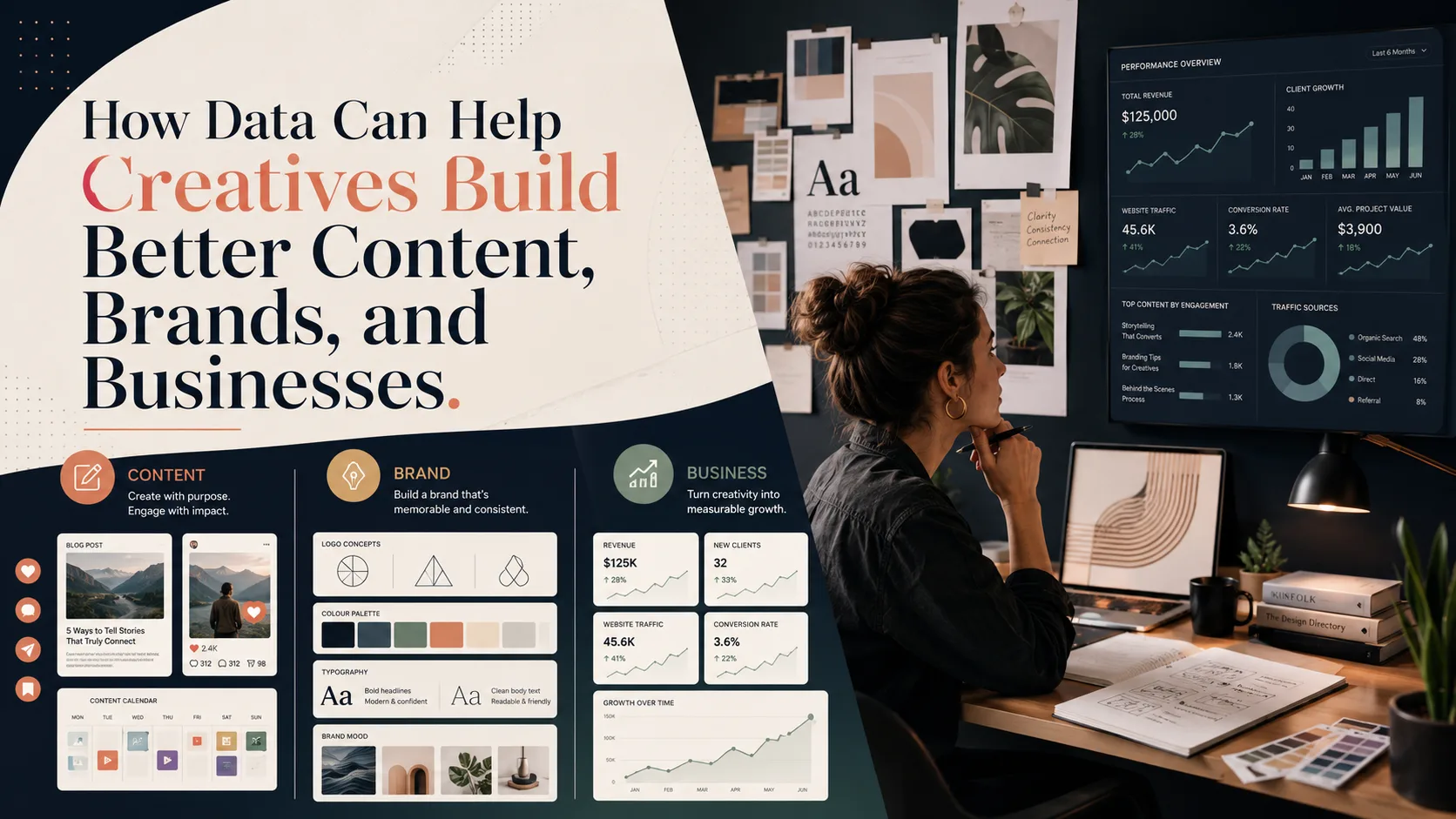
Data does not replace creativity. Instead, it strengthens creativity. It helps creatives build better content, stronger brands, and more successful businesses by showing them how people respond to their work.
What Data Means for Creatives
Data is simply information that can be collected, measured, and studied. For creatives, data does not have to be complex. It can come from everyday activities such as posting on social media, publishing blog articles, receiving client messages, tracking website visits, or recording business income.
Examples of data creatives can use include:
- Social media views, likes, comments, shares, and saves
- Website visits and blog page views
- Portfolio clicks and contact page visits
- Client inquiries and project requests
- Email newsletter opens and clicks
- Content topics that perform best
- Audience location, interests, and behaviour
- Income, expenses, and profit
- Service demand and customer feedback
When creatives understand this information, they can make better decisions. Instead of asking, “What should I create next?” they can look at what their audience already responds to. Instead of wondering, “Which service should I promote?” they can check which service brings the most inquiries or income.
Data helps creatives see the real story behind their work.
Why Data Matters in Creative Growth
Creative growth is not only about creating more. It is about creating better, reaching the right audience, and making decisions that support your goals. Data matters because it helps you understand the difference between activity and progress.
For example, posting every day does not automatically mean your content is helping your brand grow. Having many followers does not always mean you are attracting clients. Getting many likes does not always mean people are taking action. A blog post with fewer views may still be valuable if it brings serious readers or inquiries.
Data helps you measure what really matters. It shows whether your effort is producing results.
Data can help creatives:
- Understand their audience more clearly
- Create content that solves real problems
- Improve personal branding
- Choose the right platforms
- Track business growth
- Improve offers and services
- Make better pricing decisions
- Reduce wasted effort
- Grow with more confidence and direction
When creatives use data properly, they stop working blindly. They begin to create, improve, and grow with intention.
How Data Helps Creatives Build Better Content
Content is one of the most important ways creatives communicate with their audience. Content can include blog posts, social media posts, videos, newsletters, tutorials, case studies, portfolio updates, podcasts, and visual designs.
Good content should not only look attractive. It should also connect with the audience, provide value, and support a clear goal. Data helps creatives understand whether their content is doing that.
1. Data Helps You Know What Your Audience Likes
Every audience has preferences. Some audiences prefer tutorials. Some prefer behind-the-scenes content. Some enjoy personal stories. Others want practical guides, examples, case studies, or quick tips.
By tracking content performance, creatives can identify what their audience enjoys most. For example, if your posts about Excel for creatives get more saves and shares, it may mean your audience wants practical tool-based content. If your design process posts get more comments, it may mean people enjoy learning how you think and create.
This helps you create more content that your audience actually values.
2. Data Helps You Choose Better Topics
Many creatives struggle with topic ideas. They may ask, “What should I post?” or “What should I write about next?” Data can answer this question.
Look at your best-performing posts, most-read blog articles, repeated audience questions, and most-clicked links. These can reveal topics your audience cares about.
For example, if your audience responds well to posts about personal branding, content performance, and Excel dashboards, those topics can become future blog posts, videos, carousels, or digital products.
3. Data Helps You Improve Content Format
Content format matters. A topic may perform differently depending on how it is presented. A design tip may work better as a carousel than as a text post. A tutorial may perform better as a video than as a single image. A detailed explanation may work better as a blog post than as a short caption.
Data helps you compare formats such as:
- Blog posts
- Carousels
- Short videos
- Infographics
- Newsletters
- Case studies
- Portfolio posts
- Behind-the-scenes content
When you understand which format performs best, you can present your ideas more effectively.
4. Data Helps You Improve Headlines and Hooks
A strong headline or hook can determine whether people pay attention to your content. If people are not clicking, reading, or watching, the problem may not be the idea itself. It may be how the idea is introduced.
By comparing content performance, you can identify which titles, headlines, or opening lines attract more attention. For example, a title like “How Creatives Can Track Their Content Performance Using Excel” may perform better than a vague title like “Content Tracking Tips” because it is more specific and practical.
Data helps you understand what kind of message makes people stop, read, and respond.
5. Data Helps You Create Content with Purpose
Not every content should have the same goal. Some content is created to educate. Some is created to build trust. Some is created to attract clients. Some is created to drive traffic to a blog or website.
Data helps you know whether each content goal is being achieved. For example:
- If a post gets many saves, it may be useful educational content.
- If a post gets many shares, it may be valuable or relatable.
- If a post gets many comments, it may be starting conversation.
- If a post gets clicks, it may be encouraging action.
- If a post brings inquiries, it may be supporting your business.
This allows creatives to create content intentionally rather than randomly.
How Data Helps Creatives Build Stronger Brands
A brand is more than a logo, colour palette, or profile picture. A brand is the impression people have of you or your business. It includes your message, values, style, tone, consistency, and the value you provide.
Data helps creatives build stronger brands by showing how people respond to their message and identity.
1. Data Helps You Understand Brand Perception
Brand perception is how people see you. Do they see you as helpful? Professional? Creative? Reliable? Educational? Strategic? Affordable? Premium?
You can understand brand perception by studying comments, messages, testimonials, audience feedback, profile visits, and repeated questions. If people often ask you about Excel tracking, content analytics, or data for creatives, it may mean they are beginning to associate your brand with practical data education.
This helps you strengthen your positioning.
2. Data Helps You Clarify Your Brand Message
A strong brand message tells people what you do, who you help, and why your work matters. Data helps you know which message connects best with your audience.
For example, if your audience responds strongly to posts about using data to grow creative work, your brand message could become:
I help creatives use data to improve content, grow their brands, and make smarter decisions.
This message is clear because it connects your skill, your audience, and the value you provide.
3. Data Helps You Build Consistency
Consistency is important in branding. People should be able to recognise your message, style, and value over time. Data helps you identify the themes that your audience connects with most.
If your best-performing topics are content strategy, Excel tracking, personal branding, and audience insights, you can build your brand around those themes. This does not mean you cannot explore new ideas, but it gives your brand a clear direction.
4. Data Helps You Build Trust
People trust brands that show value and results. Data can help you prove your expertise.
For example, instead of saying, “I create content strategies,” you can say, “I help creatives track content performance and use insights to improve engagement.” This sounds more specific and credible.
You can also use data in case studies, reports, testimonials, and portfolio presentations to show how your work creates value.
5. Data Helps You Know What to Improve
A brand should grow and improve over time. Data can show weak areas. For example, if many people visit your profile but do not click your website, your bio may need improvement. If people visit your portfolio but do not contact you, your call-to-action may be unclear. If your content gets reach but low engagement, your message may need to be more relevant.
Data helps you identify these gaps and fix them.
How Data Helps Creatives Build Better Businesses
Many creatives want to turn their skills into income. They want to attract clients, sell services, build digital products, grow blogs, or create sustainable creative businesses. Data can help make this possible.
A creative business becomes stronger when decisions are based on evidence rather than guesswork.
1. Data Helps You Identify Profitable Services
Not every service brings the same value. Some services may bring many inquiries but little profit. Others may bring fewer clients but higher income. Some may take too much time and energy.
Creatives should track:
- Service name
- Number of inquiries
- Number of clients
- Revenue generated
- Time spent
- Expenses involved
- Client feedback
- Profit
This helps you know which services to promote, improve, increase in price, or remove.
2. Data Helps You Understand Client Behaviour
Client behaviour data helps you understand how people discover your services and what makes them decide to work with you.
Track where clients come from:
- Website
- Blog posts
- Referrals
- Email newsletter
- Online communities
For example, you may discover that Instagram brings many casual inquiries, while LinkedIn brings more professional clients. You may also discover that referrals bring clients who trust you faster.
This helps you focus on the marketing channels that produce real business results.
3. Data Helps You Improve Pricing
Pricing is one of the biggest challenges for creatives. Many undercharge because they do not track time, effort, expenses, and value delivered.
Data can help you price better by tracking:
- Time spent on projects
- Number of revisions
- Project complexity
- Client budget
- Expenses
- Profit per project
- Demand for the service
- Value delivered
If a project takes too much time and brings little profit, you may need to increase your price, reduce unnecessary revisions, or restructure the service.
4. Data Helps You Improve Offers
An offer is what you sell. It could be a service, package, template, consultation, course, or digital product. Data helps you understand what people are interested in.
For example, if many people ask how to track content performance using Excel, you could create:
- An Excel content tracker template
- A content dashboard-building service
- A beginner guide on data analysis for creatives
- A consultation service for content analytics
- A blog series or mini-course on Excel for creatives
Data helps you create offers based on real audience demand.
5. Data Helps You Measure Business Growth
A business should be measured regularly. This helps you know whether you are improving or repeating the same mistakes.
Important business metrics include:
- Monthly income
- Monthly expenses
- Profit
- Number of leads
- Number of clients
- Conversion rate
- Repeat clients
- Referral rate
- Website visits
- Client inquiries
When you track these numbers, you can understand your business clearly and make better decisions.
Practical Tools Creatives Can Use to Work with Data
You do not need expensive or complicated tools to start using data. Most creatives can begin with simple tools and gradually improve.
1. Excel
Excel is useful for tracking content performance, client inquiries, income, expenses, services, and business growth. It can also be used to create simple dashboards and charts.
2. Google Sheets
Google Sheets is useful for online tracking, collaboration, and simple reporting. It is especially helpful if you want to access your data from different devices.
3. Google Analytics
Google Analytics helps creatives understand blog, website, and portfolio visitors. It shows traffic sources, top pages, engagement, and visitor behaviour.
4. Social Media Analytics
Platforms like Instagram, LinkedIn, TikTok, YouTube, Facebook, and Pinterest provide analytics that show content performance and audience behaviour.
5. Canva
Canva can help creatives turn data into simple visual reports, infographics, and presentation graphics.
6. Notion
Notion can be used to organize content ideas, track goals, manage projects, and keep notes from data reviews.
How to Start Using Data as a Creative
The best way to begin is to start small. Do not try to track everything at once. Choose one area of your creative work and begin there.
Step 1: Choose One Goal
Decide what you want to improve. Your goal may be content engagement, blog traffic, client inquiries, personal brand growth, or income.
Step 2: Choose the Right Metrics
Select metrics that connect to your goal. For example, if your goal is content engagement, track likes, comments, shares, saves, reach, and engagement rate. If your goal is client growth, track inquiries, contact sources, proposals, and conversions.
Step 3: Create a Simple Tracker
Use Excel or Google Sheets to record your data. Keep it simple and easy to update.
Step 4: Review Weekly or Monthly
Look at your data regularly. Identify what worked, what did not work, and what you should improve.
Step 5: Turn Insights into Action
The most important step is action. If your data shows that tutorials perform well, create more tutorials. If your website has visitors but few inquiries, improve your call-to-action. If one service brings the highest profit, promote it more.
Common Mistakes Creatives Should Avoid
1. Focusing Only on Likes
Likes are useful, but they do not tell the full story. Saves, shares, clicks, inquiries, and conversions may show deeper value.
2. Tracking Too Many Metrics
Trying to track everything can become confusing. Start with the most important metrics connected to your goal.
3. Ignoring Audience Feedback
Comments, messages, testimonials, and repeated questions are valuable data. Do not focus only on numbers and ignore what people are saying.
4. Not Reviewing Data Regularly
Data becomes useful when it is reviewed. If you collect information but never study it, you will not gain insights.
5. Copying Other Creatives Blindly
What works for another creative may not work for you. Use your own data to understand your audience and brand.
6. Not Taking Action
Data should lead to improvement. If the numbers reveal a problem or opportunity, use that insight to make a better decision.
Conclusion
Data can help creatives build better content, stronger brands, and more successful businesses. It gives clarity, direction, and confidence. Instead of guessing what works, creatives can use data to understand their audience, improve their message, strengthen their offers, and make better decisions.
The purpose of data is not to remove creativity. The purpose is to make creativity more effective. When creatives understand what people respond to, they can create work that is not only beautiful but also useful, strategic, and impactful.
Whether you are creating content, building a personal brand, or growing a creative business, data can help you move with more intention. It helps you know what to continue, what to improve, and where to focus your energy.
Creativity gives your work identity, but data gives your work direction. When both are combined, creatives can build content that connects, brands that are trusted, and businesses that grow with confidence.