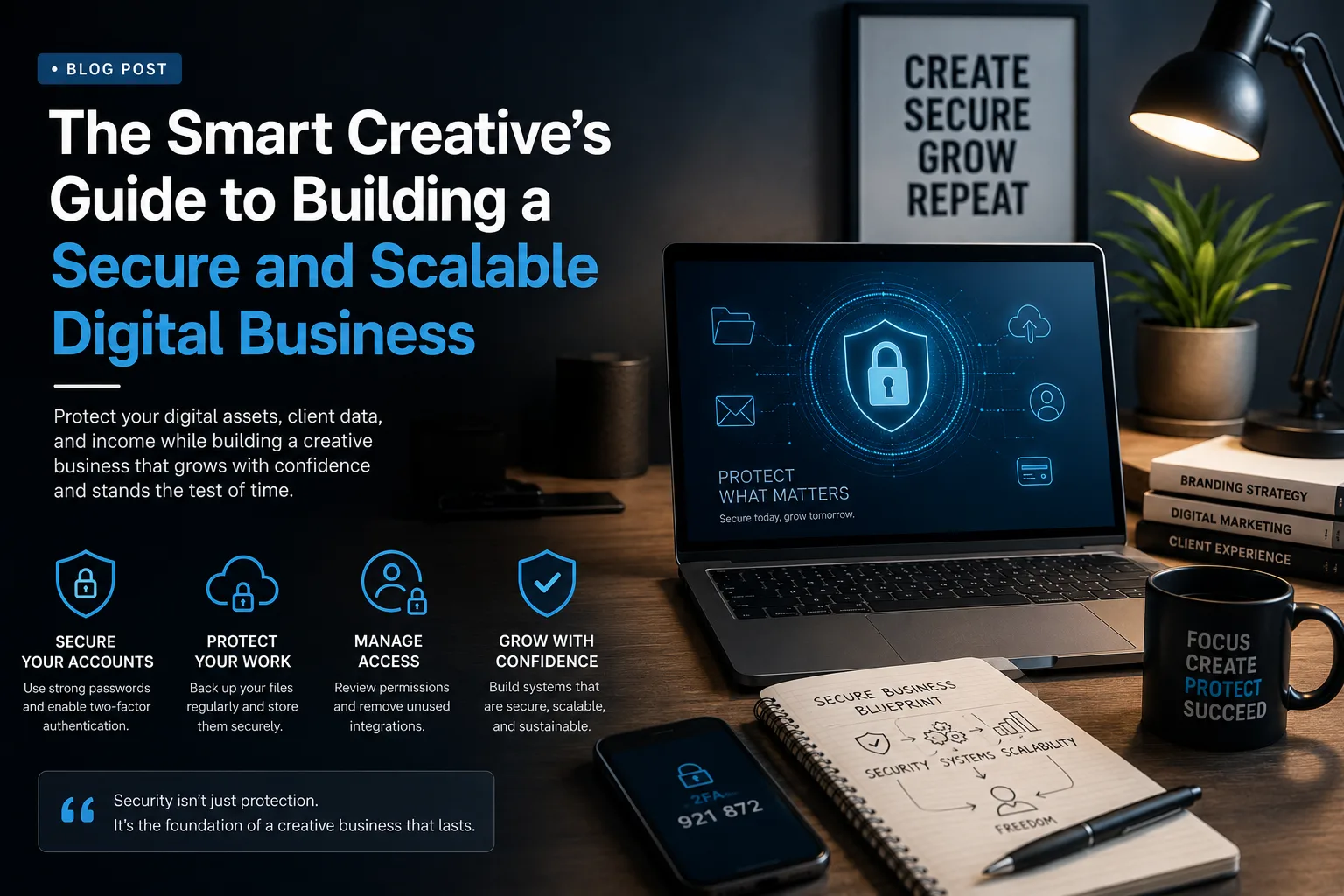

The Smart Creative’s Guide to Building a Secure and Scalable Digital Business
In today’s digital world, being a creative is no longer just about talent—it’s about systems, security, and sustainability.
You can design, write, edit, or build high-converting funnels, but if your digital foundation is weak, everything you’ve built is at risk.
The modern creative doesn’t just create—they operate like a digital business.
And every digital business needs one thing most creatives overlook: security-driven growth.
This guide will show you how to build a secure, scalable, and future-proof creative business that not only attracts clients but protects your income and reputation over time.
The New Reality: Creativity Meets Responsibility
Most creatives start with passion, not protection.
You open accounts, sign up for tools, connect platforms, and start landing clients. But behind the scenes, risks begin to stack up:
- Multiple accounts with weak or reused passwords
- Client files stored without backups
- Too many connected tools with full access
- No visibility into account activity
Everything works—until something goes wrong.
And when it does, the damage can be immediate and costly.
What Makes a Digital Creative Business Vulnerable?
Before you secure your business, you need to understand where the risks are.
1. Too Many Tools, Not Enough Control
From design platforms to funnel builders and automation tools, every connection creates a potential vulnerability.
2. No Structured Security System
Many creatives operate without:
- A password management system
- Backup routines
- Account protection strategies
This leaves everything exposed.
3. Poor Client Data Handling
Handling client information without structure can lead to:
- Data breaches
- Loss of trust
- Professional setbacks
4. Platform Dependency
If your business depends entirely on one platform (social media, email, or marketplace), you’re vulnerable to sudden loss of access.
Step 1: Secure Your Foundation First
Before scaling, protect what you already have.
Start with Your Core Accounts
Your email is your control center.
If it’s compromised, everything connected to it is at risk.
Secure it by:
- Using a strong, unique password
- Enabling Two-Factor Authentication (2FA)
- Setting up proper recovery options
Then extend this protection to:
- Social media accounts
- Payment platforms
- Domain and hosting services
Step 2: Build a Password System
Don’t rely on memory.
Create a structured system:
- Use a password manager
- Generate unique passwords for every platform
- Avoid reusing passwords
This single change dramatically reduces your exposure to attacks.
Step 3: Protect Your Work with Backups
Your work is your income.
Losing it can mean starting from scratch.
Use a simple backup strategy:
- Store files on your main device
- Sync with cloud storage
- Keep an offline backup
This ensures your work is always recoverable.
Step 4: Manage Access and Integrations
Every connected tool has permissions.
Over time, these can become risky.
Regularly:
- Remove unused apps
- Review access permissions
- Disconnect unknown integrations
A clean system is a secure system.
Step 5: Secure Your Brand Assets
Your brand is your identity.
Protect it like a business asset.
This includes:
- Social media accounts
- Website and domain
- Content and digital products
Best practices:
- Enable 2FA everywhere
- Monitor login activity
- Use professional email addresses
Step 6: Scale Without Creating Risk
Growth should not increase vulnerability.
Use Automation Carefully
Automation saves time—but can create risk if mismanaged.
Connect only trusted tools
Limit permissions where possible
Review workflows regularly
Separate Personal and Business Systems
Keep your business structured:
- Dedicated business email
- Organized file systems
- Clear tool usage
This improves both security and efficiency.
Step 7: Stay Aware and Monitor Activity
Security is not a one-time setup.
It’s an ongoing process.
Make it a habit to:
- Check login activity
- Review security alerts
- Update critical settings
Awareness is your first line of defense.
Step 8: Turn Security Into a Competitive Advantage
Most creatives ignore security.
That’s your opportunity.
When you operate securely:
- Clients trust you more
- You appear more professional
- You stand out in your niche
Security becomes part of your value—not just a background task.
Simple Security Habits That Make a Big Difference
You don’t need to be an expert—just consistent.
Daily:
- Avoid suspicious links
- Verify unknown messages
Weekly:
- Review account activity
- Check connected apps
Monthly:
- Backup your work
- Update important passwords
Build a Business That Lasts
A strong creative business is not just about visibility or income.
It’s about stability.
It’s about knowing that:
- Your work is protected
- Your accounts are secure
- Your growth is sustainable
Final Thoughts
Your creativity is valuable.
Your digital presence is powerful.
But without protection, both are vulnerable.
You don’t need complex systems—you need intentional ones.
Start small. Stay consistent. Build smart.
Because the most successful creatives aren’t just talented
They’re secure, structured, and built to last.