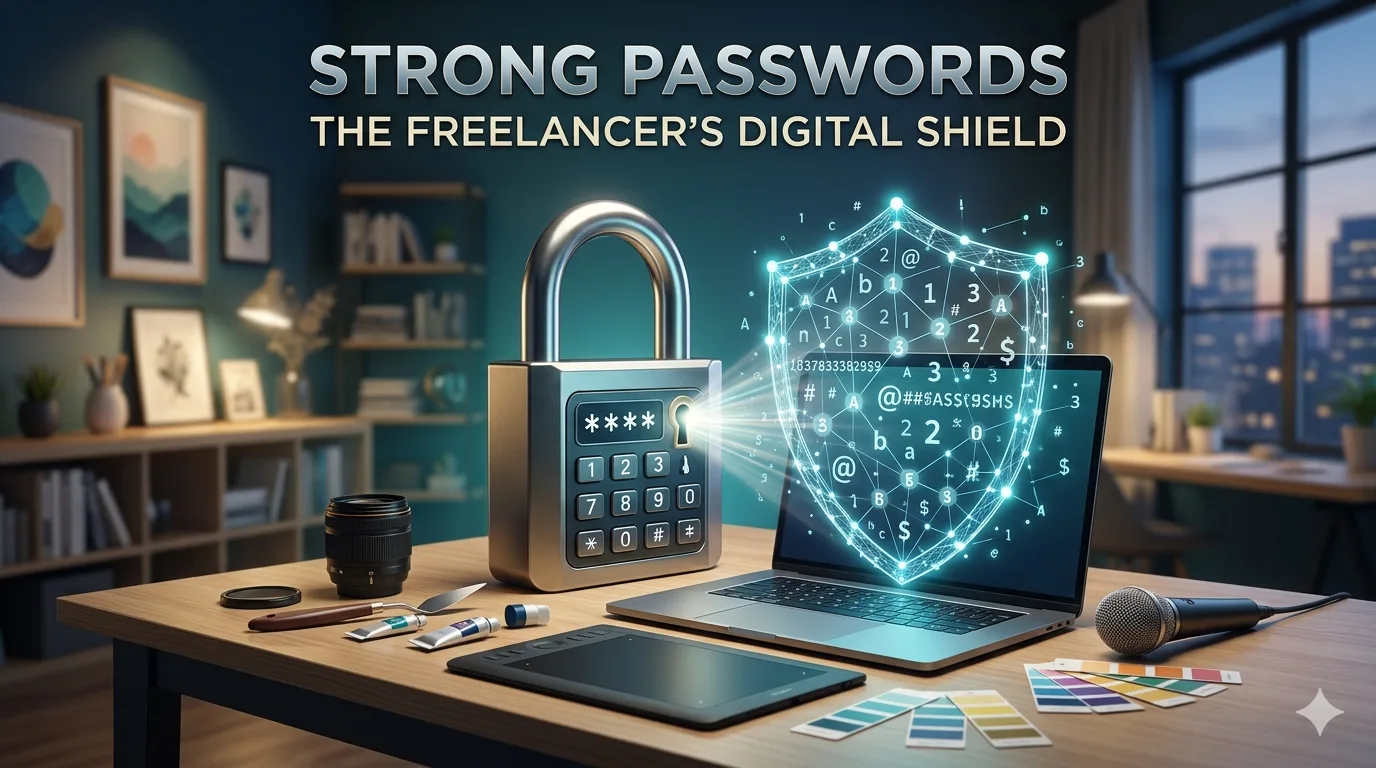
🔐 The Importance of Strong Passwords for Creatives and Freelancers
Introduction
For most creatives and freelancers, the internet is more than just a tool—it’s the foundation of their career. Your email connects you to clients, your social media builds your brand, your cloud storage holds valuable projects, and your freelance accounts help generate income.
But behind all these platforms lies one small thing protecting everything: your password.
Unfortunately, many creatives still treat passwords casually. Some reuse the same password across multiple accounts, while others rely on short and predictable combinations that are easy to remember but also easy to crack. What seems convenient today can quickly become a disaster tomorrow.
A compromised password can expose:
- Client conversations
- Personal information
- Payment details
- Creative projects
- Business accounts
- Professional reputation
And in many cases, recovering hacked accounts takes far more time and effort than preventing the attack in the first place.
That’s why strong password security is no longer optional. It is one of the most important cybersecurity habits every creative professional must develop.
In this guide, you’ll learn why password security matters, the common mistakes people make, and practical ways to better protect your digital life.
The Digital Reality Creatives Must Understand
Modern creatives operate almost entirely online.
Designers collaborate through cloud platforms. Writers communicate through email. Video editors transfer large files digitally. Freelancers manage projects and payments through online marketplaces.
Platforms like Upwork and Fiverr have created incredible opportunities for creatives to work with clients worldwide. But they have also increased digital exposure.
Cybercriminals understand that many freelancers and creators prioritize speed, convenience, and productivity over cybersecurity. Because of this, creatives have become attractive targets for attacks.
Hackers often rely on very simple weaknesses:
- Weak passwords
- Reused passwords
- Lack of two-factor authentication
- Poor account security habits
And the reality is harsh—one weak password can sometimes unlock multiple accounts at once.
Imagine using the same password for your:
- Freelance platform
- Cloud storage
If attackers gain access to one account, they will often try the same password everywhere else. This technique, known as credential stuffing, is one of the most common forms of cyberattack today.
In today’s digital environment, password security is no longer just a technical recommendation—it’s personal protection for your business and career.
The Core Cybersecurity Problem
The biggest password problem online is simple: convenience.
Most people choose passwords they can easily remember. Unfortunately, those passwords are also easy for attackers to guess.
Common weak passwords include:
- 123456
- password
- qwerty
- birthdays
- names
- phone numbers
These passwords may feel harmless, but modern hacking tools can crack them in seconds.
Many creatives also make the mistake of reusing the same password across multiple platforms. While this may seem efficient, it creates a dangerous chain reaction if one account becomes compromised.
Here’s how it usually happens:
A website experiences a data breach. Attackers steal usernames and passwords from that platform. They then test those same login details across email accounts, banking apps, and social media platforms.
If the same password is reused, the attacker suddenly gains access to multiple accounts.
The consequences can be serious:
- Stolen files
- Hacked social media accounts
- Lost client communication
- Payment fraud
- Damaged reputation
- Lost business opportunities
For freelancers and creatives, these risks directly affect income and credibility.
The scary part is that many people only start caring about password security after becoming victims.
Key Password Security Concepts Every Creative Should Know
Strong Passwords Matter
A strong password is difficult to guess and difficult for automated tools to crack.
Strong passwords usually:
- Contain 12–16+ characters
- Use uppercase and lowercase letters
- Include numbers and symbols
- Avoid personal information
The longer and more random your password becomes, the safer your account generally is.
Every Account Needs a Unique Password
Using one password everywhere is one of the biggest cybersecurity mistakes people make.
Each account should have its own password because:
- One compromised account should not affect others
- It limits the damage of breaches
- It improves overall digital security
Think of passwords like keys. You wouldn’t use one key for your house, car, office, and safe all at once.
Two-Factor Authentication (2FA)
Two-factor authentication adds another layer of protection beyond passwords.
After entering your password, you must confirm your identity using:
- A mobile app
- SMS code
- Authentication app
- Security key
This means attackers still cannot easily access your account even if they know your password.
2FA is one of the simplest and most effective cybersecurity tools available today.
Password Managers Simplify Security
Many people avoid strong passwords because they fear forgetting them.
This is where password managers become useful.
Password managers:
- Generate strong passwords
- Store passwords securely
- Automatically fill login details
- Reduce password reuse
Instead of remembering dozens of passwords, you only remember one master password.
Practical Password Security Strategies
Use Longer Passwords
Short passwords are much easier to crack.
A password with 12–16 characters is significantly stronger than one with six or eight characters.
Longer passwords increase the time and effort required for attackers to break them.
Create Passphrases Instead of Simple Words
Passphrases are easier to remember and harder to crack.
Examples:
- Coffee&Design2026!
- MyCreativeStudio#45
- SecureMyBrandToday!
These combinations improve both security and usability.
Enable 2FA Everywhere Possible
If a platform offers two-factor authentication, use it.
Especially on:
- Email accounts
- Social media
- Freelance platforms
- Banking apps
- Cloud storage services
This extra layer of security can stop many attacks instantly.
Avoid Unsafe Password Storage
Never save passwords:
- In screenshots
- On sticky notes
- In plain text files
- Inside random notes apps
Use secure password managers instead.
Change Weak or Compromised Passwords Immediately
If you suspect suspicious activity:
- Change your password immediately
- Log out of unknown devices
- Review account activity
- Enable additional security features
Fast action reduces potential damage.
Helpful Cybersecurity Tools for Password Protection
Several tools can help creatives improve password security:
- Bitwarden
- 1Password
- LastPass
- Google Authenticator
These tools simplify password management while improving security.
Common Password Mistakes Creatives Should Avoid
Many creatives unintentionally expose themselves through poor habits.
Avoid:
- Reusing passwords
- Using personal information in passwords
- Ignoring 2FA
- Sharing passwords casually
- Saving passwords insecurely
- Using very short passwords
Small mistakes create large vulnerabilities online.
Real-Life Example: How One Weak Password Can Destroy Multiple Accounts
Imagine a freelancer using the same password for:
- Freelance accounts
- Cloud storage
A small website they once signed up for gets hacked, exposing login credentials.
Attackers test the same password elsewhere.
Within hours:
- Their email gets compromised
- Their social media account is hijacked
- Client files become vulnerable
- Payment information is exposed
All because of one reused password.
Now imagine the opposite scenario:
Every account has a unique password.
Two-factor authentication is enabled.
A password manager is active.
Even if one password leaks, the attacker cannot access anything else.
That’s the power of proper password security.
Quick Action Plan
Start improving your password security today:
- Create unique passwords for every account
- Use passwords with 12–16+ characters
- Enable two-factor authentication everywhere
- Install a trusted password manager
- Replace weak passwords immediately
- Monitor account activity regularly
Small habits create strong long-term protection.
Conclusion
Strong passwords are one of the simplest yet most powerful forms of cybersecurity protection.
For creatives and freelancers, protecting your accounts means protecting:
- Your work
- Your reputation
- Your clients
- Your income
- Your future opportunities
Cybersecurity does not always require advanced technical skills. Sometimes, it starts with something as simple as creating a better password.
And in today’s digital world, that small step can make a massive difference.
```