

When Numbers Meant Nothing
No matter how hard I tried to focus, my mind kept wandering.
Calculations didn't feel difficult in the exciting way a puzzle feels difficult. They felt empty. Dry. Like staring at a blank wall and being told to find meaning in it. I would sit in class, watching the lecturer speak, but my thoughts were somewhere else entirely.
And one question kept echoing in my mind: Is this really my life?
Doing the Real Math
I started doing a different kind of mathematics — not the one in the textbook, but the one that measured the shape of my future.
Wake up by 6am. Rush to work. Spend the whole day staring at spreadsheets. Come back home tired around 5pm. Sleep. Repeat. Do it again for 40 years. Then retire, grow old, and slowly fade out.
That equation never balanced for me.
Something deep in my gut kept whispering, You can do better than this.
A Stranger in My Own Life
But the problem was, I had no proof. Nobody around me was living differently. Nobody was showing me another road. All I had was this quiet, stubborn feeling that I was wearing a life that didn't belong to me.
The only subjects that ever made me feel alive were the borrowed courses — Technical Drawing, Building Technology, Architectural Design. In those classes, something switched on. My hands would move before my brain could overthink. I wasn't just escaping boredom. I was chasing something I didn't yet have the language to explain.
The Proof I Buried
And the real evidence had been sitting quietly in my past all along — hidden under a failure I didn't want to look at.
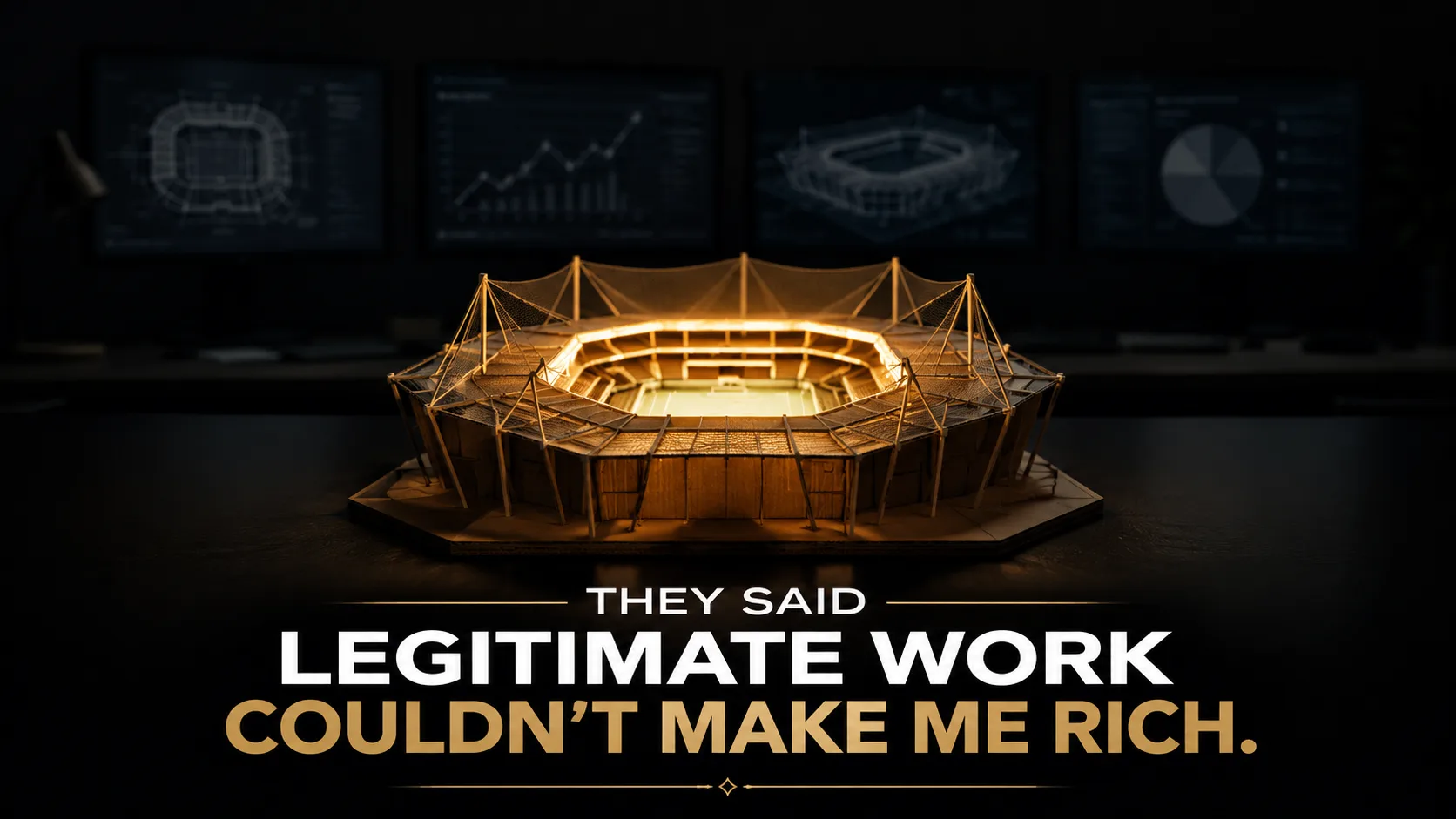
When I was 18, the year I graduated from secondary school, I built a stadium.
Not a sketch. Not a quick school project for marks. A full physical model, built from cartons with my own hands.
I cut the structure. I shaped it. I installed tiny lights so it could glow. I carved seats for an invisible crowd. I used mosquito netting for the goal nets, lollipop sticks for the floodlight poles, and watercolors to paint the field. Every detail came from somewhere inside me that didn't need a teacher, a deadline, or permission.
The Gift I Never Saw Received
I built it for our school's Valedictory Service. I wanted to present something that would make people pause. Something that would say, without me needing to explain myself, I can create things that matter.
But I never attended the event.
That year, I failed both WAEC and NECO. My results made me feel like I wasn't good enough to celebrate. And I hate losing. I hate it so deeply that instead of showing up and facing the shame, I took the stadium to school the day before the event, dropped it there, and walked away.
I never saw who looked at it. I never heard what anyone said. I never watched people react to the thing I had built with so much care.
It became a gift I delivered in secret, to an audience I never met.
What the System Does to a Creative Child
That is what happens when a creative child is told by the system that he is a failure. He still builds. He still creates. He still makes something beautiful out of almost nothing. But he no longer believes he deserves to be in the room when the lights come on.
Years later, I found myself sitting in a Quantity Surveying lecture, unable to stay still for two hours without feeling like I wanted to crawl out of my own skin.
And then the memory came back. The carton stadium. The mosquito-net goals. The lollipop-stick floodlights. The watercolor grass. The project I built in the shadow of failure and delivered in silence.
It returned like a question I had been avoiding for years: If I could build that with nothing but cartons and heartbreak, why am I here slowly dying inside a classroom that was never meant for me?
The math was simple, even for a weak mathematics student: I was living someone else's life. And the problem was never me.
The Discovery
My Brother's Desktop
The first time I opened Blender, I was in Abuja, sitting in front of my brother's desktop.
He wasn't just my brother. He was my mentor. The only person on earth who could understand my vision without making me explain it a hundred times first.
I had just finished my National Diploma, and instead of spending my one-year Industrial Training period doing something that would drain me even further, I went to him.
The Spaceship Cockpit
Then he opened Blender.
The interface looked like a spaceship cockpit — buttons everywhere, panels inside panels, a wide gray grid stretching into nothing. To some people, it would have looked confusing. Maybe even intimidating.
To me, it looked like a canvas.
My brother walked me through a few keys. Basic navigation. How to move around in 3D space. How to shape something from nothing. Then he stepped back and let me explore.
With ChatGPT open beside me, I asked question after question. I made mistakes. I fixed them. I broke things. I tried again. And within one week, I had improved enough to know one thing clearly: This is what I understand.
A Tool That Finally Matched My Mind
In Quantity Surveying lectures, I felt like a stranger trapped inside a language I was never meant to speak. Every calculation felt like punishment for a crime I didn't commit.
But Blender felt different. Blender felt like someone had finally handed me the tool that matched the kind of mind I had always carried.
The carton stadium I built at 18 — with its mosquito-net goals, lollipop-stick floodlights, and watercolor grass — I could now build that same kind of world digitally. But this time, with more detail. More control. More life.
The same hands that once cut and glued cardboard in secret could now create entire worlds on a screen.
I didn't just discover software. I found a bridge between who I had always been and who I could become.
Two Brothers, Two Paths
But that bridge had limits.
My brother's PC could not handle Blender's full requirements. And his own path was different. He was building the website that would later become Craftdas — the platform meant to host millions of creators.
His path was infrastructure. Mine needed powerful tools. I needed a machine that could render. I needed to execute. I needed to bring the images in my head into the real world. And I didn't have that machine yet.
So I did what I always do when the physical world says, "Not yet." I researched.
The $50 Trap
I started watching Blender tutorials obsessively. I searched for how to make money with 3D. I looked up what Blender artists could earn. And the numbers I found broke my heart — not because they were too small, but because they felt too ordinary.
Freelancers bidding against each other on Fiverr. $50 here. $150 there. A ceiling that looked too much like a cage wearing a nicer outfit.
I didn't leave the Quantity Surveying path just to become a cheap freelancer begging for gigs. That wasn't freedom. That was just a different kind of 9-to-5 with a prettier screensaver.
Finding the Territory
So I dug deeper. I asked better questions. Harder questions. And somewhere in the rabbit hole of forums, YouTube deep dives, and AI conversations, I found a phrase that changed the rhythm of my pulse: speculative concept design.
Then another: future-luxury storytelling.
Then another: premium visual world-building for brands, films, and automotive studios.
Those didn't sound like ordinary job titles. They sounded like territories. And no one from where I come from was claiming them.
The Birth of a Studio
So I kept refining. I kept searching. I refused to settle for simply being a "3D artist" when I could become a visual storyteller who designs the future for luxury clients who cannot fully see it yet themselves.
The name came through that same research process. Not like a lightning bolt from the sky, but like a conviction slowly becoming clear.
Lightson — a word that carries illumination, visibility, the act of making something dark become bright. Design Lab — because this was never meant to be just a portfolio. It was meant to be a creative studio. A place of experimentation. A place of premium output. A place where ideas could be tested, shaped, refined, and turned into worlds.
That was how Lightson Design Lab was born.
It didn't matter that I had no desktop yet. It didn't matter that most people around me still believed fraud was the only ladder to luxury. I had found my territory. And once a man finds where he belongs, the next mission is simple: build a house there.
The Resistance
Not Enemies, Just Tired
They were not enemies. That is the part people may not understand.
My friends genuinely wanted me to succeed. They just had a very specific picture of what success was supposed to look like.
And in the world we grew up in, the path that seemed to deliver the "good life" fastest was fraud.
Not because they were evil. Not because they were born bad. But because they were tired. Tired of a system that makes legitimate work feel like punishment. Tired of watching graduates beg for jobs that barely exist. Tired of a government that sells its own people for pocket change while young men are still expected to be patient, honest, and hopeful forever.
Twisted Love
So when I told them I wanted to build a career with Blender — designing future worlds for luxury brands and automotive studios from a laptop in Nigeria — their advice came from a strange kind of love:
"Leave that thing. If you want to succeed, follow our path. This creative work you're doing is for people with connections abroad. Here? You're wasting time."
I don't blame them. I really don't.
Windows Instead of Doors
The system that made fraud look like the only rational option is a government problem, not a friendship problem. Most Nigerian tech creators struggle just to verify freelance accounts on global platforms. PayPal doesn't even work properly here. The gatekeepers did not build doors for people like us.
So some people decided to climb through windows. I understand the logic. I just chose a different response.
My Patience Confused Them
What confused them most was not even my Blender dream. It was my patience.
They saw a 26-year-old man still living with his parents. Still waiting for a desktop. Still talking about future-luxury storytelling while eating home-cooked meals and surviving on small pencil portrait commissions.
In their framework, that was not discipline. That was delusion. A man with no car, no flat, no visible proof of progress — talking about designing worlds for brands he had never even been in the same room with.
But here is what they could not see: I was already building.
Choosing Silence
I stopped talking to them. Not with a dramatic fight. Not with a speech. I just faded.
Their mindset required a version of me I was no longer willing to become. They lacked patience, and I was building something that might take years. They were chasing shortcuts, and I was laying foundations.
We were running in opposite directions. And after a while, you cannot keep shouting across that distance. It becomes exhausting for everybody. So I chose silence.
The Loneliness of Walking Away
The funny thing about walking away from people who think you are making a mistake is that it does not feel like victory at first. It feels like loneliness.
Especially when your own path is not paying yet. Especially when the pencil commissions barely cover transport. Especially when you are eating from home and the desktop still feels far away.
On those days, the question comes quietly: What if they are right?
Small Proof, Big Meaning
But in that silence, I learned something important. I learned how to manage.
Small portrait commissions here and there. A little art money that is truly mine. Not handed out by a politician. Not borrowed from someone who will later use it as leverage. Not money that comes with fear attached to it. Just clean, honest, creative income.
It is not much. But it is proof. Proof that a man can survive without compromising. Proof that the creative path can feed you, even before it makes you rich.
Clean Hands, Open Future
That is why I do not go back to them. Not because I am proud. Because I have tasted something they have not: the freedom of building your own house brick by brick, even when that house is still small enough to fit inside your parents' house.
And I have seen what their path does to men. It can give them money. Sometimes fast. Sometimes a lot. But it does not give them peace. You cannot design worlds when you are always looking over your shoulder. You cannot build a legacy with hands that are afraid of the light.
I want my hands clean. I want my future open. I want to walk into any room in the world and know that everything I have came from my mind and my craft, not from someone else's loss.
The Long Game
That is not naivety. That is strategy.
Because the luxury clients I plan to serve — the automotive studios, the film directors, the real estate visionaries — they do not hire anonymous ghosts. They hire people with reputations. And reputation is the one currency fraud can never produce.
So I am playing the longer game. And if that means losing friends who cannot see the finish line, so be it. I am not building for the applause of people who gave up on legitimate dreams before they even started.
The Cage
A Typical Day Right Now
Right now, a typical day feels heavy.
I wake up in my parents' house, surrounded by people I love, but who do not fully understand what I am carrying. My mind is already full before my feet touch the floor.
I have finished the research. I know my niche. I know my tools. I know exactly what I need to do. And still, I cannot fully do it yet — because the one thing I need is a desktop I do not have.
So I wait. And waiting, when you have already seen the future, can feel like its own kind of prison.
Choosing Isolation as Protection
I have stopped engaging with most people. Not because I think I am better than them, but because I am not mentally stable enough right now to absorb their drama, their discouraging words, and their small talk about things that have nothing to do with the world I am trying to enter.
I have learned that isolation is not always loneliness. Sometimes it is protection. So I moved away from people who drained me, even when that meant standing alone.
Building With Nothing
For now, I am not building much with my hands because the tools are not here yet. Just my phone. Just this blog. Just my mind, refusing to shut down even when my circumstances tell it to rest.
But here is the strange thing I am learning: the research phase is over.
I know what speculative concept design is. I know what future-luxury storytelling requires. I know how to position Lightson Design Lab as a premium studio, not a cheap freelance gig. I know the enemies — fraud mindset, limited thinking, government failure, platform barriers. And I know the mission.
The only missing piece is hardware. A machine. A desktop that can handle the renders, the builds, the worlds I need to create. That is a material problem. And material problems can be solved with time and strategy.
The House My Brother Built
While I wait, Craftdas.com is live.
My brother — my mentor, the only person who truly understands my vision — built it. He is the first creator on the platform. I am not the pioneer here. I am standing on a foundation he laid with his own hands, his own code, and his own belief that Nigerian creators deserve a home that actually works for them.
Craftdas is his path. The website, the platform, the infrastructure — that is his masterpiece. My path is different. I am supposed to fill a corner of this platform with worlds that do not exist yet.
Built for Us, By Us
Craftdas.com is not just a website. It is an answer to a specifically Nigerian problem.
Freelancers here struggle to verify accounts on global platforms. Payment gateways do not smile at us. The big sites — Amazon, Gumroad, and the rest — were not built with us in mind.
Craftdas is different. It is designed for creators, freelancers, bloggers, digital product sellers, entertainers — anyone who needs a home for their work that understands where they are coming from. The vision is millions of creators. My brother is building the house. My job is to build something inside it worth visiting.
Laying Intellectual Foundations
These words — the blog I am writing on his platform — are not just blog posts. They are the intellectual foundation of Lightson Design Lab.
Years from now, when a luxury automotive brand or a film director searches for a speculative concept designer and finds my work, I want them to find the philosophy behind it too. I want them to see the origin story of a founder who built his studio from almost nothing — no desktop, no funding, no audience — just a brother who believed in him, a platform that gave him a place to start, and a refusal to quit.
The Room I Can Already See
When I close my eyes, I can see the room where it all comes together.
A black minimalist space. Four screens arranged in front of me. The only light comes from the monitors and the work glowing on them. No noise. No pressure. No one rushing me. Just peace. Just calm. Just creation.
That room does not exist yet. But I have seen it. And once a man has seen where he is going, the waiting becomes easier to bear — because waiting is not the same thing as stopping.
Guarding the Flame
The desktop will come. The cage door will open. And when it does, the mind that walks out will already be fully formed, fully researched, and fully ready.
Until then, I write. I plan. I protect my peace like a man guarding a flame in the wind.
Why I'm Writing This Anyway
This is not the end of the story. This is the part before the breakthrough — the part most people hide because it does not look impressive yet. But I am writing it down anyway.
Because one day, someone else will be in their own cage, waiting for their own desktop, surrounded by people who do not understand. And they may find these words. And when they do, I want them to know this: the waiting is not failure. It is preparation.
The Mission
What Lightson Design Lab Is
So what is Lightson Design Lab, really?
In one sentence: It is a premium concept studio that helps brands see the future before they build it — through speculative design and visual world-building.
That is what the words mean. But personally, the mission means much more than that.
What It Means to Me
Lightson Design Lab is my escape from a life I did not choose. It is the carton stadium I built at 18, finally given the tools it deserved. It is my rejection of fraud as the only ladder to luxury. It is my refusal to become a $50 freelancer begging for gigs on platforms that were not built for people like me. It is the black minimalist room with four screens and total peace.
But more than anything, it is proof.
Proof that a creative mind born in Nigeria, trained in Quantity Surveying against his will, without a desktop, without funding, and without a crowd cheering him on, can still build something that matters. Proof that he can design worlds that make global brands stop and stare. Proof that he can win legitimately, on his own terms.
The Journey Continues
The journey is not finished. I am still at my parents' house. I am still waiting for the machine that will unlock the next stage. I am still writing blog posts from a phone while the renders live only in my imagination.
But the mission is clear now. The research is done. The territory is claimed. The name exists: Lightson Design Lab.
And one day — maybe sooner than the doubters think — the work will speak louder than any explanation I could ever give.
What I Ask of You, the Reader
If this story meant something to you — if you have ever felt trapped on a path you did not choose, surrounded by people who do not understand the thing burning inside you — then I invite you to do two things.
Follow This Journey
These blog posts will continue. The philosophy will deepen. The visuals will come. And when Lightson Design Lab finally opens its doors fully, you will already know what it stands for.
Join Craftdas
If you are a creator yourself — a writer, a designer, a freelancer, a digital product seller, an artist, a voice looking for a home — come to Craftdas.com.
This platform was built for us. By someone who understands the walls Nigerian creators face. It is new. It is growing. And you do not have to wait until you are "ready" to start. I am not fully ready either. I am just starting anyway.
My brother built the house. I am building my studio inside it. Your corner is waiting.
The future belongs to those who can see it before it arrives. Let's build it together.
— Lightson, Founder & Creative Director, Lightson Design Lab