The Night the Bridge Died
Four Hours Over the Lagoon
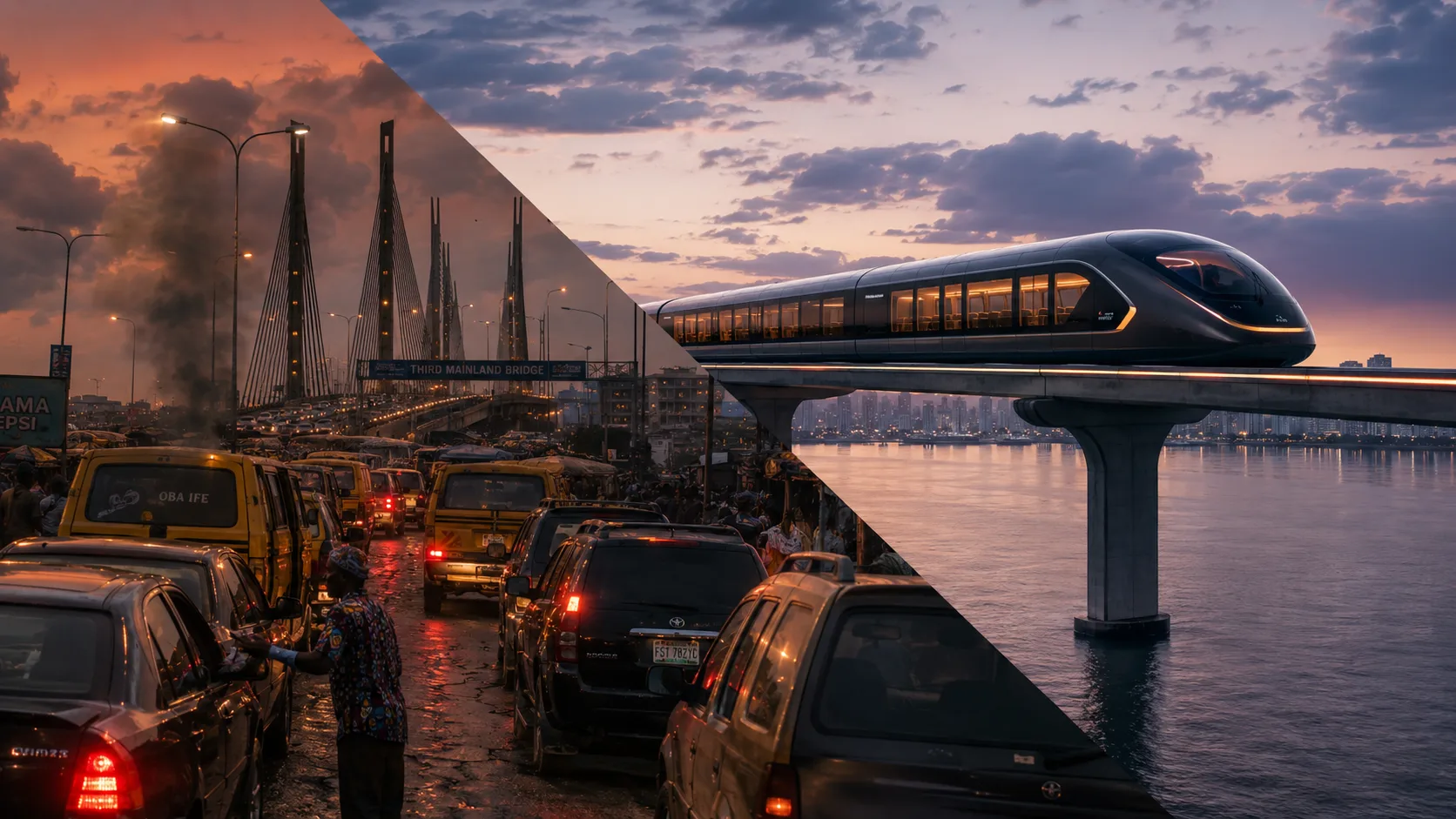
It was a Tuesday in mid-November, 6:45 PM on the Third Mainland Bridge. The sky wasn't just dark; it was a heavy, bruised purple, pregnant with a late-season downpour. Traffic didn't just slow down — it died. We sat completely frozen on the concrete artery over the lagoon for four hours.
The sensory overload was suffocating. I could smell the harsh, metallic tang of burning clutch plates mixed with the sulfurous exhale of the lagoon at low tide, all trapped inside a cabin where the AC had finally sputtered and given up.
Outside, the world was a strobe light of aggressive red brake lights reflecting off the cracked asphalt. The soundscape wasn't just noise; it was an oppressive, chaotic symphony — the desperate, rhythmic thumping of a danfo's loose exhaust pipe against its chassis, the piercing wail of an ambulance three miles back that everyone knew would never get through, and the persistent, sharp slap of a street vendor's hand against my glass, offering cold bottled water.
The Vibration of Wasted Potential
I felt the physical vibration of the bridge beneath us as heavily loaded container trucks idled, sending a low-frequency shudder straight up through my seat. My mind didn't drift to anger; it spiraled into a deep, creative despair.
I kept thinking about the sheer, staggering waste of human potential. Millions of brilliant minds, trapped in analog tin cans, burning through fuel and life hours just to cross a body of water. We were a megacity operating on a dial-up framework.
And somewhere in that four-hour paralysis, a question planted itself in my mind: What would the opposite of this look like?
The Vision: Introducing the Eko Meridian Network
Beyond Speed — A Sanctuary
By 2050, premium transit in Lagos should not just be about speed. It must be an absolute sanctuary from the sensory chaos of the earth below.
Imagine the Eko Meridian Network — a fleet of low-altitude, autonomous mag-lev pods that glide seamlessly along dedicated, raw monolithic concrete guide-ways rising directly out of the Lagos Lagoon. The network does not touch the gridlocked ground. It floats above it, a clean line drawn across water and sky, effortlessly bypassing the chaos below.
This is not a bus with a fresh coat of paint. This is a complete reimagining of what movement feels like.
Stepping Inside the Pod
You arrive at a launch pad at the edge of Ikoyi. The pod door glides open with a silent, pressurized hiss. The transition is instant.
Inside, you step onto deep, dark matte-textured floors. The seating is sculpted from a single piece of stealth-black performance composite, contoured to perfection. The materials are deliberate: dark matte carbon fiber, raw walnut accents, surfaces that feel cool and solid under your fingertips.
There are no bright, jarring screens. No advertisements screaming for your attention. Instead, the lighting is incredibly controlled — a minimal, recessed amber signature that traces the geometric architecture of the cabin, casting just enough light to highlight the rich, dark wood surfaces without ever feeling harsh.
The Windows That Think
The windows are made of smart obsidian glass that automatically tints to match the mood of the hour. At noon, they gently filter the harsh tropical sun into something soft and golden. At dusk, they clarify, letting you watch the city ignite beneath you.
Active noise-canceling technology is embedded into every surface. The moment the door seals, the symphony of honking, shouting, and exhaust rattle disappears. The silence is not empty. It is luxurious. It is space to think, to breathe, to arrive somewhere without having first survived something.
Weightless Over the Water
As the pod lifts off, there is no vibration, no engine roar. The mag-lev suspension engages with absolute smoothness. It feels like weightlessness.
You look down through the tinted glass as you sweep across the lagoon at 300 kilometers per hour. Below you, the chaotic lights of the city blur into a beautiful, distant cinematic backdrop. You are entirely separated from the noise, entirely present in the silence of your capsule.
You are crossing Lagos — not enduring it.
The Gap: Why Lagos Currently Thinks Too Small
Palliative, Not Visionary
The fundamental flaw in how Lagos currently imagines its future is a severe lack of scale and aesthetic ambition.
The current initiatives — the BRT corridors, the Blue and Red rail lines — are necessary. Let me be clear: they serve a purpose. But they are purely palliative. They are designed to solve yesterday's problems using mid-tier, utilitarian templates copied from other cities. They treat movement as a chore of survival rather than an elevated experience.
Lagos is a city of immense status, energy, and visual drama. Yet our transit plans are entirely devoid of poetry.
Moving Numbers, Not Humans
The city thinks about movement in terms of moving numbers, not human beings who crave dignity, style, and seamless integration with technology. We build concrete tracks and paint them bright primary colors, hoping it hides the lack of systemic vision.
We are trying to patch up a broken grid when we should be completely redefining the geometry of our skies and waterways. The BRT is an improvement. But an improvement on a broken model is still a broken model with better tires.
The Design Language Deficit
What is entirely missing is a cohesive design language. Lagos has a visual identity — chaotic, vibrant, improvisational, brilliant. But none of that identity appears in our infrastructure. Our bridges are functional. Our buses are imported afterthoughts. Our stations are concrete boxes with corrugated roofs.
A city that produces Nollywood, Afrobeats, and a globally recognized fashion aesthetic deserves transit that looks like it belongs to the same culture. Where is the Lagos of our transit system? Where is the drama, the elegance, the audacity?
The Bridge: Lagos Is Already Cyberpunk
The Danfo at Dusk
There is a precise moment at dusk when the classic yellow danfo buses undergo a bizarre, accidental cyberpunk transformation.
As the daylight fades into that deep Lagos twilight, the drivers switch on their cheap, aftermarket interior LED strip lights. They are never standard white; they are always a piercing, neon electric blue or a toxic green, crudely taped around the dashboard and the rusted exposed metal of the ceiling.
When the bus rattles past you in the dust, the contrast is jarring: a battered, analog vehicle from another era, completely illuminated from within by a harsh, futuristic neon glow, casting long, distorted colored shadows on the faces of the tired commuters inside.
It is a striking, beautiful contradiction that belongs nowhere else in the world.
The Future Already Whispers Here
This is the secret that urban planners miss: Lagos is already coded for the future. The visual language is already here, hiding in plain sight — in the danfo LEDs, in the neon signs of Computer Village, in the improvised architecture of Makoko, in the way the city lights reflect off the lagoon at night like a circuit board made of fire.
The Eko Meridian is not a foreign import. It is not Dubai copied and pasted onto West African soil. It is the logical, luxurious evolution of something that already exists in the city's DNA. The raw concrete guide-ways rising from the lagoon are an echo of the Third Mainland Bridge itself — but elevated, literally and philosophically. The amber cabin lighting is a refinement of the danfo's accidental neon. The silence is not the absence of Lagos; it is the curation of Lagos — keeping the beauty, filtering out the chaos.
The Mission: Why This Matters for Lightson Design Lab
Designing Worlds That Don't Exist Yet
This is what speculative concept design does. It does not wait for a government tender or an RFP from a transit authority. It asks: What is the most beautiful, functional, human-centered version of this experience? What would make someone feel something when they step into a transit pod in 2050?
Then it makes that vision visible.
Lightson Design Lab exists for this exact purpose: to help brands, cities, and visionaries see the future before they build it. The Eko Meridian is a concept — but every real-world transit project, every luxury automotive brand, every cinematic world-builder starts with a concept. Someone has to draw the thing that does not exist yet. Someone has to make it feel real enough to inspire engineers, investors, and policymakers to chase it.
A Love Letter to Lagos
This post is also a love letter to the city that shaped me. I have been stuck on its bridges. I have inhaled its exhaust. I have felt the despair of its gridlock. But I have also seen its accidental beauty — the danfo LEDs, the lagoon at twilight, the impossible energy of millions of people improvising their way through every single day.
Lagos does not need a transit system that apologizes for itself. It needs one that understands the assignment: move people not just efficiently, but beautifully. Design not just for survival, but for experience. Build not just for today, but for 2050 — and beyond.
What I Ask of You, the Reader
If this vision sparked something in you — if you have ever been stuck on the Third Mainland Bridge and dreamed of a better way — then I invite you to do two things.
Follow This Journey
These posts will continue. The philosophy will deepen. The visuals will come. Lightson Design Lab will render the Eko Meridian, and when it does, you will already understand the thinking behind every design choice.
Join Craftdas
If you are a creator — a writer, a designer, an urbanist, a filmmaker, a dreamer — come to Craftdas.com. This platform was built for Nigerian creators who need a home that understands them. It is new. It is growing. And your voice belongs here.
My brother built the house. I am building my studio inside it. Your corner is waiting.
The future of Lagos will not be designed by people who only see what is currently possible. It will be designed by those who dare to see what is beautiful, and then build it anyway.
— Lightson, Founder & Creative Director, Lightson Design Lab